Math problem-solving skills Worksheets for Ages 5-8
5 filtered results
-
From - To
Enhance your child's math problem-solving abilities with our engaging worksheets designed for ages 5-8. These resources offer a variety of interactive challenges to help young learners develop critical thinking and logical reasoning skills. With colorful visuals and age-appropriate problems, children will tackle addition, subtraction, and basic word problems in a fun and stimulating way. Each worksheet aligns with educational standards, ensuring a comprehensive learning experience that boosts confidence and fosters a love for math. Equip your child with essential problem-solving strategies; explore our collection of math problem-solving skills worksheets and make learning an enjoyable adventure!
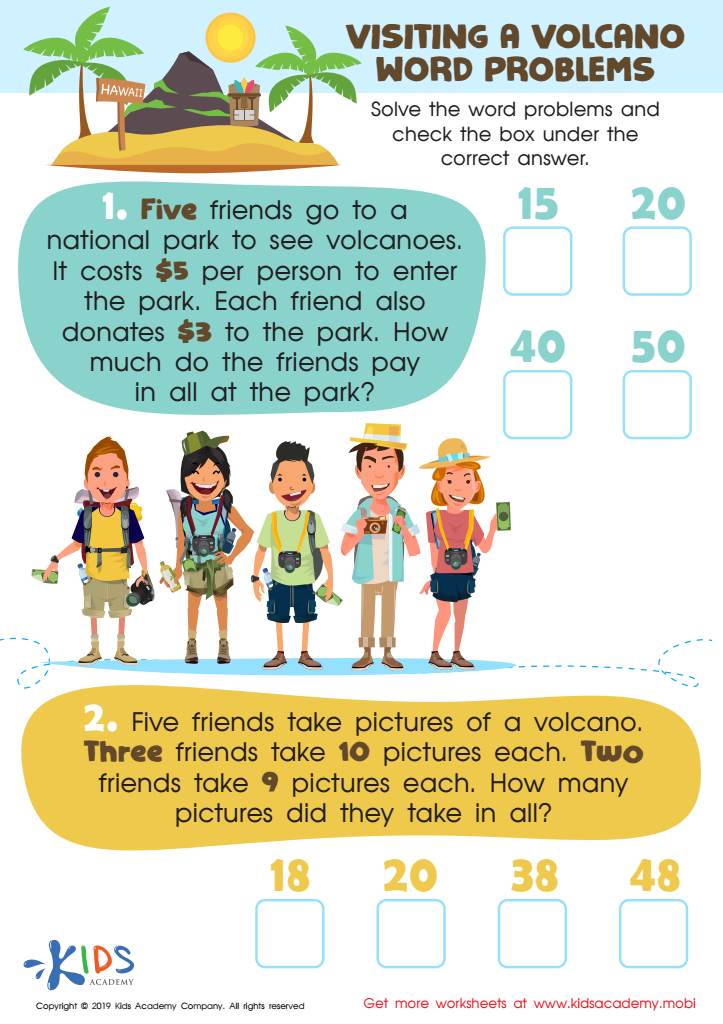
Visiting a Volcano Word Problems Worksheet
 Assign to My Students






.jpg)
Parents and teachers should prioritize math problem-solving skills for children aged 5-8 because these foundational abilities lay the groundwork for future academic and cognitive successes. During these early years, children develop critical thinking and analytical skills essential for navigating complex problems later in life. Math problem-solving fosters logical reasoning, encourages perseverance, and enhances creativity, helping young learners understand concepts beyond numerical calculations.
Furthermore, engaging in math problem-solving can boost children’s confidence in their abilities, reducing math anxiety and promoting a growth mindset. It nurtures curiosity and encourages children to explore different strategies, reinforcing the idea that there can be multiple solutions to a problem. Beyond the academic realm, these skills are vital in real-world situations, enabling children to approach challenges with a systematic mindset.
Moreover, as we move into an increasingly data-driven society, strong math skills are essential for success in various fields, from science and engineering to finance and everyday decision-making. By emphasizing math problem-solving in early education, parents and teachers equip children with essential tools for personal growth and achievement, ultimately shaping them into confident, capable adults adept at tackling the challenges of their future.








