
Understanding equivalence Worksheets for Ages 5-8
3 filtered results
Difficulty Level
Grade
Age
-
From - To
Subject
Activity
Standards
Explore our engaging Understanding Equivalence Worksheets tailored for children ages 5-8. These printable worksheets are designed to help young learners grasp the concept of equality in mathematics, enhancing their problem-solving and critical thinking skills. Through a variety of fun and colorful exercises, kids can practice balancing equations, understanding equivalence in number sentences, and building a strong mathematical foundation. Perfect for classroom use or at-home practice, our worksheets support early learning standards and make mastering equivalence concepts enjoyable for young minds. Boost your child's math confidence today with our expertly crafted resources from Kids Academy!
Favorites
With answer key
Interactive
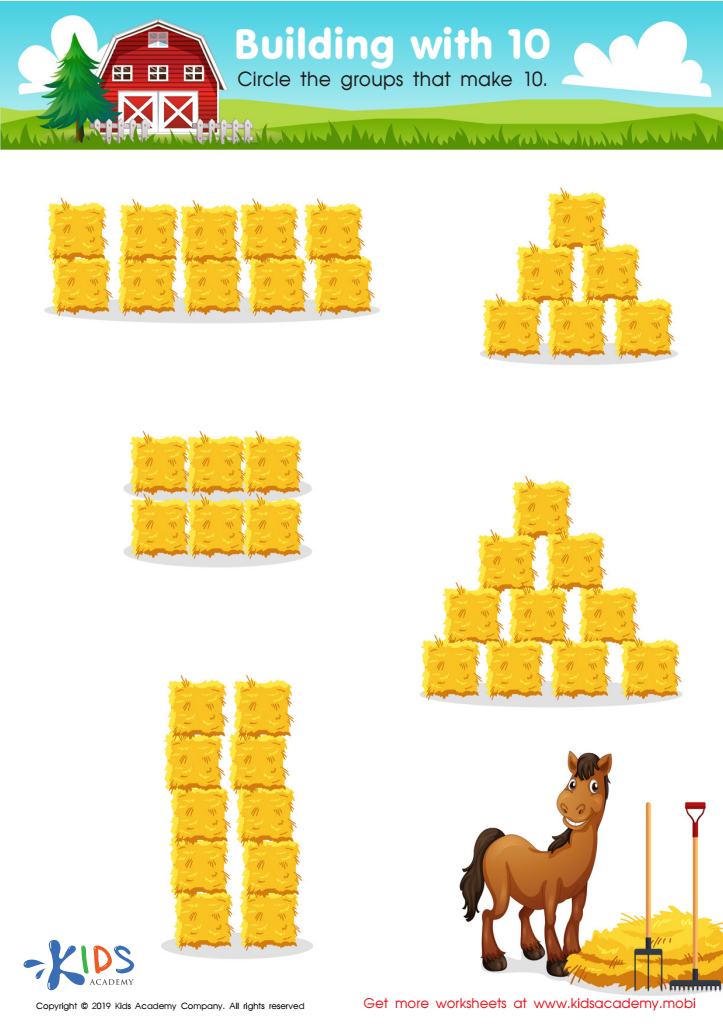
Building with 10 Worksheet
Counting numbers can be simple with this worksheet: Ask your kids to count the stacks of objects, ensure accuracy with your help, then circle the ones of ten. With practice and guidance, your children will soon become counting pros!
 Assign to My Students
Building with 10 Worksheet
Worksheet
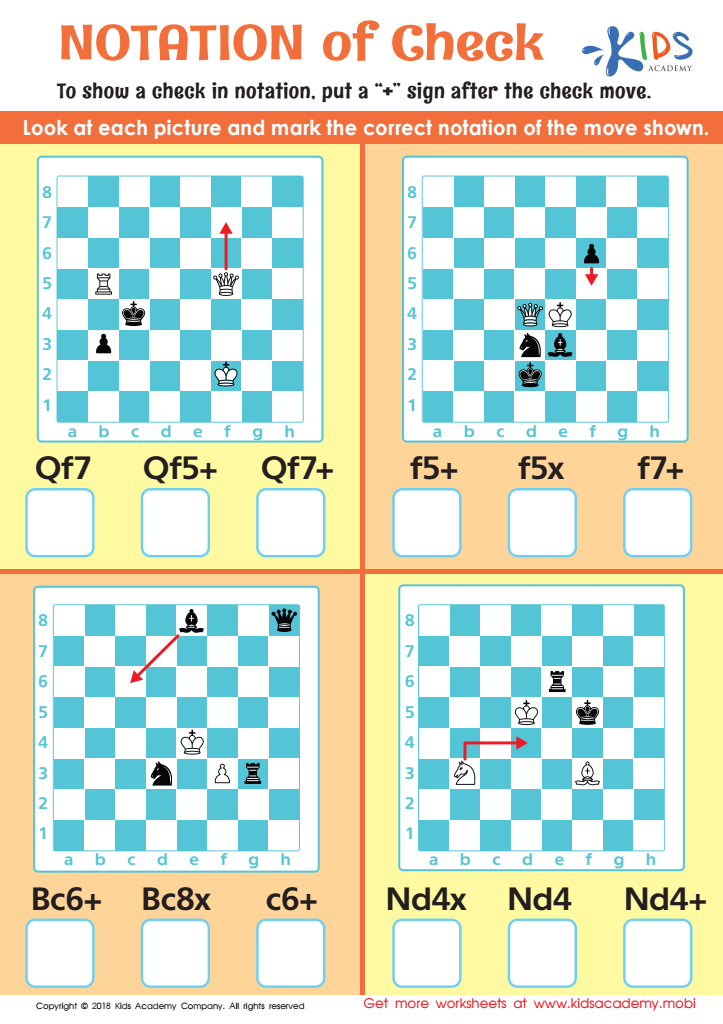
Notation of Check Worksheet
Chess is an addictive game! Once you know the basics of check and checkmate, you'll be hooked! Teach your little one to make check notation with this free PDF worksheet. They can use downloadable practice to look at each picture and mark the correct notation, strengthening their problem-solving skills while they learn to play - and win - this fun game!
Notation of Check Worksheet
Worksheet
Join Kids Academy for Free
Who is primarily going to use this learning content?







Understanding equivalence is essential for young children, especially between the ages of 5 and 8, as it lays the foundation for critical mathematical concepts they’ll encounter later on. At this age, grasping equivalence goes beyond simply recognizing that two amounts are the same; it helps children comprehend that different representations can convey the same value. This skill is vital for learning higher-level math processes, such as addition and subtraction, fractions, algebra, and problem-solving strategies.
When parents and teachers focus on teaching equivalence, they also nurture important cognitive skills such as pattern recognition, logical thinking, and the ability to relate objects and numbers in a meaningful way. For example, recognizing that 4 + 2 is equivalent to 3 + 3 builds an understanding of equality and balance in equations, paving the way for algebraic thinking later on.
Moreover, teaching equivalence promotes perseverance and flexible thinking in children. It encourages them to look for multiple solutions and to better understand concepts such as fairness and equality in everyday life. Early mastery of these principles sets children up for greater success and confidence in more advanced mathematical topics, making learning smoother and more engaging in the long run. Engaging children with practical, hands-on activities that illustrate equivalence harmonizes their learning with real-world experiences, enriching their developmental journey.








