
Understanding fossils Worksheets for Ages 5-8
4 filtered results
Difficulty Level
Grade
Age
-
From - To
Subject
Activity
Standards
Explore the fascinating world of fossils with our engaging "Understanding Fossils" worksheets, designed for children ages 5-8! These interactive resources provide a fun way for young learners to discover how fossils form, the different types of fossils, and their significance in understanding Earth's history. Each worksheet is crafted to enhance critical thinking, creativity, and basic scientific knowledge. Kids will enjoy activities such as matching fossils to their corresponding dinosaurs, coloring exciting illustrations, and completing simple sentences related to paleontology. Perfect for classroom use, homeschooling, or extra practice at home, our worksheets make learning about fossils exciting and accessible!
Favorites
With answer key
Interactive
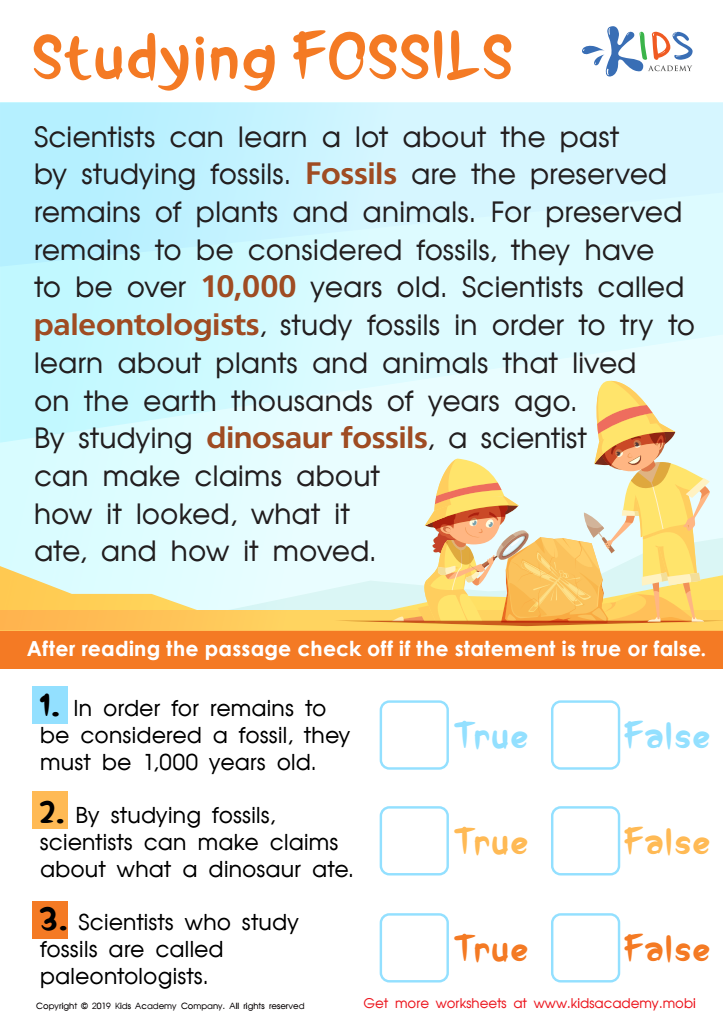
Studying Fossils Worksheet
Fossils captivate children! It's no wonder why; when we learn about them, we are getting a glimpse into history and uncovering old mysteries! With this free download, kids will understand what a paleontologist is and how they use fossils to learn about long-gone plants and animals. They'll discover that old bones are priceless and that exploring ancient history can be exciting!
 Assign to My Students
Studying Fossils Worksheet
Worksheet
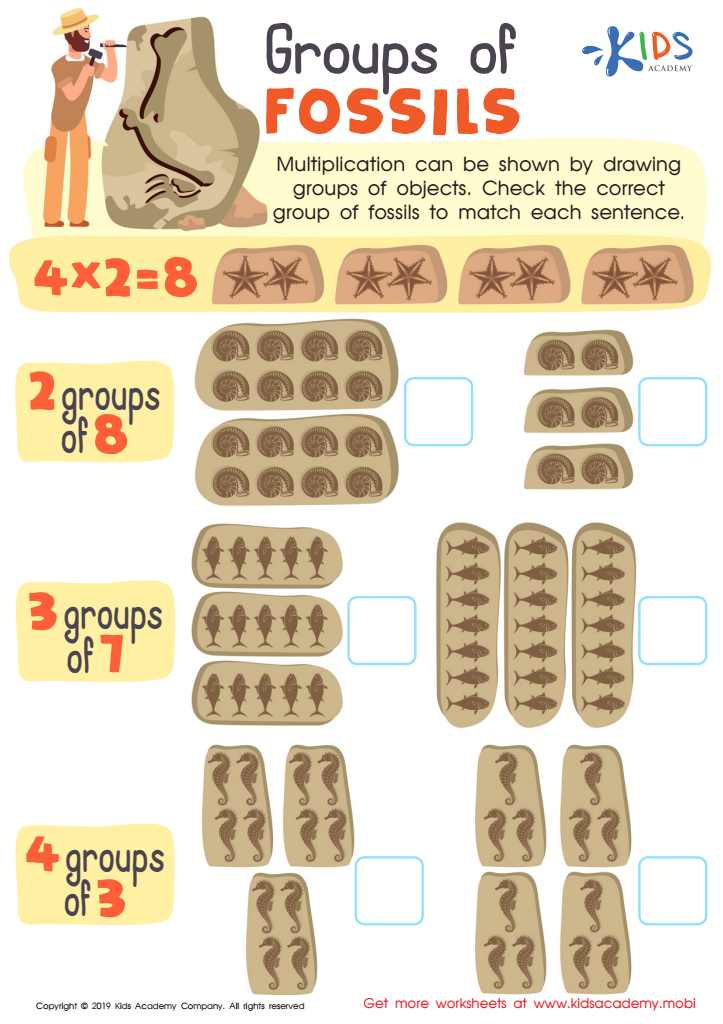
Groups of Fossils Worksheet
Kids need to learn multiplication after mastering addition and subtraction. To make it fun, use worksheets like this one. Have kids draw objects to match each sentence - this helps them understand multiplication better. With this approach, they'll be sure to learn the concepts.
Groups of Fossils Worksheet
Worksheet
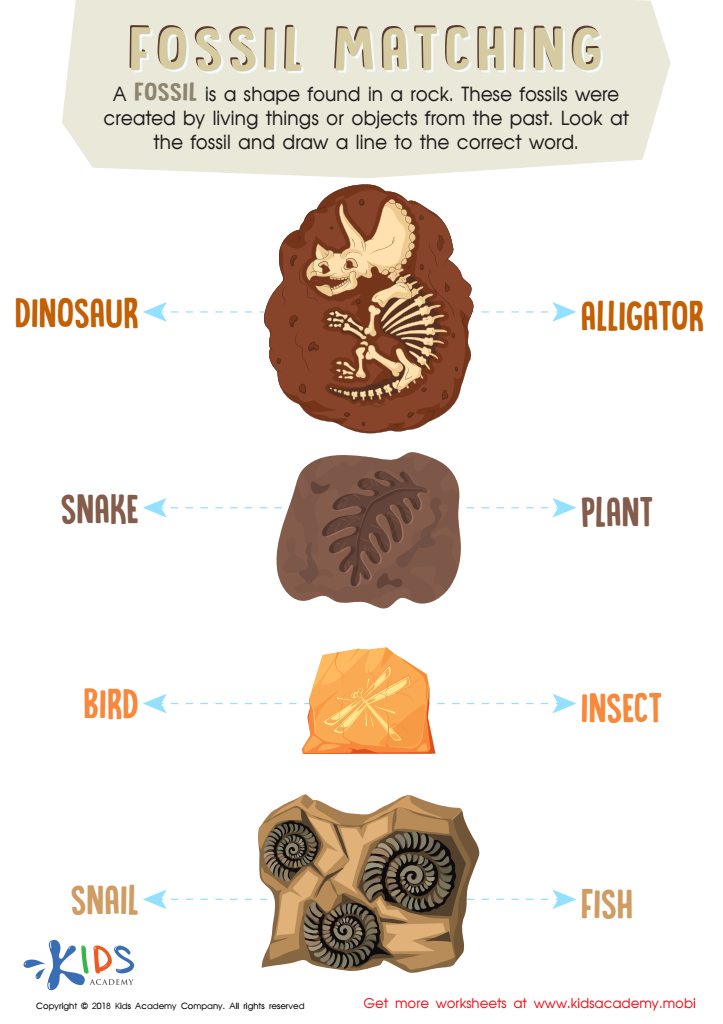
Fossil Matching Worksheet
Kids love learning about fossils! Let them go on a dig of their own with this free worksheet. They'll match pictures of fossils with the correct word choice and get tangible representation. Plus, they'll have imagery to refer to when thinking about fossils!
Fossil Matching Worksheet
Worksheet
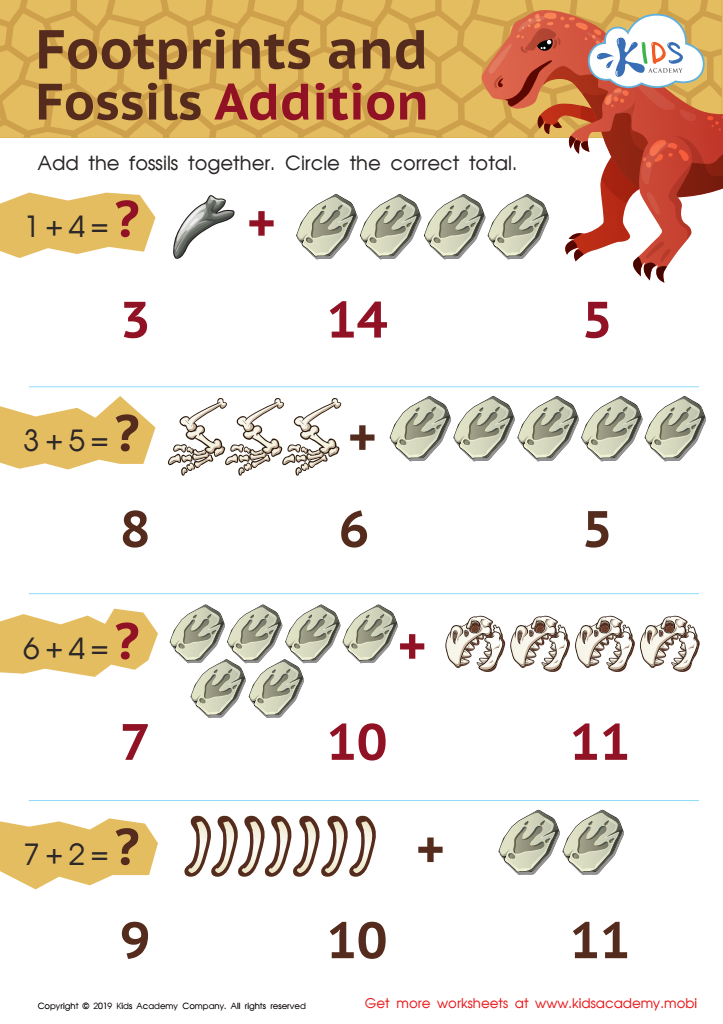
Footprints and Fossils Addition Worksheet
Show your students that addition and subtraction is easy with the right guidance and exercises. Use this worksheet to help them practice by adding fossils and circling the correct total of each equation. Your students will soon see that addition and subtraction is not so intimidating after all.
Footprints and Fossils Addition Worksheet
Worksheet
Join Kids Academy for Free
Who is primarily going to use this learning content?




.jpg)


Understanding fossils is vital for young learners aged 5-8 as it sparks their curiosity about the natural world and encourages scientific thinking. Fossils provide a tangible connection to history, revealing the stories of ancient life and the Earth’s evolution. This fosters an appreciation for geology and biology, making kids more aware of biodiversity and the importance of preserving it.
Introducing fossils can promote inquiry and exploration. Hands-on activities, like creating simple fossil replicas, help develop critical thinking and problem-solving skills by allowing children to ask questions, make predictions, and draw conclusions. Such investigative play is crucial at a young age as it cultivates a lifelong love for science and learning.
Moreover, discussing fossils develops vocabulary and comprehension skills, as children encounter new terms such as "paleontology," "extinct," and "sedimentary." This enriches their ability to express ideas and understand complex concepts.
Lastly, teaching about fossils can highlight environmental themes, emphasizing the need to protect our planet's current ecosystems to prevent future extinctions. In this way, understanding fossils is not just about the past; it empowers young learners to think critically about our world today and inspires them to care for it in the future.








