Understanding skip-counting Worksheets for Ages 5-8
3 filtered results
-
From - To
Explore our comprehensive "Understanding Skip-Counting Worksheets for Ages 5-8" to enhance your child's mathematical skills! Designed for young learners, these engaging worksheets introduce skip-counting through fun and interactive activities. By counting by twos, threes, fives, and tens, children will develop their number sense and improve their speed and accuracy in math. Our worksheets are tailored to align with educational standards, making them the perfect supplement for home or classroom learning. Engage your child’s curiosity and confidence in numbers with these creative resources, paving the way for a solid foundation in arithmetic. Start skip-counting fun today!
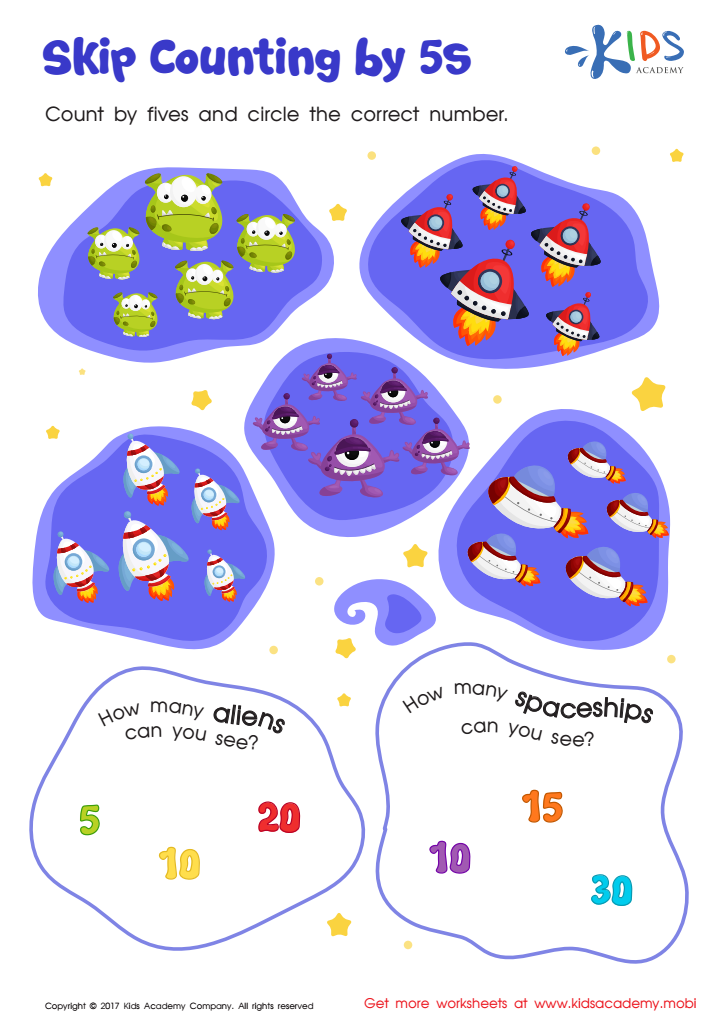
Skip Counting by 5s: Aliens and Spaceships Printable
 Assign to My Students
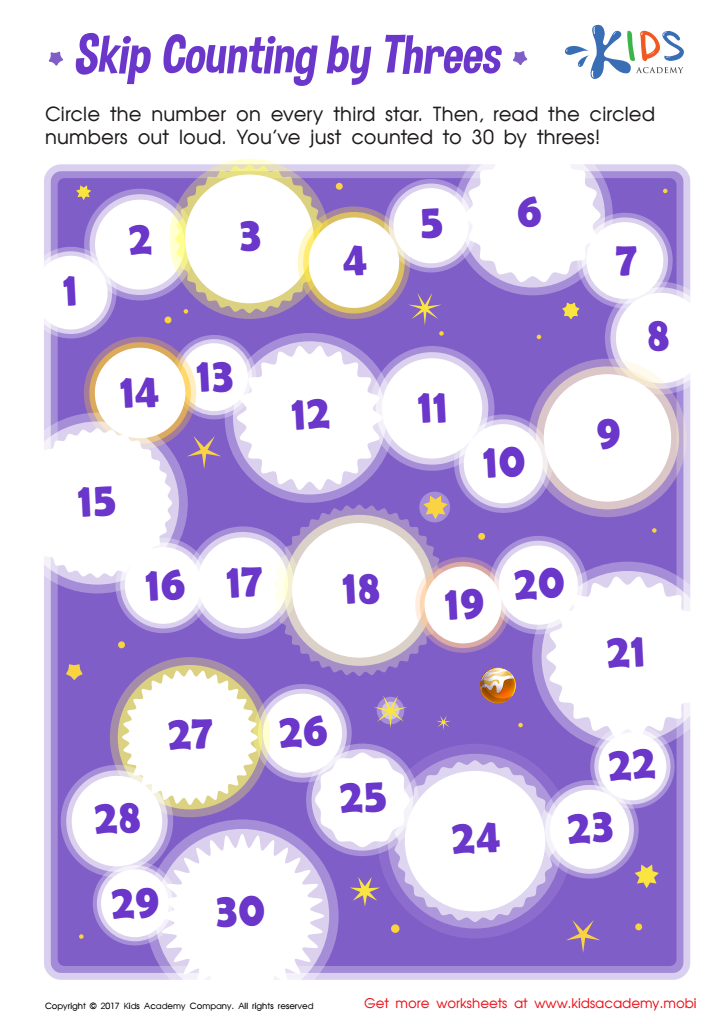
Skip Counting By Three Printable
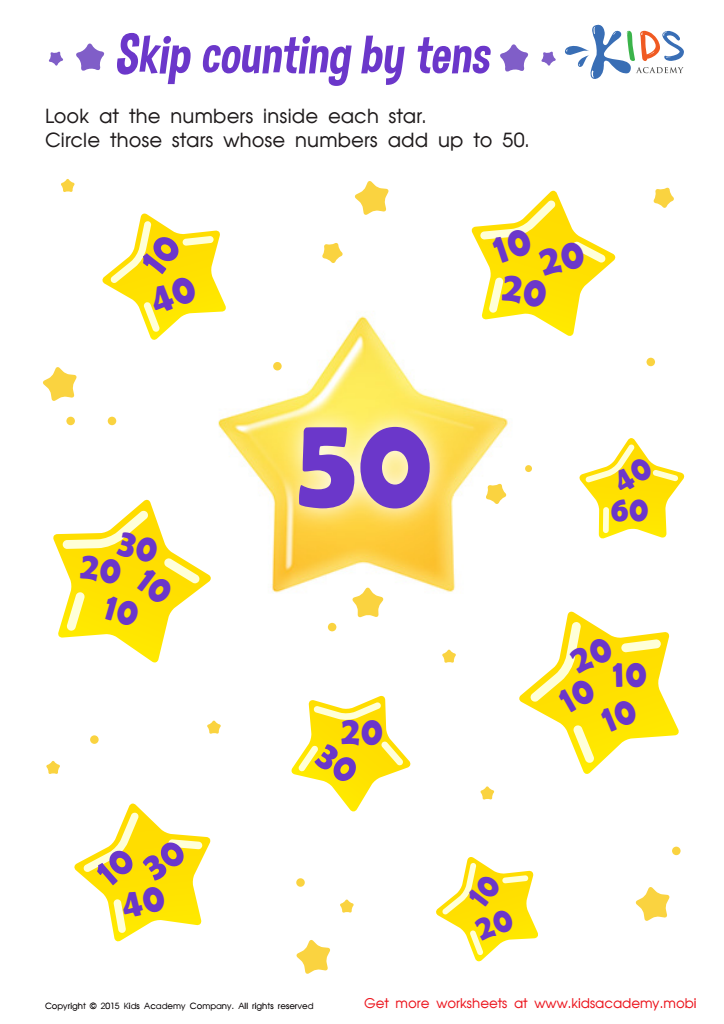
Learn Dozens: Skip Counting by Tens Printable






.jpg)
Skip-counting is an essential mathematical skill that significantly enhances children's understanding of numbers and lays the foundation for more complex arithmetic. For children aged 5-8, mastering skip-counting—such as counting by twos, fives, and tens—improves their numerical fluency and helps with future learning in addition, subtraction, multiplication, and division.
Understanding skip-counting also fosters critical thinking. As children learn to identify patterns and groups within numbers, they develop problem-solving skills that will be valuable throughout their education and in everyday life. This skill encourages awareness of numerical relationships and reinforces the concept of grouping, which is vital in many mathematical contexts.
Moreover, skip-counting serves as a tool for enhancing children's mental math abilities. When children can quickly understand how to jump in set increments, they face less difficulty when faced with larger or more complex calculations.
Parents and teachers should care about promoting skip-counting not only for its academic benefits but also for its role in building confidence in young learners. By encouraging these skills early, we empower children to approach mathematics with a positive mindset, thereby laying a solid groundwork for lifelong learning and enthusiastic engagement with this critical subject.








