
Understanding word problems Worksheets for Ages 5-8
3 filtered results
Difficulty Level
Grade
Age
-
From - To
Subject
Activity
Standards
Explore our "Understanding Word Problems" worksheets, designed specifically for children ages 5-8. These engaging resources help young learners develop essential reading comprehension and critical thinking skills. The worksheets feature relatable scenarios, promoting problem-solving abilities while encouraging children to decipher important information and identify key concepts. With colorful illustrations and age-appropriate language, these problems are tailored to ignite curiosity and enhance mathematical understanding. Whether at home or in the classroom, our worksheets provide students with the foundational skills they need to tackle word problems with confidence. Start fostering a love for learning and empower kids to approach mathematics with a positive mindset!
Favorites
With answer key
Interactive
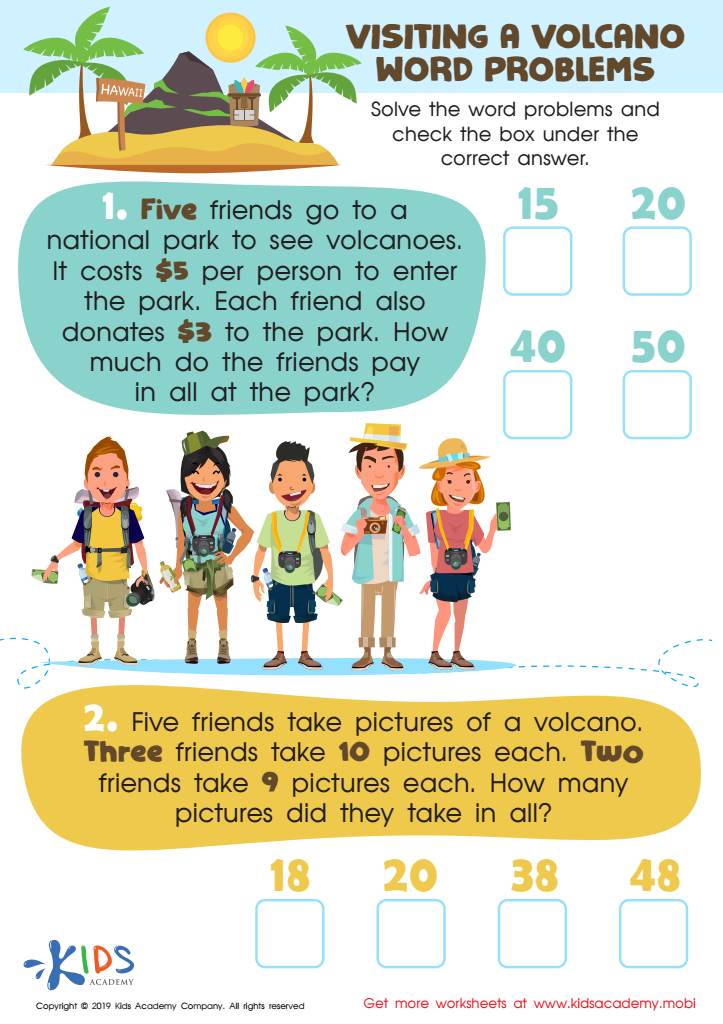
Visiting a Volcano Word Problems Worksheet
Read the word problems to your kids, note down the numbers and help them solve. Check the box under the correct answer. Word problems are sentences posed as math problems; just like regular number problems, first you must understand and interpret the sentence.
 Assign to My Students
Visiting a Volcano Word Problems Worksheet
Worksheet
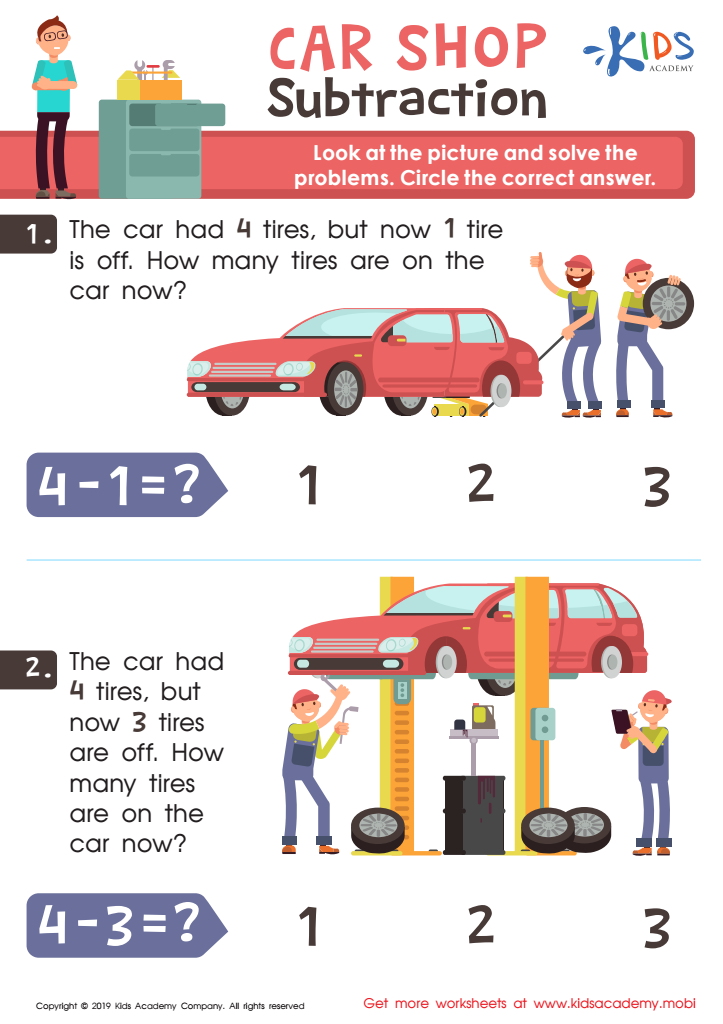
Car Shop Subtraction Worksheet
Encourage your kids to practice addition and subtraction with this worksheet. Read the word problems aloud, help them solve and check the answer from the provided options. With enough exercises and guidance, this task should be fairly easy.
Car Shop Subtraction Worksheet
Worksheet
Join Kids Academy for Free
Who is primarily going to use this learning content?


.jpg)



Understanding word problems is crucial for children aged 5-8 as it lays the foundation for critical thinking and problem-solving skills. At this age, children start to move beyond simple arithmetic and are encouraged to apply their mathematical knowledge to real-world situations. Word problems teach them how to interpret information, identify relevant details, and develop strategies to arrive at a solution, fostering analytical skills essential for future academic success.
Moreover, engaging with word problems enhances language skills, enabling children to articulate their understanding and reasoning. As they decipher the language used in the problems, they improve their reading comprehension and vocabulary, both of which are vital for overall cognitive development.
Parents and teachers play a pivotal role by promoting a growth mindset towards challenges. Encouraging children to embrace mistakes and view them as learning opportunities helps boost their resilience. Additionally, when adults work collaboratively with children on word problems, it can create a deeper understanding and appreciation for math, making it a more enjoyable experience.
Investing time in understanding word problems nurtures not only mathematical abilities but also equips children with lifelong skills that extend beyond the classroom, preparing them for complex decision-making in everyday life.








