Comparing Fractions Addition & Subtraction Worksheets for Ages 5-8 - Page 4
87 filtered results
-
From - To
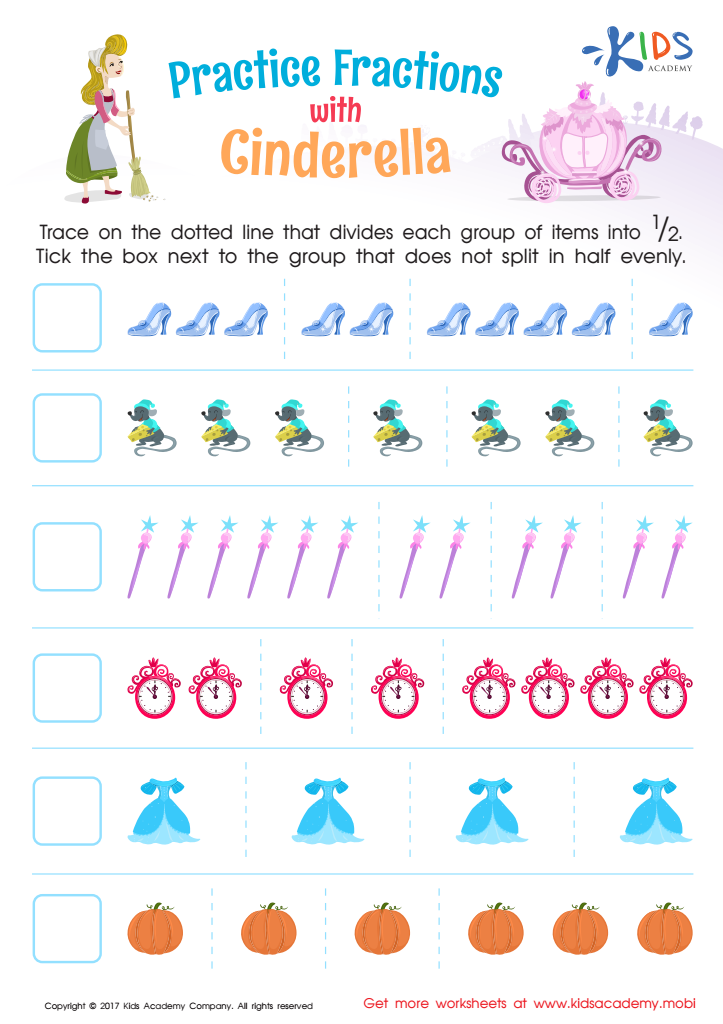
Fractions: Cinderella Printable
 Assign to My Students








Understanding how to compare, add, and subtract fractions is essential in early math education for children aged 5-8. For parents and teachers, fostering these skills lays the foundation for more advanced mathematical concepts and critical thinking later in life. By engaging with fractions—an essential mathematical concept—children learn to understand parts of a whole, developing their ability to reason and solve problems.
When children learn to compare fractions, they begin to grasp the concept of equivalence, which is crucial in everyday life, whether they’re measuring ingredients for a recipe or dividing a pizza. Adding and subtracting fractions enhances their understanding of quantity, enabling them to make informed decisions and manage resources.
Moreover, mastering these fundamental skills boosts children's confidence in their math abilities. When they feel capable and knowledgeable, they are more likely to engage with the subject, leading to a positive attitude towards learning. Parents and teachers play a vital role by providing supportive environments and hands-on opportunities for practice. Encouraging exploration of fractions through games, visual aids, and real-life applications makes learning enjoyable. This nurturing approach not only solidifies mathematical understanding but also helps develop a child’s overall cognitive skills.








