Decision making skills Addition & Subtraction Worksheets for Ages 5-8
3 filtered results
-
From - To
Enhance decision-making skills in young learners with our engaging Addition & Subtraction Worksheets designed for ages 5-8! These expertly crafted worksheets combine fundamental math operations with thoughtful problem-solving exercises, encouraging children to make confident decisions. Each worksheet provides a range of scenarios demanding that students choose the best mathematical strategies, fostering critical thinking and analytical skills. Perfect for classroom or home use, these resources align with educational standards while making learning fun and interactive. Equip your child with the essential tools to boost their arithmetic precision and decision-making abilities today! Explore and download at Kids Academy.
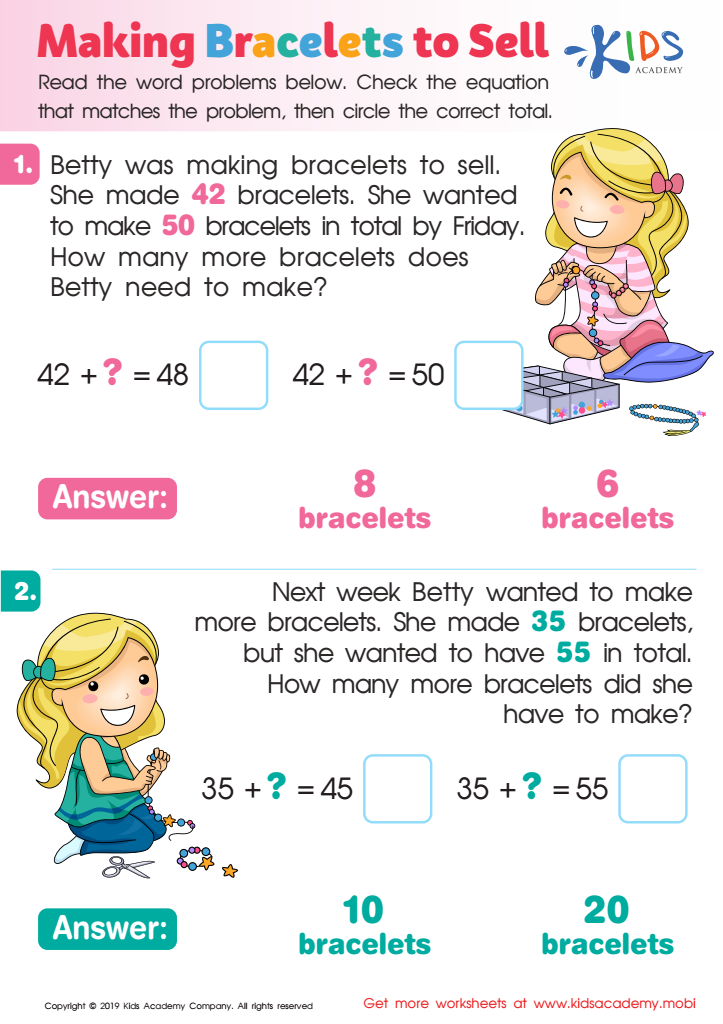
Making Bracelets to Sell Worksheet
 Assign to My Students
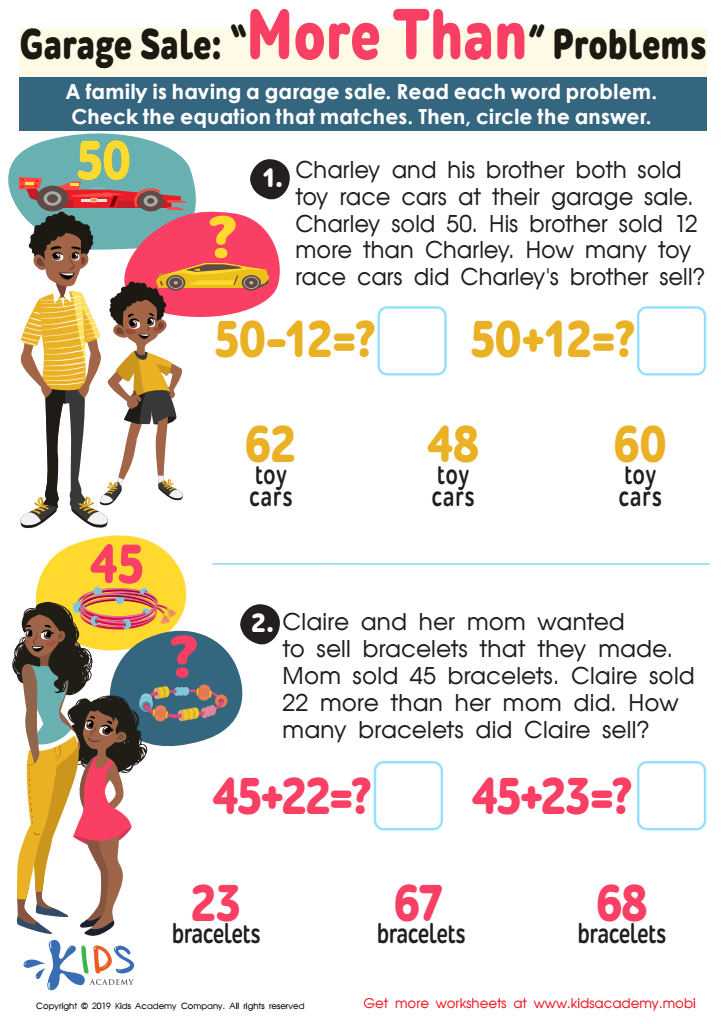
Garage Sale - More yhan Worksheet








Developing decision-making skills alongside addition and subtraction for children ages 5-8 is crucial for both immediate and long-term success. At this age, children are in a formative stage where foundational math concepts are introduced, and setting the groundwork for problem-solving and critical thinking can significantly impact their intellectual growth.
Mathematics is much more than just numbers; it is about recognizing patterns, understanding relationships, and making informed decisions. By practicing addition and subtraction, children learn to think logically, follow sequences, and derive conclusions from given data. These skills are transferable to everyday decision-making, such as choosing the right amount of toys to play with, or figuring out they have enough time for another activity before bedtime.
Moreover, strengthening these skills enhances a child’s confidence and independence. When children feel capable of solving math problems, they are more likely to tackle other challenges with a positive mindset. Teachers and parents should intentionally create scenarios where children must decide how to approach addition and subtraction problems, and perhaps, even allow them to make mistakes to understand the consequences of their choices.
Engaging and interactive approaches, such as games and practical experiences, can make learning these skills enjoyable and fulfilling. Establishing a clear link between math and real-world decisions helps to underline the significance and applicability of what they are learning. In essence, fostering decision-making skills along with math reasoning in early childhood paves the way for well-rounded, critical thinkers.








