
Enhancing critical thinking Addition & Subtraction Worksheets for Ages 5-8
5 filtered results
Difficulty Level
Grade
Age
-
From - To
Subject
Activity
Standards
Our "Enhancing Critical Thinking Addition & Subtraction Worksheets for Ages 5-8" are expertly designed to foster problem-solving abilities in young learners. These worksheets blend fundamental math skills with engaging scenarios that encourage kids to think critically and make connections. By tackling various addition and subtraction challenges, children not only sharpen their arithmetic prowess but also develop logical reasoning and analytical thinking. Ideal for both classroom and home use, these worksheets provide a stimulating learning experience that supports cognitive growth and builds a strong mathematical foundation at an early age. Boost your child's confidence and competence in math with our interactive worksheets.
Favorites
With answer key
Interactive
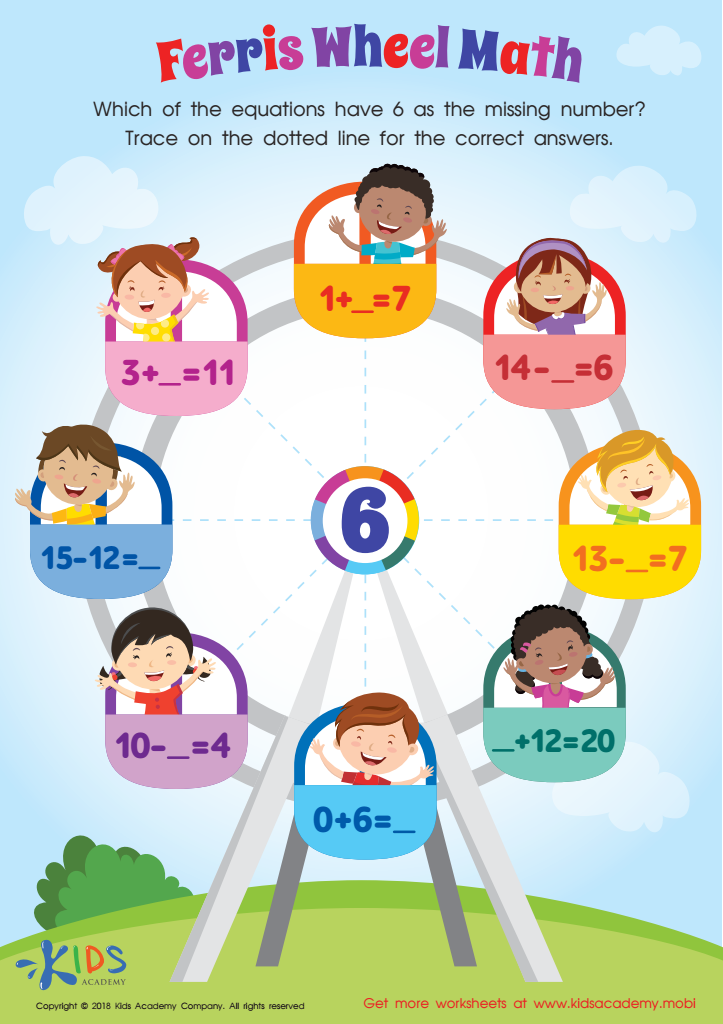
Missing Number: Ferris Wheel Math Worksheet
Hop on the Ferris wheel and solve the equations in the baskets! If the missing number is 6, draw a line from the basket to the middle of the wheel. Kids Academy's addition worksheet will not only help practice pre-algebra but also keep kids entertained with its vibrant illustrations. So, go round and round and have fun with math!
 Assign to My Students
Missing Number: Ferris Wheel Math Worksheet
Worksheet
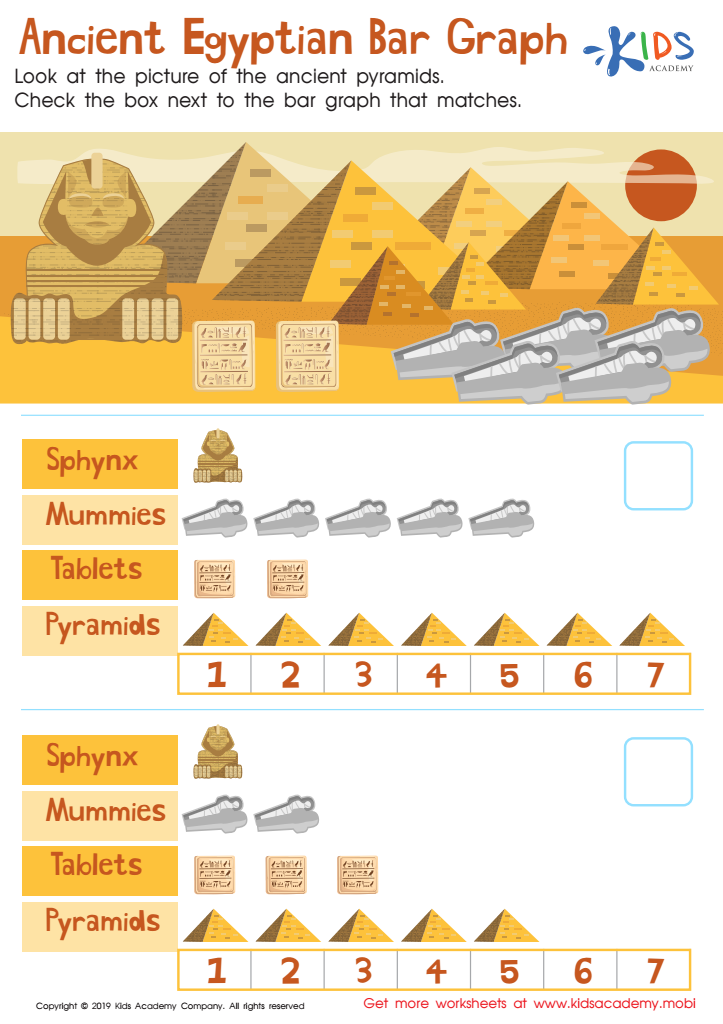
Egyptian Bar Graph Worksheet
Help your kids get a hang of bar graphs with this fun worksheet. Examine the picture of the ancient pyramids and help them match the bar graph to it. Check the box next to the correct bar graph and watch your little ones learn quickly!
Egyptian Bar Graph Worksheet
Worksheet
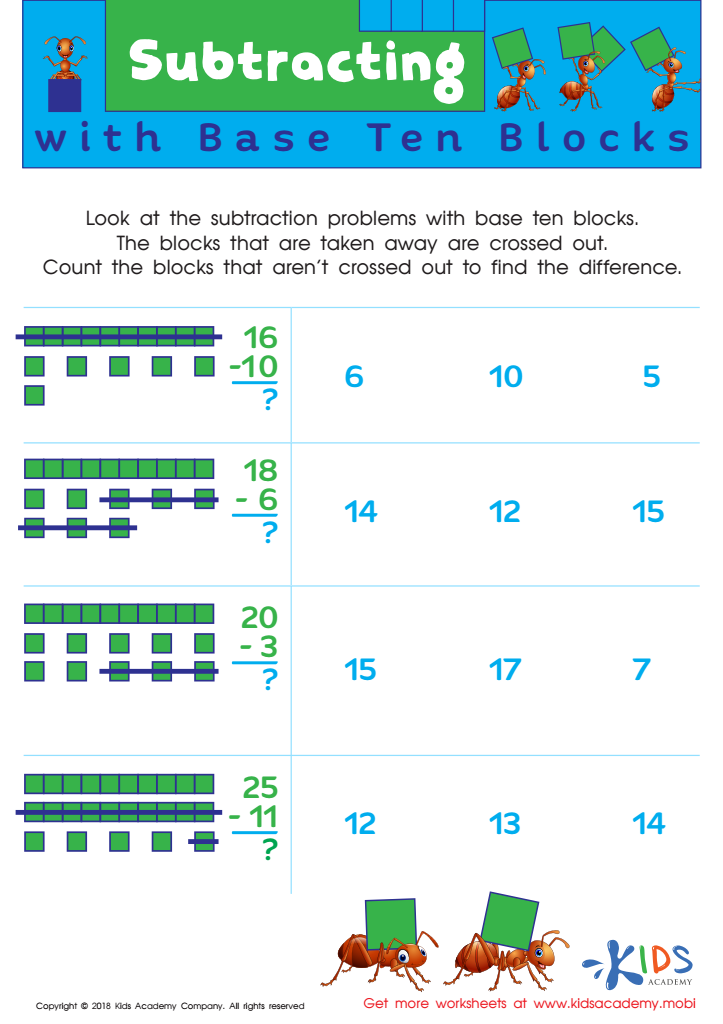
Subtracting with Base Blocks Worksheet
Little mathematicians can use base ten blocks to understand place value for subtraction. This worksheet helps them cross out blocks to solve problems with accuracy. Seeing equations like this boosts their number reasoning skills and helps them work with larger numbers.
Subtracting with Base Blocks Worksheet
Worksheet
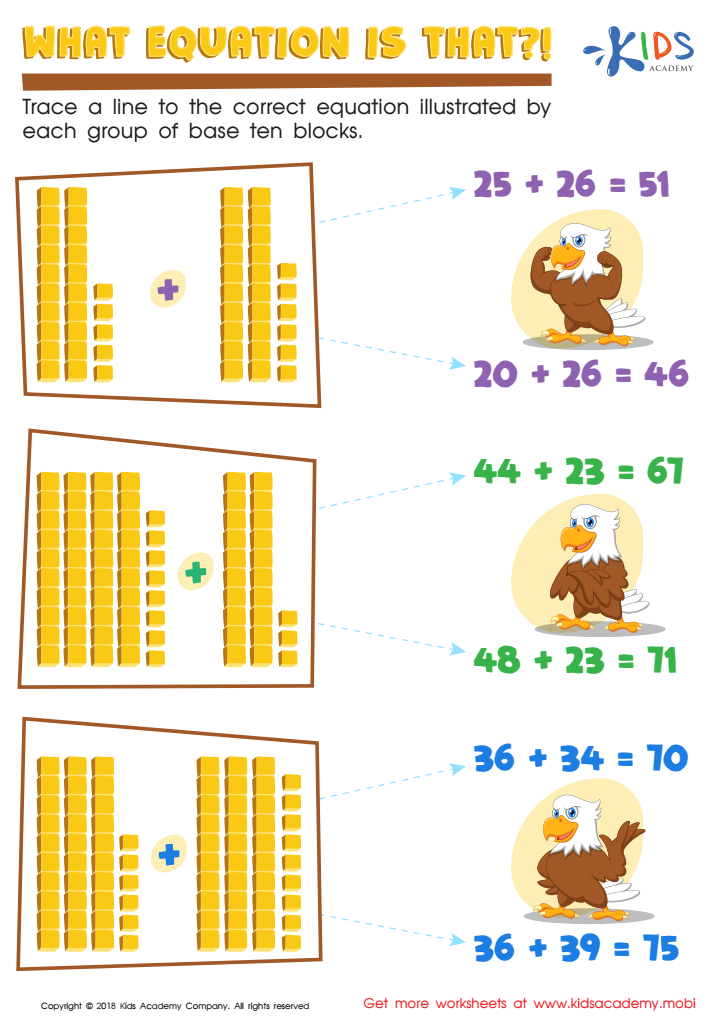
What Equation Is That? Worksheet
Have your students practice counting with base ten blocks. This will help them with math struggles. Homework and worksheets will help them improve; ask them to trace lines to the correct equation on a tracing sheet. Guide them as they count the blocks and trace the lines.
What Equation Is That? Worksheet
Worksheet
Join Kids Academy for Free
Who is primarily going to use this learning content?








Enhancing critical thinking in addition and subtraction for children aged 5-8 is pivotal for developing foundational math skills and fostering broader cognitive growth. At this formative stage, children begin to explore concepts that contribute to problem-solving and analytical capabilities. Mastery of basic arithmetic is not merely about learning to count or perform simple operations; it engages students in understanding patterns, making predictions, and comprehending relationships between numbers. These skills translate into better problem-solving strategies, encouraging children to think convergently and divergently.
Incorporating critical thinking into math instruction helps children to go beyond rote memorization. It enables them to ask why certain methods work and understand the underlying principles of math operations, which builds a deeper, lasting understanding. For instance, when children use critical thinking to solve an addition or subtraction problem, they learn to break down problems, anticipate various solutions, and verify their answers, fostering independence and resilience.
For parents, reinforcing this development at home through engaging activities and real-life applications—like cooking or shopping—enhances the practical relevance of math. For teachers, integrating critical thinking with arithmetic instruction creates a dynamic learning environment, promoting curiosity and encouraging students to become lifelong learners. Nurturing these skills early in life equips children to face more complex academic challenges with confidence and competence.








