
Observational skills Addition Worksheets for Ages 5-8
5 filtered results
Difficulty Level
Grade
Age
-
From - To
Subject
Activity
Standards
Discover our engaging Observational Skills Addition Worksheets, designed for children aged 5-8! Boost your child's math abilities and critical thinking with fun exercises that combine addition and observation tasks. These skill-building activities help young learners recognize patterns, enhance attention to detail, and develop problem-solving techniques. Ideal for early grade students, our worksheets foster a love for learning as kids enjoy beautiful illustrations and interactive challenges. Perfect for both classroom and at-home practice, these resources pave the way for strong mathematical foundations and improved observational skills. Explore our collection today to support your child's academic journey!
Favorites
With answer key
Interactive
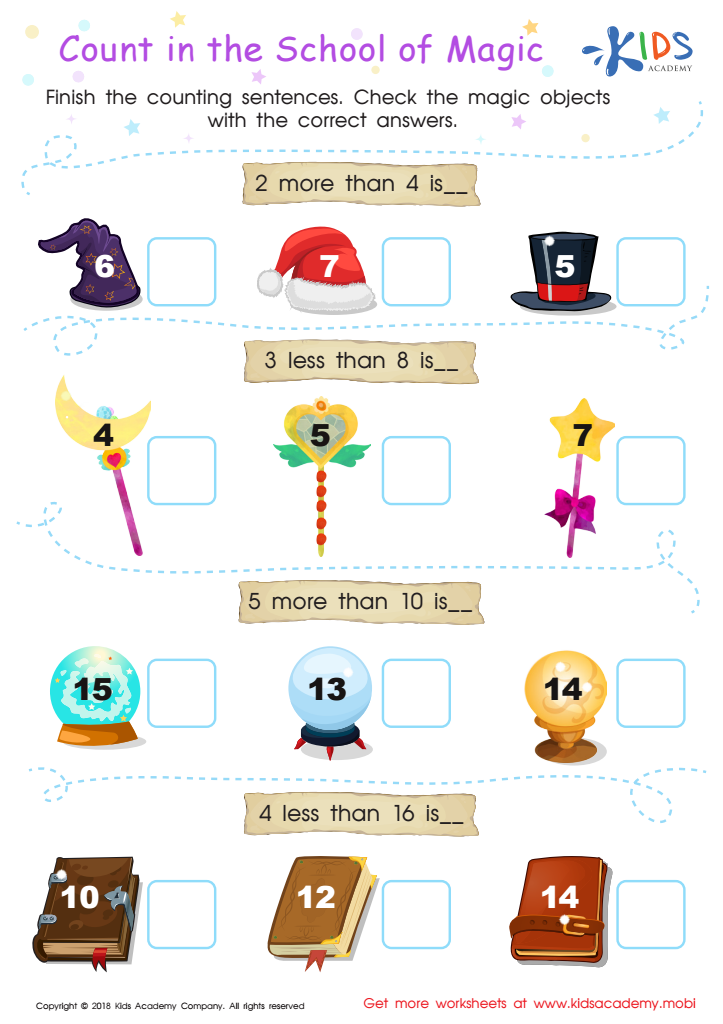
Count in the School of Magic Worksheet
Your math learners can explore the School of Magic with this worksheet. They'll read equations with addition and subtraction numbers under 20, count back and forth to find the answer, then complete the counting sentences. Fun pictures and easy accuracy make it an enjoyable and successful learning experience.
 Assign to My Students
Count in the School of Magic Worksheet
Worksheet
Join Kids Academy for Free
Who is primarily going to use this learning content?








Observational skills are crucial for young children, particularly those aged 5-8, as they form the foundation for effective learning and critical thinking. During these formative years, children are naturally curious and eager to explore the world around them. Developing observational skills allows them to notice details, make connections, and understand concepts more deeply.
For parents and teachers, prioritizing the enhancement of these skills means fostering more attentive, engaged learners who can process information more accurately. When children improve their ability to observe, they become better at distinguishing between different shapes, colors, patterns, and numbers, which is essential for subjects like mathematics and science. For example, noticing patterns in math problems or observing scientific phenomena can lead to a stronger grasp of these subjects.
Moreover, strong observational skills contribute to social and emotional development. Children become more adept at understanding non-verbal cues and emotions in social interactions, leading to healthier relationships and better communication skills.
Teachers and parents can encourage observational skills through simple activities like 'I Spy' games, nature walks, drawing from observation, or discussing new environments and experiences. By nurturing these skills, adults help children build a solid foundation for lifelong learning and problem-solving, while also enhancing their cognitive and social abilities.








