Building vocabulary Math Worksheets for Ages 5-8
3 filtered results
-
From - To
Discover engaging "Building Vocabulary Math Worksheets for Ages 5-8" that seamlessly blend language and arithmetic skills! Our expertly designed printables make learning fun and accessible, helping young learners grasp essential mathematical terms and concepts. Perfect for classroom use or at-home practice, these worksheets reinforce vocabulary through meaningful activities tailored for developing minds. Boost your child’s confidence and foundational math knowledge with our creative exercises, making math an enjoyable adventure. Accessible now at Kids Academy, a trusted resource for nurturing young scholars. Explore our collection today to support your child's educational journey from the very first steps!
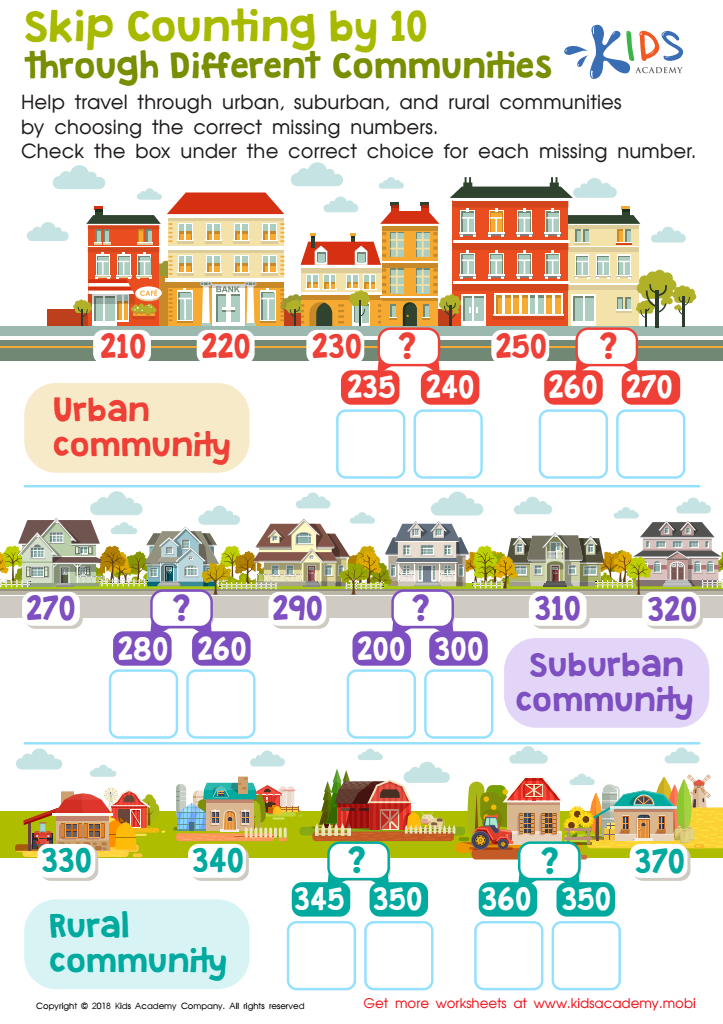
Skip Counting by 10 through Different Communities Worksheet
 Assign to My Students








Building a strong math vocabulary for children ages 5-8 is essential for their overall academic development and confidence in math. At this stage, children are exposed to fundamental mathematical concepts and language that form the foundation for future learning. When parents and teachers focus on building math vocabulary, it ensures that children understand the terminology associated with math operations, shapes, measurements, and problem-solving strategies.
A robust math vocabulary aids in clear communication of mathematical ideas, allowing children to describe their thinking and reasoning accurately. For example, understanding terms like “addition,” “subtraction,” “difference,” and “sum” helps children grasp the operations they perform. This clarity in communication reduces math anxiety and builds confidence, encouraging a positive attitude towards learning math.
Furthermore, math vocabulary development supports reading comprehension and problem-solving skills. As children grow, math problems become more word-based, requiring strong comprehension skills to decode the problem and identify the steps needed to solve it. The integration of mathematical language into everyday experiences also reinforces learning and helps children see math as relevant and applicable to their lives.
Investing effort in building a solid math vocabulary sets a strong foundation for academic success, boosts confidence, and fosters an enduring interest in mathematics, essential for navigating future education and real-world scenarios.








