
Enhance logical thinking Math Worksheets for Ages 5-8
4 filtered results
Difficulty Level
Grade
Age
-
From - To
Subject
Activity
Standards
Unlock your child's analytical potential with our "Enhance Logical Thinking Math Worksheets for Ages 5-8." These expertly designed activities not only sharpen math skills but also promote critical thinking and problem-solving abilities in young learners. Interactive exercises ranging from patterns and sequences to comparisons, provide endless fun while fostering cognitive development. Perfectly tailored for early graders, our worksheets encourage curiosity and confidence in math. Each worksheet is thoughtfully crafted to align with educational standards, ensuring your child gains the foundational skills needed for future success. Transform math practice into an enjoyable journey and watch your child thrive academically and intellectually. Explore now!
Favorites
With answer key
Interactive
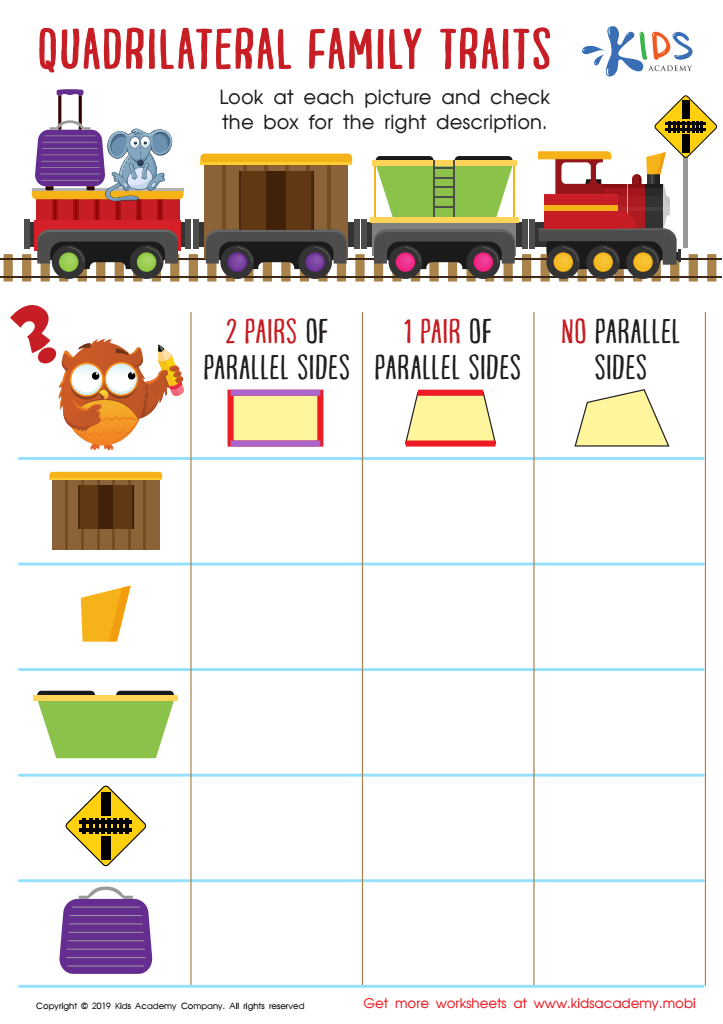
Quadrilateral Family Traits Worksheet
Review with your students what a quadrilateral is: four sides and angles. Now, go through the worksheet with them. Look at the pictures and help them check the boxes to identify the shapes.
 Assign to My Students
Quadrilateral Family Traits Worksheet
Worksheet
Join Kids Academy for Free
Who is primarily going to use this learning content?








Fostering logical thinking through math in children aged 5-8 is crucial for their overall cognitive development. At this formative stage, engaging their problem-solving abilities lays a strong foundation for academic success and real-world skills. Logical thinking in math teaches children how to approach problems methodically, recognize patterns, and develop critical reasoning.
By nurturing these skills early on, children can build confidence as they navigate increasingly complex concepts both in school and life. For example, early math experiences promote perseverance and patience, allowing kids to learn that mistakes are part of the process. This critical mindset builds resilience and a growth-oriented outlook.
Furthermore, enhanced logical thinking aids children in understanding and making sense of their experiences. It encourages curiosity and enhances their ability to ask insightful questions. Math activities, like puzzles and games, can make this learning fun and relatable, helping to transform numbers into tools that children can use rather naturally.
For teachers and parents, prioritizing logical thinking in math equips children with essential tools for later academic pursuits in fields like science, technology, engineering, and mathematics (STEM). It also sharpens everyday decision-making skills. Ultimately, cultivating logical thinking in early math sets the stage for lifelong learning and problem-solving capabilities.








