
Fraction identification Math Worksheets for Ages 5-8
6 filtered results
Difficulty Level
Grade
Age
-
From - To
Subject
Activity
Standards
Discover our engaging Fraction Identification Math Worksheets specially designed for children ages 5-8. These worksheets will boost your child's understanding of fractions through fun and interactive exercises. With activities such as coloring, matching, and problem-solving, young learners will master the basics of fractions like halves, thirds, and quarters. Our visually appealing worksheets use common, relatable objects to help your child easily grasp the concept of fractions. Foster a love for math and improve essential skills through our expertly crafted resources that encourage hands-on learning and make fraction identification an enjoyable experience!
Favorites
With answer key
Interactive
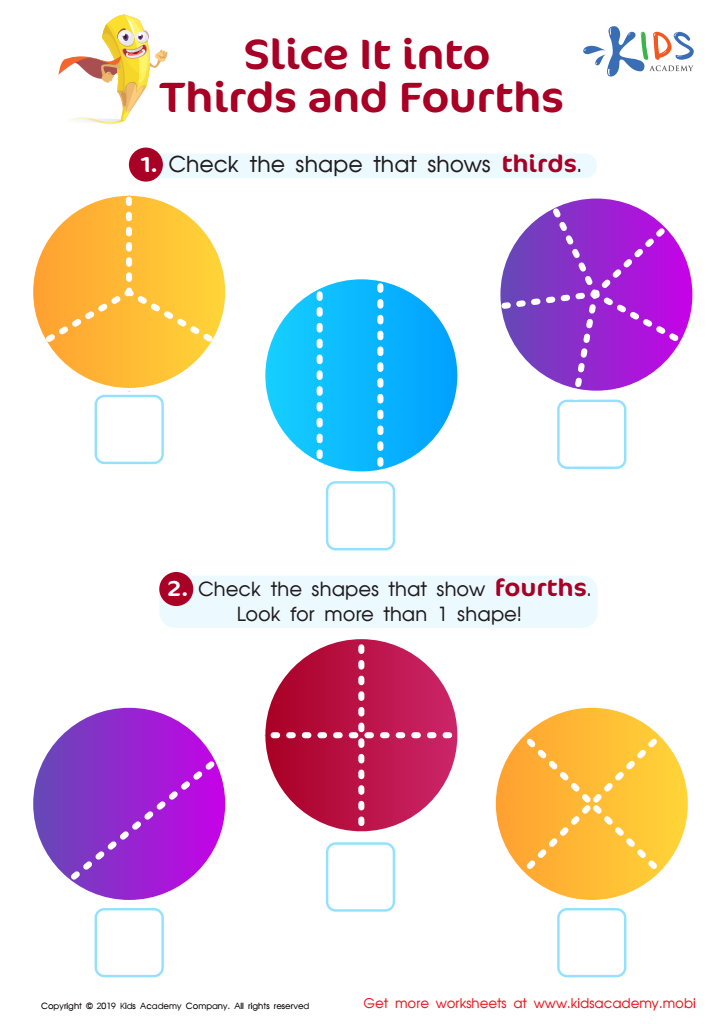
Slice in Thirds Fourths Worksheet
This worksheet helps kids learn fractions visually by dividing circles into thirds and fourths. They will learn that fractions must be equal parts, not just sets, by choosing the right colorful circles. It's an easy way to master fractions and have fun doing it!
 Assign to My Students
Slice in Thirds Fourths Worksheet
Worksheet
Join Kids Academy for Free
Who is primarily going to use this learning content?







Introducing children aged 5-8 to fraction identification is crucial for their foundational math development and future academic success. At this early stage, young learners have the incredible ability to absorb new concepts, and understanding fractions provides them with essential skills that extend beyond simple number operations.
First, mastering fractions at a young age develops a child's number sense, which is foundational for comprehending more complex math topics. Fractions represent parts of a whole and relationships between numbers, enabling children to grasp division, multiplication, and understanding ratios in later grades.
Second, learning fractions also supports real-world problem-solving skills. Everyday tasks, such as cooking, shopping, or sharing, often require an understanding of fractions. By recognizing and working with parts of a whole early on, children can better handle these practical activities and develop critical thinking.
Additionally, early exposure to fractions promotes a positive attitude toward math. When children learn fractions in a fun and engaging manner, such as through visual aids, games, and hands-on activities, they are more likely to enjoy math and perceive it as less daunting.
In sum, prioritizing fraction identification for young children equips them with indispensable math skills, simplifies their day-to-day experiences, and fosters a confident, positive outlook towards math in general.








