Improving observational skills Math Worksheets for Ages 5-8
3 filtered results
-
From - To
Enhance your child's observational skills with our engaging math worksheets designed specifically for ages 5-8. These worksheets incorporate fun activities that challenge young learners to notice details, make comparisons, and understand visuals, laying a strong foundation for mathematical thinking. As they explore vibrant illustrations and thought-provoking questions, children will boost their critical thinking and problem-solving abilities. Perfect for at-home learning or classroom activities, our worksheets seamlessly blend enjoyment with education. Help your child develop essential observational skills that are crucial for math success and confidence. Download today and watch your little one thrive in their learning journey!
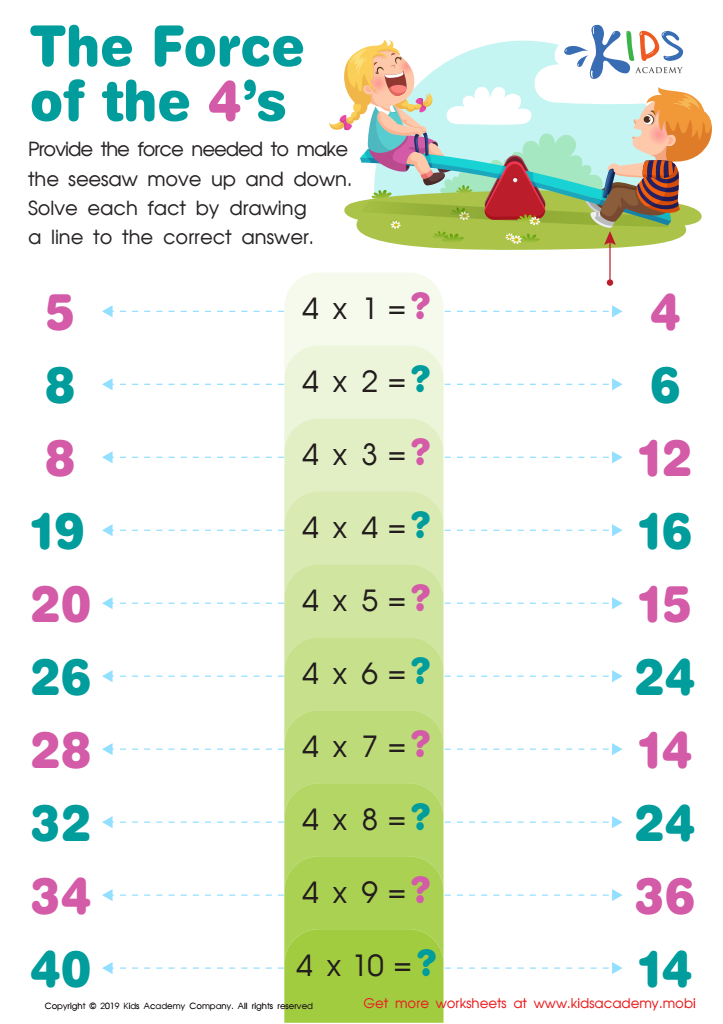
The Force of the 4's Worksheet
 Assign to My Students








Improving observational skills in math for children aged 5-8 is crucial for their overall cognitive development and understanding of mathematical concepts. At this age, kids are naturally curious, and enhancing their ability to observe closely encourages them to notice patterns, shapes, and relationships in the world around them. Strong observational skills serve as the foundation for critical thinking and problem-solving, both of which are essential in mathematics.
When children learn to observe details, they develop the ability to analyze and make connections, leading to a deeper understanding of mathematical concepts such as addition, subtraction, and spatial awareness. This also fosters a sense of curiosity and confidence in tackling math challenges, building a positive attitude towards the subject.
Moreover, engaged and observant learners tend to be better at collaboration, as they can share and discuss their observations, learning from their peers in the process. Parents and teachers who prioritize developing these skills are not only enhancing their children's mathematical abilities but also equipping them with lifelong learning tools. Investing in observational skills helps students become more resilient and adaptable, preparing them for future academic success and real-world problem-solving scenarios. Thus, improving observational skills in mathematics should be a shared goal.








