Number pattern recognition Math Worksheets for Ages 5-8
3 filtered results
-
From - To
Nurture your child's mathematical skills with our engaging Number Pattern Recognition Math Worksheets for ages 5-8, offered exclusively by Kids Academy. These worksheets are designed to reinforce crucial pattern recognition abilities, aiding young minds in grasping the building blocks of math. Each printable worksheet is crafted to make learning fun and intuitive, promoting perseverance, critical thinking, and problem-solving. As children navigate through vivid patterns and sequences, they'll unlock the joy of discovering relationships and predicting outcomes, making math both exciting and approachable. Invest in your child's math success with our expertly designed materials today!
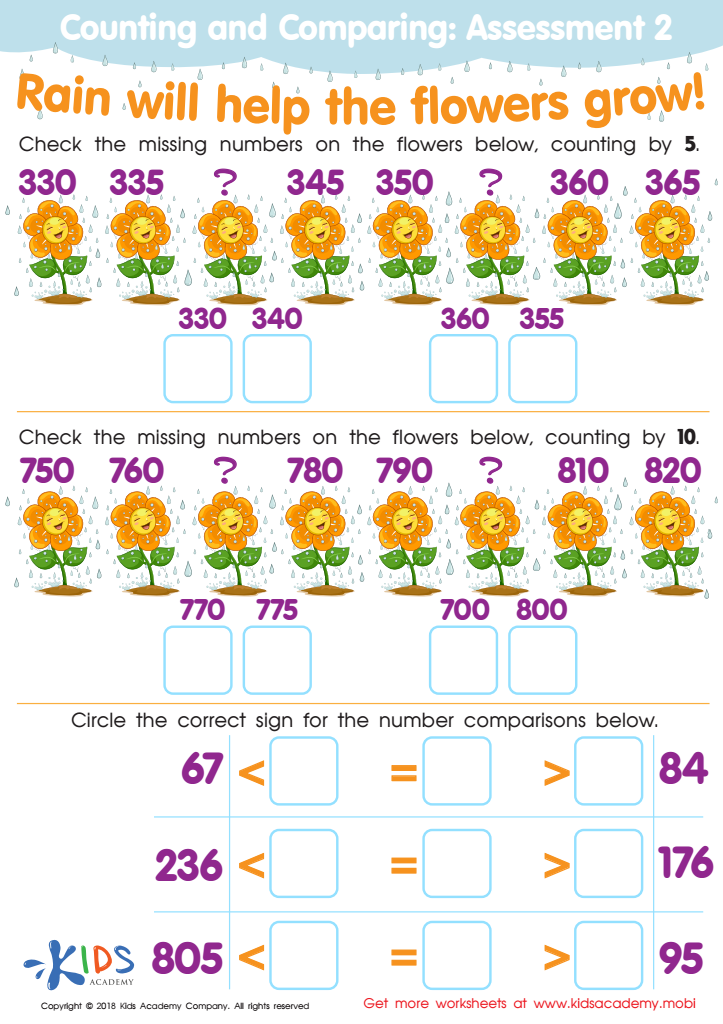
Counting and Comparing: Assessment 2 Worksheet
 Assign to My Students
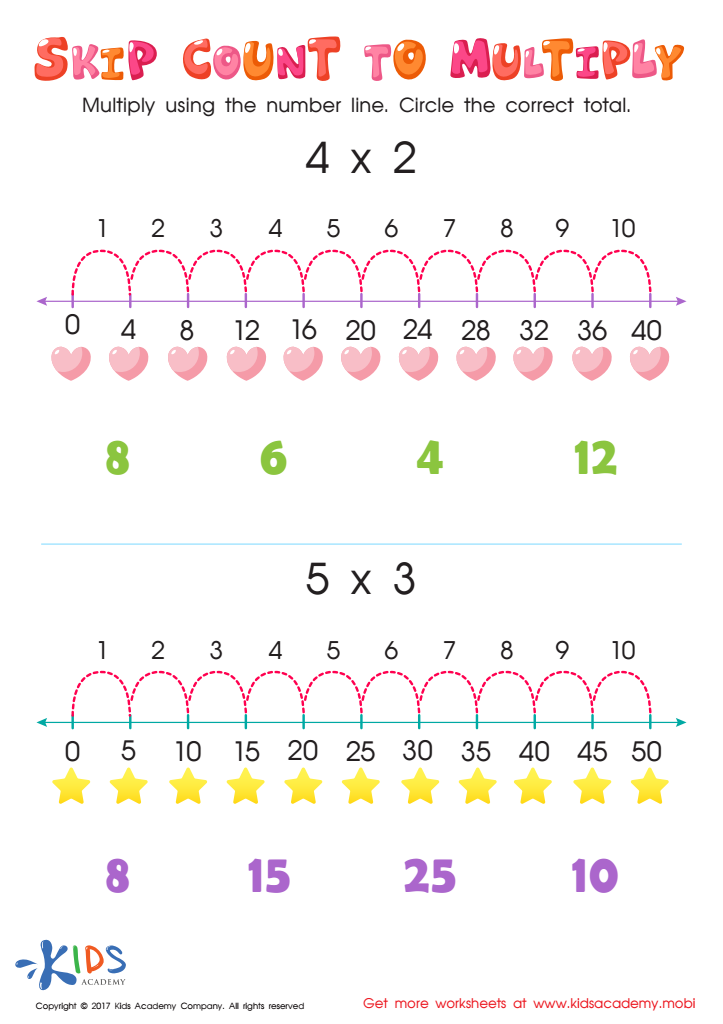
Skip Count Multiplication Worksheet








Number pattern recognition is a foundational mathematical skill that is crucial for young children aged 5-8. Parents and teachers should care about this aspect of math for several compelling reasons. Firstly, recognizing patterns helps children develop a sense of order and predictability, which is vital for understanding the world around them. Patterns are everywhere, from the rhythm of seasons to daily routines; grasping these concepts provides children with a structured way to predict and interact with their environment.
Secondly, number patterns enhance cognitive skills such as critical thinking and problem-solving. When children learn to identify and extend patterns, they engage in practices that involve reasoning, logic, and the ability to extrapolate information. This is essential for more complex math concepts they will encounter later, such as algebra and calculus.
Moreover, number pattern recognition lays the groundwork for effective learning in subjects beyond math. Skills acquired through pattern recognition—such as sequencing, classifying, and making predictions—are transferable to reading, writing, and science. This interconnected understanding helps create versatile learners who are adept at various tasks.
Lastly, early success in pattern recognition boosts confidence and fosters a positive attitude toward math. Achieving proficiency at an early stage encourages a lifelong affinity for the subject, laying the foundation for continued academic success. Consequently, investing time in teaching number patterns in early grades reaps substantial long-term benefits.








