
Understanding measurement units Measurement Worksheets for Ages 5-8
3 filtered results
Difficulty Level
Grade
Age
-
From - To
Subject
Activity
Standards
Unlock the world of measurement for young minds with our "Understanding Measurement Units" worksheets, designed specifically for ages 5-8! At Kids Academy, our engaging and educational printable worksheets introduce children to foundational concepts of measurement, including length, weight, and volume. Through fun and interactive activities, children develop critical thinking and practical math skills. Perfect for teachers and parents alike, these carefully crafted resources ensure that young learners grasp essential measurement units in a hands-on and enjoyable way. Dive into our collection today and watch your child's confidence in measurement grow!
Favorites
With answer key
Interactive
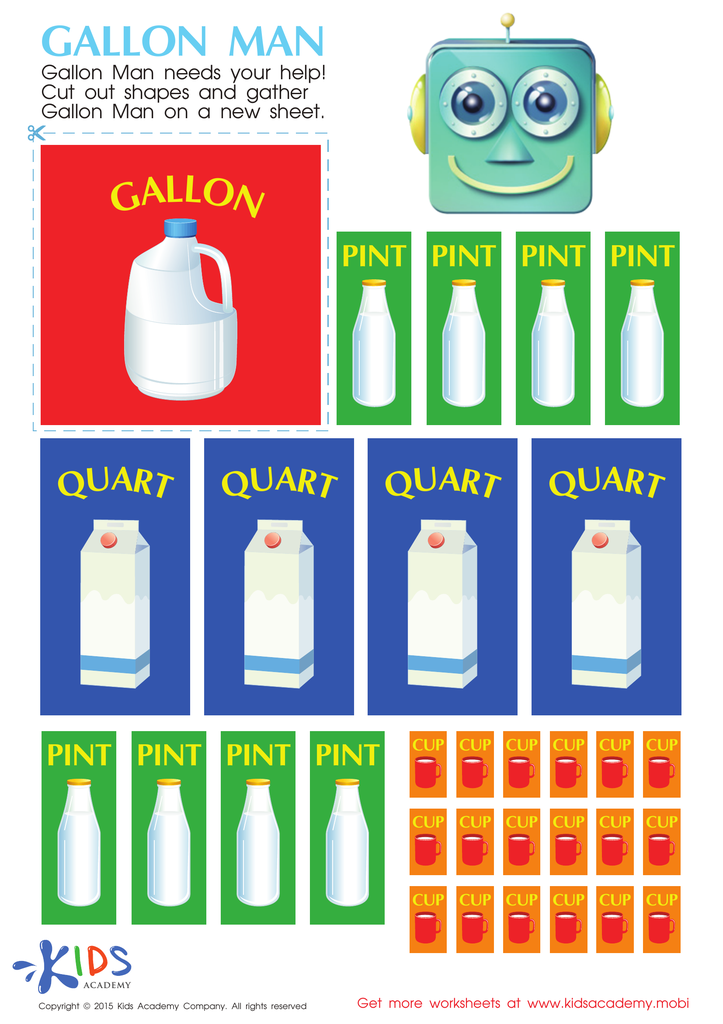
Cups, Pints and Quarts With Gallon Man Worksheet
Measurement in cups, pints, quarts and gallons has never been this fun!
Cups, Pints and Quarts With Gallon Man Worksheet
Worksheet
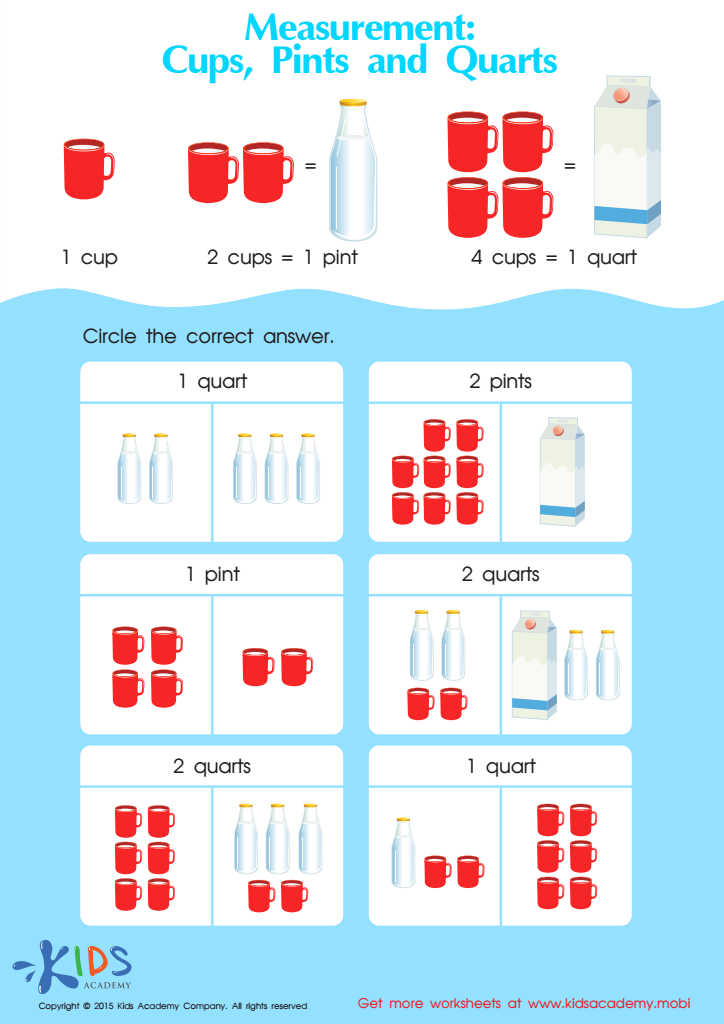
Cups, Pints and Quarts Worksheet
Let your kids explore the world of math with our worksheet! Have them count cups, pints and quarts in pictures and circle the right answer. Get even more free printable math worksheets for kindergarten on our website. Come on, join the adventure!
 Assign to My Students
Cups, Pints and Quarts Worksheet
Worksheet
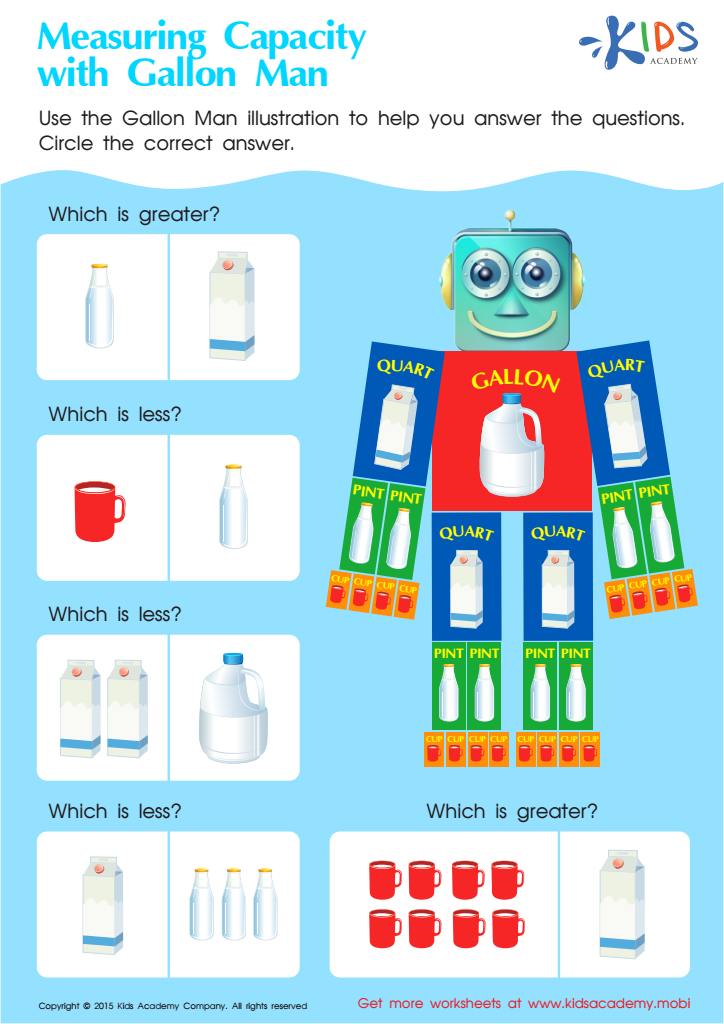
Measurement: Measuring Capacity with Gallon Man Worksheet
Check out Gallon Man to practice measuring capacity with cups, pints, quarts, and gallons. Our worksheet has questions with answers checked against Gallon Man. For more practice, visit our site for free printable math worksheets for kindergarten and learn math with fun!
Measurement: Measuring Capacity with Gallon Man Worksheet
Worksheet
Join Kids Academy for Free
Who is primarily going to use this learning content?








Understanding measurement units is as fundamental as learning the alphabet or basic math, especially for children aged 5-8. When children grasp the concept of measurement units early, it serves as a cornerstone for their overall academic and practical development.
Firstly, teaching measurement units, such as inches, centimeters, grams, and liters, helps children develop important math skills. Children learn to quantify the world around them, which reinforces basic arithmetic operations like addition, subtraction, multiplication, and division.
Secondly, understanding measurements fosters critical thinking and problem-solving skills. When children compare the lengths, weights, or volumes of different objects, they learn to make logical decisions and reason systematically. These are life-long skills that transcend subject boundaries, proving beneficial in science, technology, engineering, and everyday tasks.
Practicality is another crucial aspect. Whether measuring ingredients for a recipe, understanding distances on a map, or interpreting time, knowing measurement units equips children to navigate the world confidently. Their day-to-day lives become filled with opportunities to apply what they've learned, making concepts stick more profoundly and intuitively.
Parents and teachers who prioritize this aspect of learning are essentially empowering young minds with the tools they need to understand, analyze, and interact meaningfully with their environment, setting a strong foundation for future learning and problem-solving.








