
Understanding equivalence Worksheets for Ages 5-9
3 filtered results
Difficulty Level
Grade
Age
-
From - To
Subject
Activity
Standards
Unlock your child's potential with our engaging "Understanding Equivalence Worksheets for Ages 5-9." Designed to cultivate a strong math foundation, these printable worksheets make learning fun and effective. Through hands-on activities and vivid illustrations, children explore key concepts such as balance, equality, and equivalence in everyday math problems. Ideal for both classroom and home study, these resources assist young learners in developing critical thinking skills and mathematical fluency. Empower your child with the confidence to tackle more complex math challenges as they grow. Download today and make early math learning a joyous journey!
Favorites
With answer key
Interactive
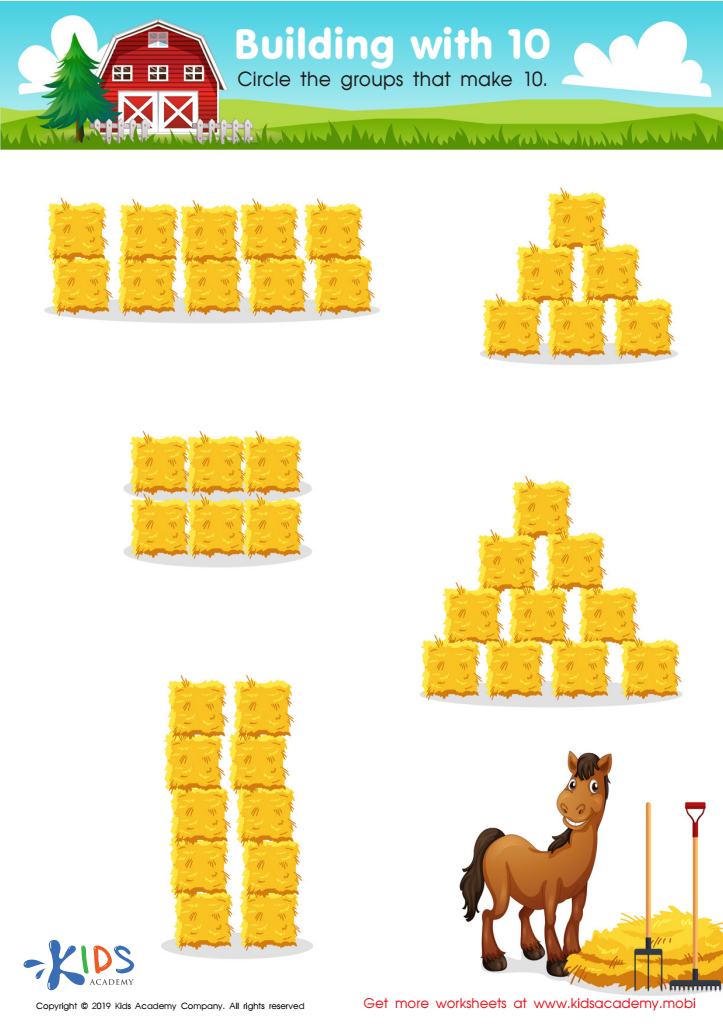
Building with 10 Worksheet
Counting numbers can be simple with this worksheet: Ask your kids to count the stacks of objects, ensure accuracy with your help, then circle the ones of ten. With practice and guidance, your children will soon become counting pros!
 Assign to My Students
Building with 10 Worksheet
Worksheet
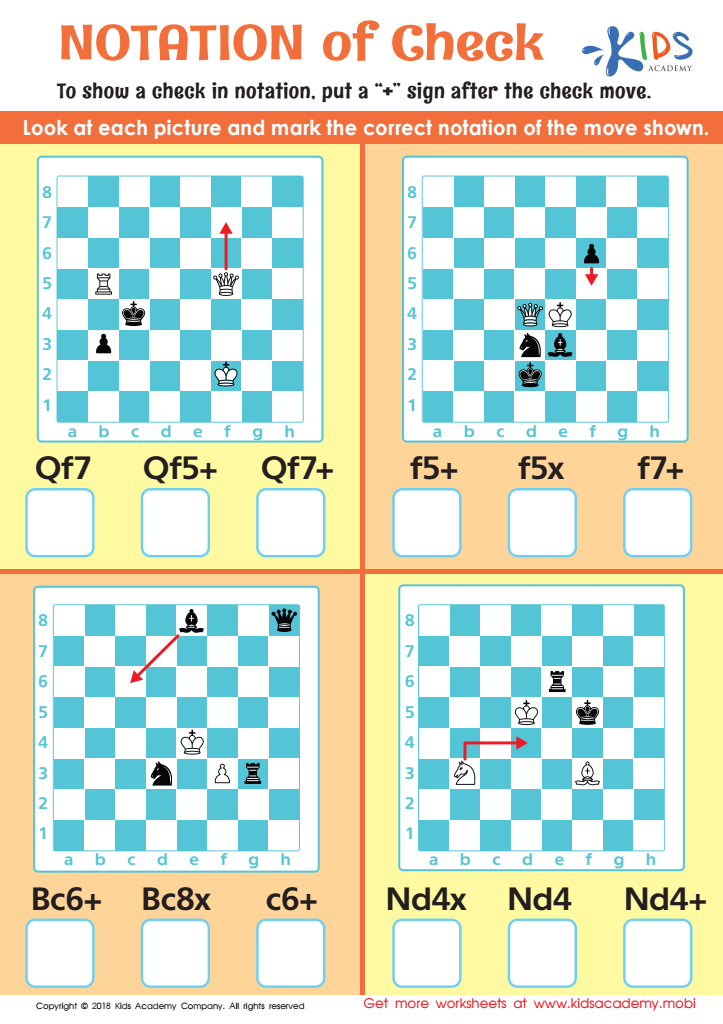
Notation of Check Worksheet
Chess is an addictive game! Once you know the basics of check and checkmate, you'll be hooked! Teach your little one to make check notation with this free PDF worksheet. They can use downloadable practice to look at each picture and mark the correct notation, strengthening their problem-solving skills while they learn to play - and win - this fun game!
Notation of Check Worksheet
Worksheet
Join Kids Academy for Free
Who is primarily going to use this learning content?






Understanding equivalence is foundational for young children, particularly between ages 5-9, as it sets the groundwork for future mathematical learning and critical problem-solving skills. Equivalence, the idea that different expressions can represent the same quantity, helps children grasp the concept of equality in mathematics by equipping them to recognize balanced relationships.
For parents, encouraging an understanding of equivalence can support their child’s development in numeracy, fostering confidence and competence in dealing with numbers and basic operations. It helps children make meaningful connections between addition, subtraction, multiplication, and division in practical contexts, enhancing their ability to approach real-world problems logically.
Teachers play a crucial role in presenting equivalence through various activities like balance scales, number sentences, and visual aids. These tools enable children to engage with the concept physically and visually, promoting deeper comprehension. Early mastery in understanding equivalence aids children’s algebraic thinking later, as it is a stepping-stone to grasping more complex ideas in mathematics.
By prioritizing this aspect of early math education, both parents and teachers can provide a robust mathematical foundation. This preparation helps children with more advanced math and develops their logical thinking skills, positioning them for academic success in these crucial early learning years and beyond.








