Spatial awareness 2D Shapes Worksheets for Ages 5-9
3 filtered results
-
From - To
Unlock the power of learning with our Spatial Awareness 2D Shapes Worksheets, tailored for children ages 5-9. These engaging resources help young learners master essential math skills by exploring a variety of 2D shapes. Each worksheet is designed to enhance spatial awareness through fun, interactive activities that build foundational knowledge in geometry. Kids will love identifying, coloring, and arranging shapes, boosting their confidence and piquing their interest in mathematics. Perfect for parents and educators, our worksheets align with educational standards, ensuring that learning is both rewarding and effective. Start shaping bright minds today!
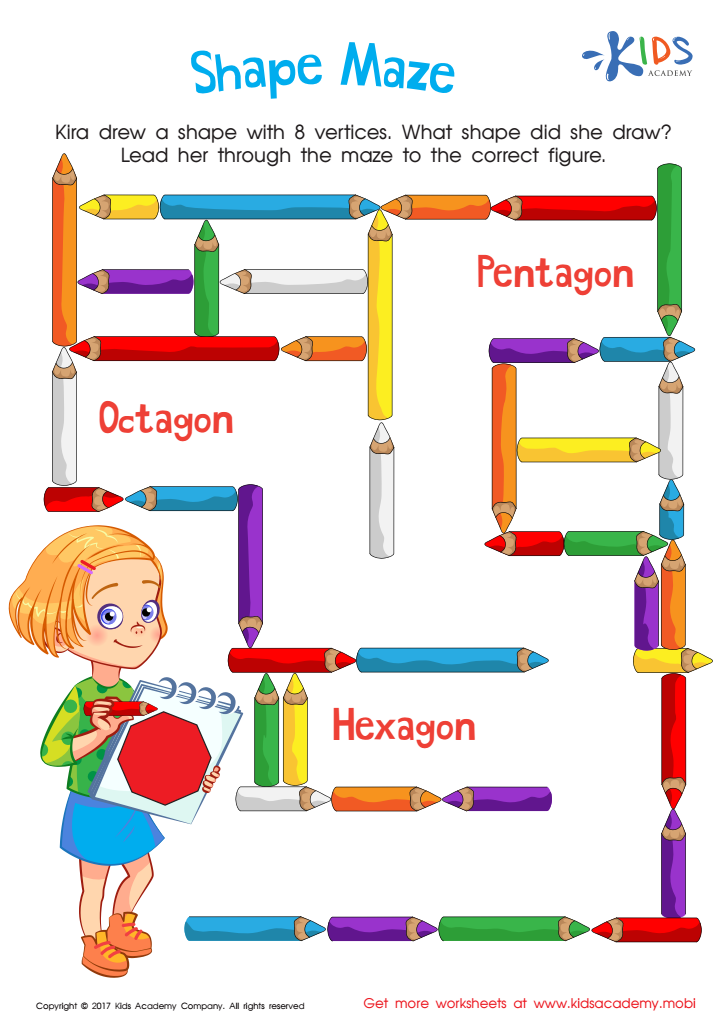
Shape Maze Worksheet
 Assign to My Students


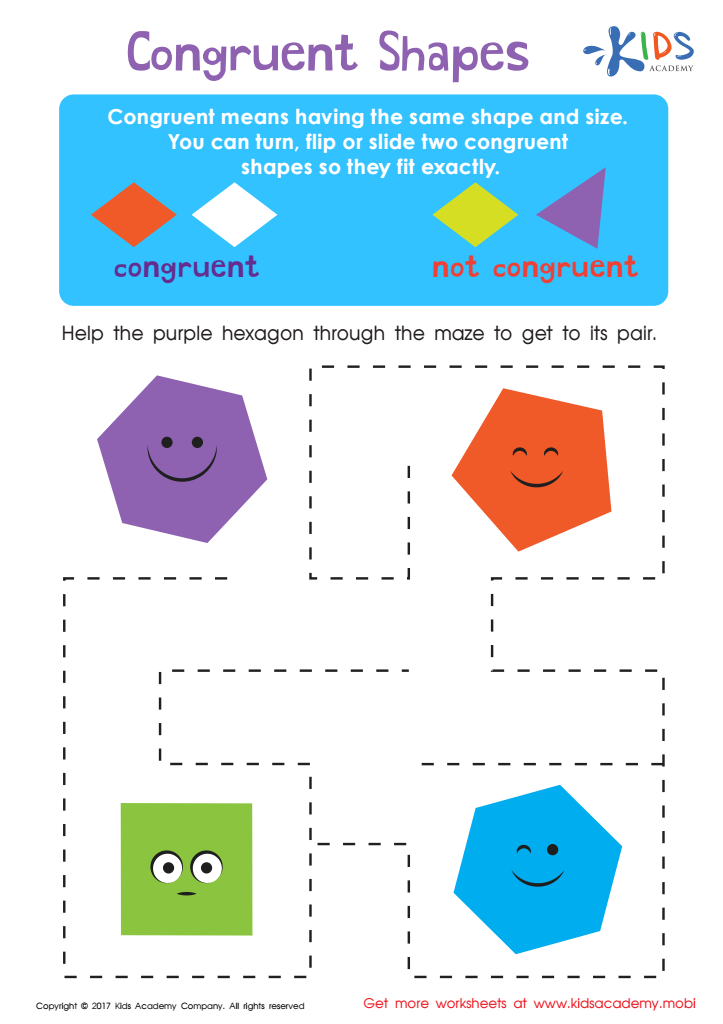
Congruent Shapes Worksheet
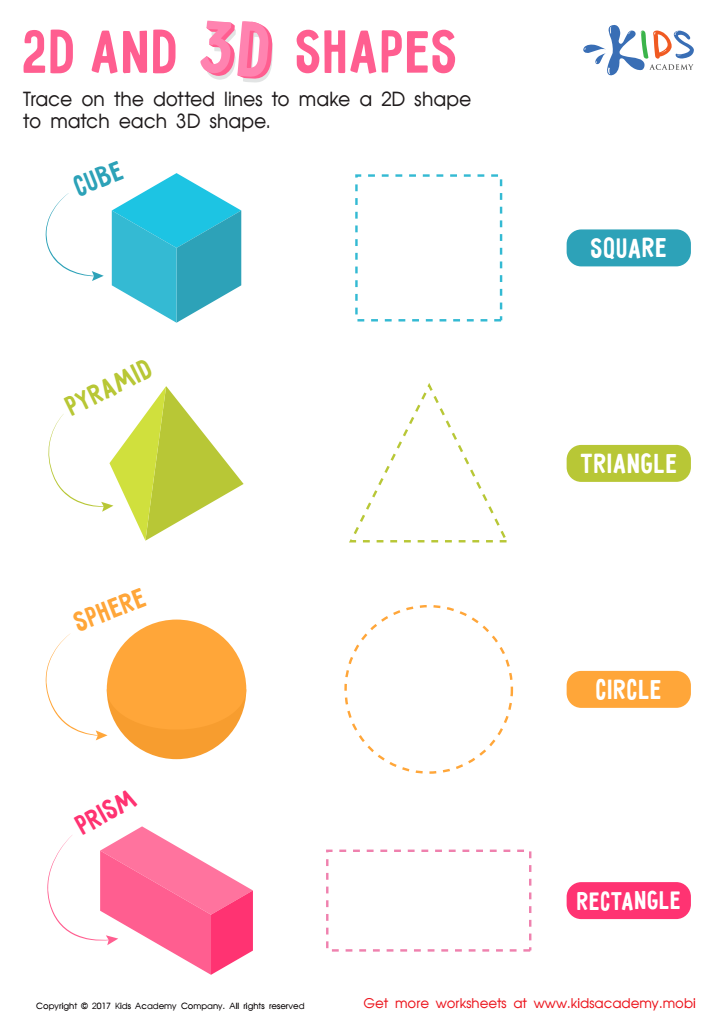
2D and 3D Shapes Worksheet








Spatial awareness and understanding 2D shapes are fundamental skills that serve as building blocks for a child's cognitive development, particularly for ages 5-9. This skill fosters better math comprehension, as recognizing and manipulating shapes can directly translate to geometry and other mathematical concepts. For instance, when children understand the properties of circles, triangles, and squares, they are better equipped to grasp more complex ideas like area, perimeter, and volume later on.
Moreover, spatial awareness enhances problem-solving abilities. Navigating puzzles, arranging objects, and visualizing spaces require one to mentally manipulate shapes and spaces. It's a crucial skill not just in mathematics but in everyday life, such as reading maps or even packing a bag efficiently.
Strong spatial skills also support language development and literacy. When children describe shapes and their positions (e.g., "the circle is on top of the square"), they practice spatial vocabulary and complex sentences, enriching their verbal articulation and comprehension.
Engaging with 2D shapes through hands-on activities also aids fine motor skill development. Activities like drawing shapes or cutting out paper shapes improve hand-eye coordination and dexterity.
Ultimately, fostering spatial awareness and familiarity with 2D shapes during these formative years equips children with vital skills that extend beyond the classroom, promoting holistic cognitive and physical development.