
Improve comprehension Addition Worksheets for Ages 5-9
3 filtered results
Difficulty Level
Grade
Age
-
From - To
Subject
Activity
Standards
Discover our "Improve Comprehension Addition Worksheets for Ages 5-9" to boost young learners' math skills seamlessly. Our engaging worksheets are meticulously crafted to enhance students’ understanding of addition through fun, interactive exercises. Each worksheet builds on foundational mathematics concepts, promoting critical thinking and problem-solving abilities. Perfect for classroom use or at-home practice, these engaging activities are designed to keep children motivated and eager to learn. Help your child master addition with ease, improve their comprehension, and foster a lifelong love for math. Explore this effective resource and watch young minds blossom into math whizzes!
Favorites
With answer key
Interactive
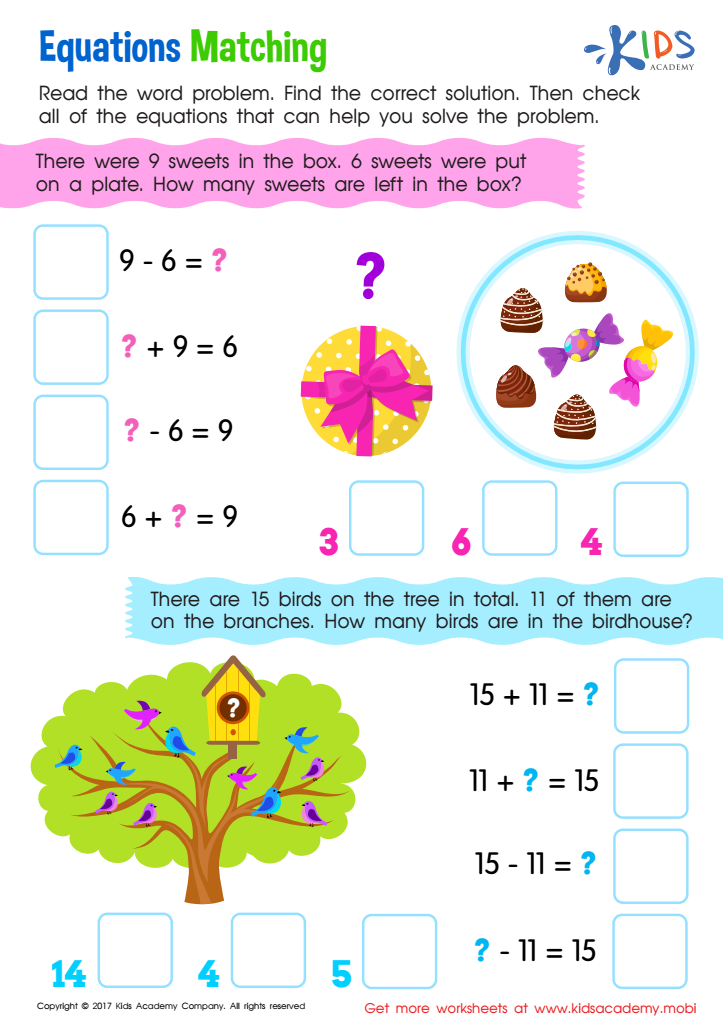
Equations Matching Word Problems Worksheet
Download this worksheet and give your young mathematician practice in solving equations using matching numbers and number family facts. They'll solve word problems, develop critical thinking and algebraic reasoning, and gain success with addition and subtraction.
 Assign to My Students
Equations Matching Word Problems Worksheet
Worksheet
Join Kids Academy for Free
Who is primarily going to use this learning content?








Parents and teachers should prioritize improving comprehension in addition for children aged 5-9 because foundational math skills are crucial for their future academic success. At this age, children are in a prime developmental stage for learning new concepts, and mastering essential math skills early on sets the stage for more complex problem-solving abilities. Understanding addition is not just about knowing how to add numbers; it's about developing logical thinking, recognizing patterns, and improving overall cognitive skills.
For parents, actively engaging in their child's math education helps build a positive mindset towards learning. This can foster a love for math, reducing anxiety or negative attitudes that could hinder future academic performance. Teachers play a vital role by providing differentiated instruction to meet each child's unique learning needs, ensuring that no student falls behind.
Moreover, improved comprehension in addition can lead to better performance in other subjects. Math skills are often linked with improvements in areas like reading and science, as logical thinking and problem-solving are transferable skills.
In essence, focusing on addition comprehension for young learners provides them with a strong educational foundation, preparing them for more advanced concepts in later grades and contributing to their overall intellectual development and confidence.








