Improving counting skills Geometry Worksheets for Ages 5-9
3 filtered results
-
From - To
Enhance your child's counting abilities and geometric understanding with our "Improving Counting Skills Geometry Worksheets" designed for ages 5-9. These engaging worksheets combine the fun of shapes with essential counting exercises to boost math proficiency. Kids will enjoy a variety of activities, such as identifying and counting shapes, which promote both analytical and critical thinking skills. Tailored to support young learners, these resources are perfect for reinforcing classroom lessons or for practice at home. Set your child on a path to math success with interactive and educational geometry worksheets available at Kids Academy!
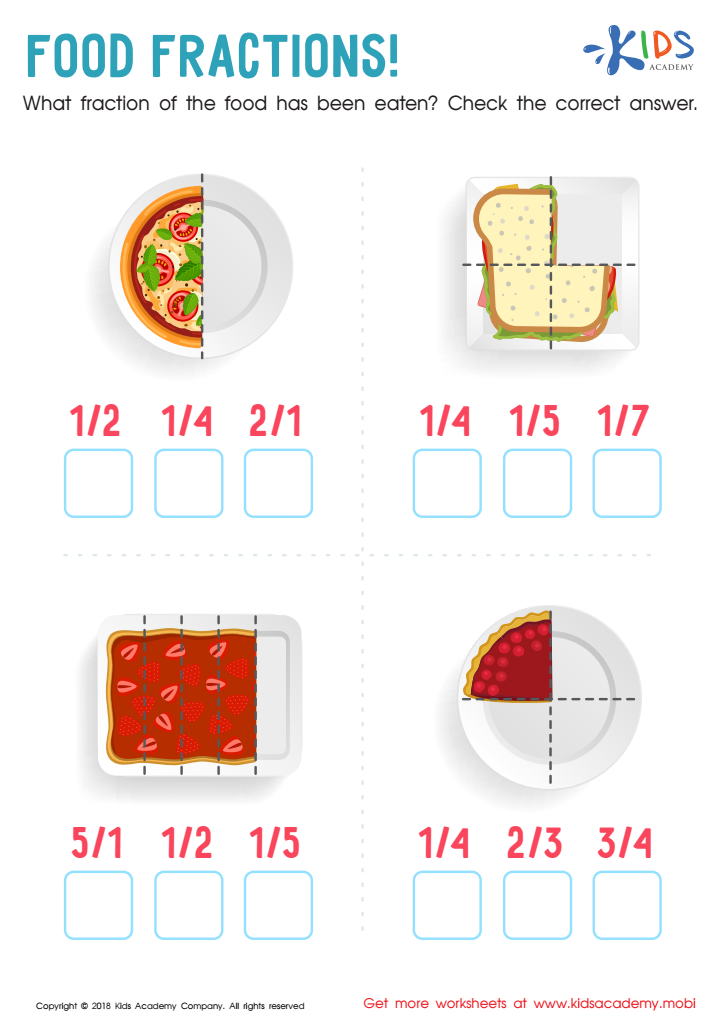
Food Fractions Worksheet
 Assign to My Students











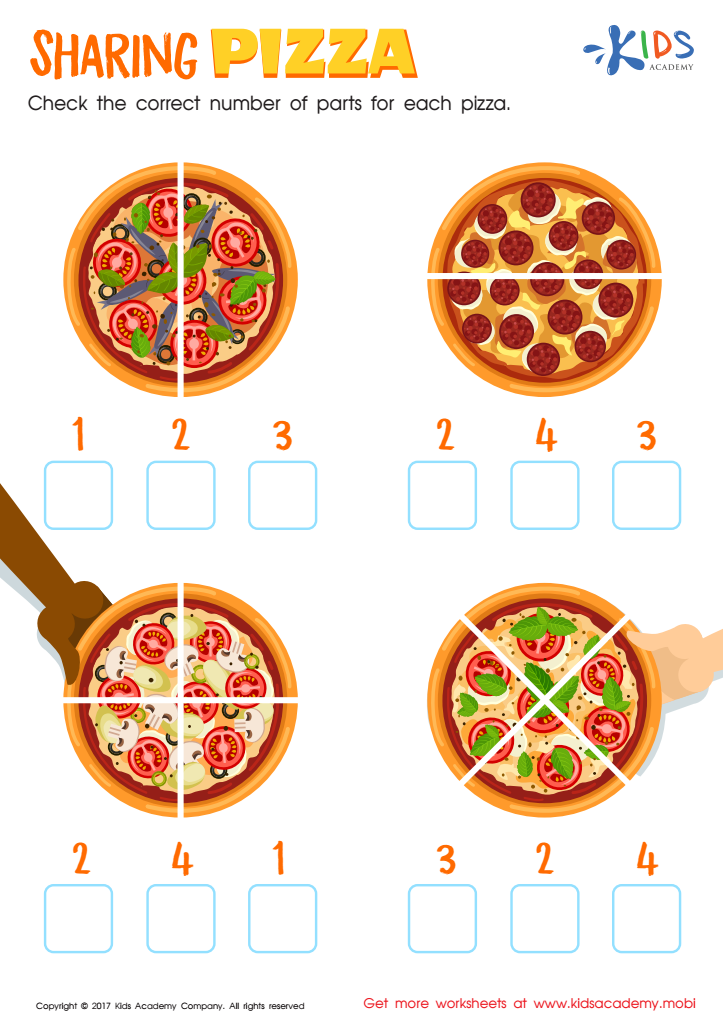
Sharing Pizza Worksheet
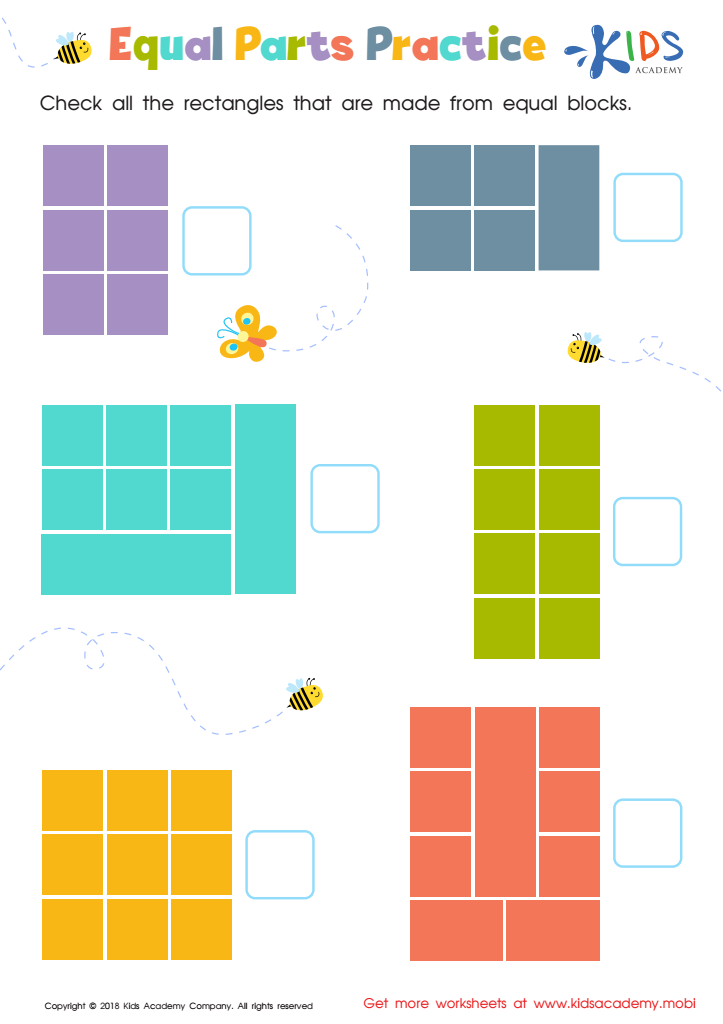
Equal Parts Practice Worksheet








Parents and teachers should prioritize improving counting skills and geometry for children aged 5-9 because these skills form the foundational building blocks for future learning in mathematics and beyond. During this developmental stage, children’s brains are highly receptive to new concepts, making it an ideal time to instill strong mathematical foundations.
Counting skills enable children to understand numbers as quantities, recognize patterns, and develop problem-solving abilities. Mastery in counting paves the way for more complex arithmetic operations such as addition, subtraction, multiplication, and division. It also supports logical thinking and helps children apply mathematical concepts in everyday situations, enhancing their overall cognitive development.
Geometry, on the other hand, introduces children to the properties and relations of shapes and spaces. By exploring geometric concepts, children enhance their spatial reasoning, which is essential for understanding and interacting with the world around them. Concepts such as symmetry, shapes, and spatial relationships are integral to numerous fields, including science, engineering, art, and architecture.
Moreover, integrating counting and geometry skills fosters critical thinking, improves concentration, and boosts confidence in handling mathematical challenges. Early proficiency in these areas sets a strong foundation for academic success, encourages a positive attitude towards mathematics, and ultimately equips children with essential life skills for their future endeavors.








