
Understanding prepositions Math Worksheets for Ages 5-9
4 filtered results
Difficulty Level
Grade
Age
-
From - To
Subject
Activity
Standards
Explore our engaging "Understanding Prepositions Math Worksheets" designed for children aged 5-9! These worksheets combine essential math skills with learning about prepositions, helping young learners grasp important language concepts through fun activities. With interactive exercises, colorful illustrations, and clear instructions, children will enjoy practicing spatial relationships using terms like above, below, beside, and between. Our carefully crafted materials cater to various learning styles, ensuring that every child can reinforce their understanding of both math and language. Perfect for use at home or in the classroom, these worksheets offer an exciting way to enhance skills while having fun! Download your worksheets today!
Favorites
With answer key
Interactive
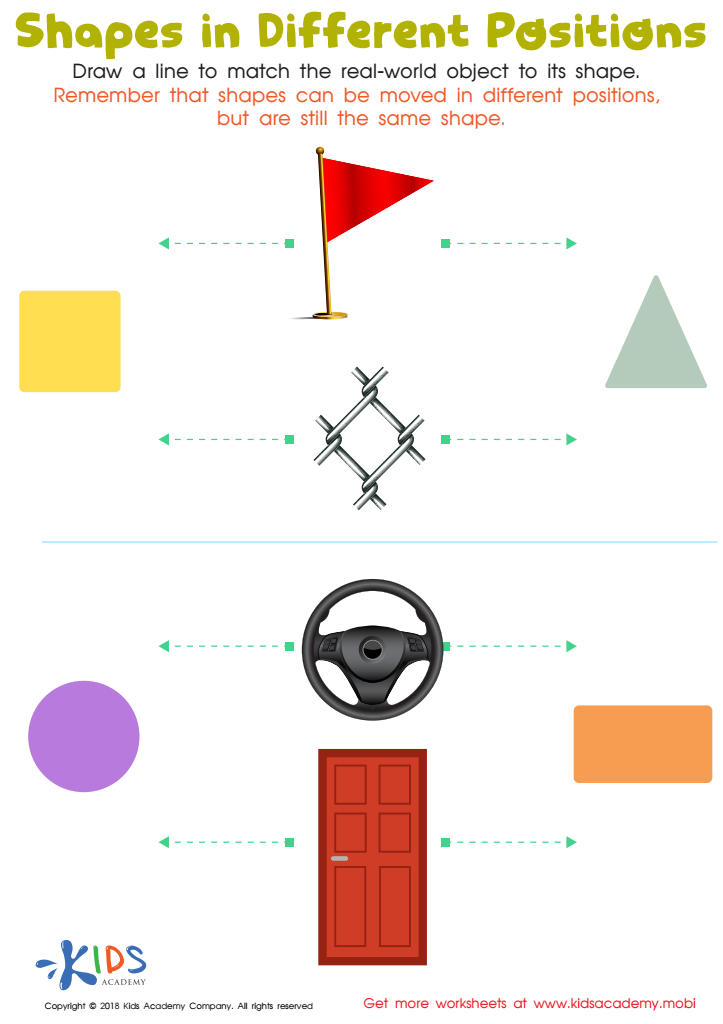
Shapes in Different Positions Worksheet
Children can practice and strengthen their visual-discernment, hand-eye coordination and neural connections by manipulating shapes in their minds and matching them with the right answer. This PDF with bright colors gives your kids the opportunity to do so.
 Assign to My Students
Shapes in Different Positions Worksheet
Worksheet
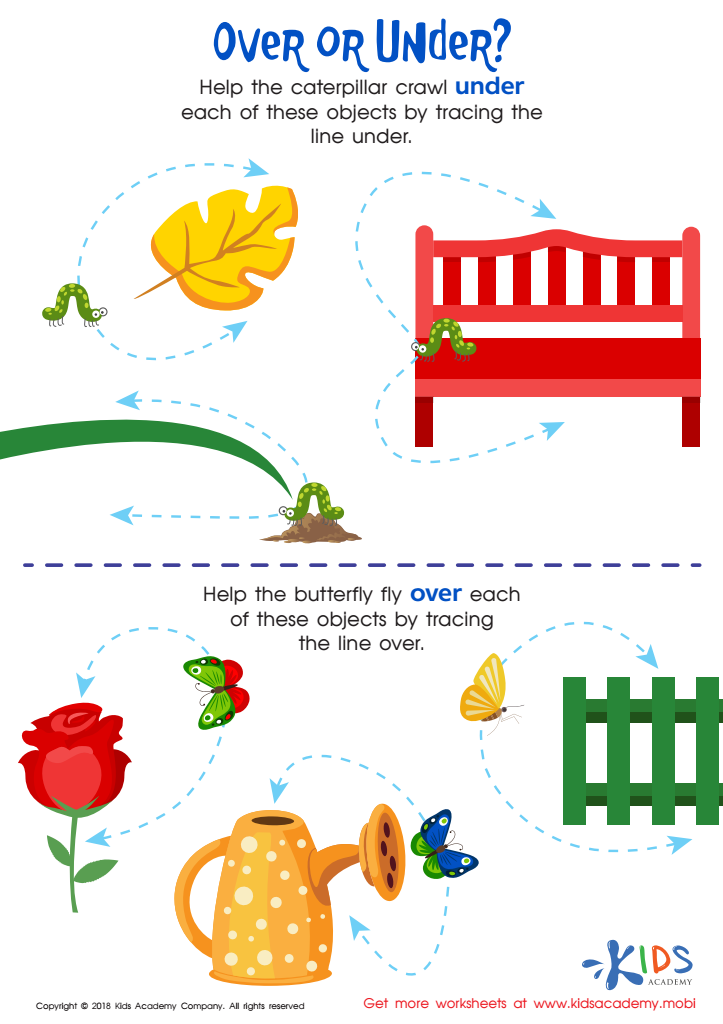
Over or Under? Worksheet
Math for young kids isn't just about numbers and counting, but also spatial concepts like geometry. This worksheet helps students learn "over" and "under" by tracing the movement of caterpillars and butterflies. Downloadable for free, it's an effective teaching tool for early learners.
Over or Under? Worksheet
Worksheet
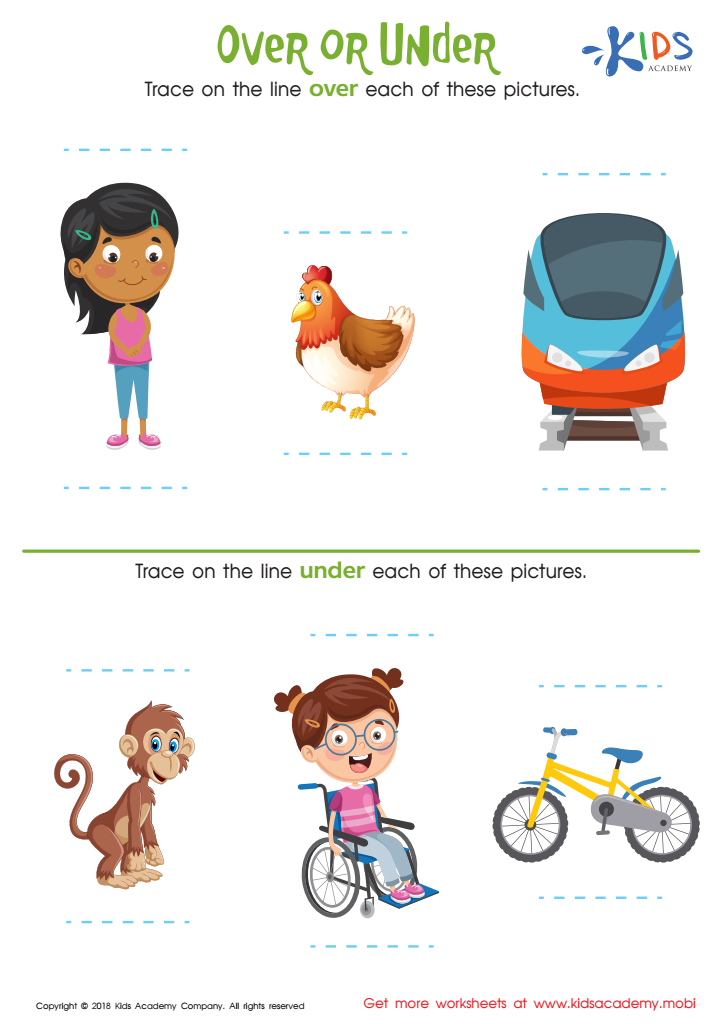
Over or Under Worksheet
Help your toddler grasp prepositions like "over" and "under" with this fun worksheet. Have them trace lines over the pictures on one half and under the pictures on the other, thus practicing basic communication and math concepts. Strengthen your child's understanding and communication skills with this activity.
Over or Under Worksheet
Worksheet
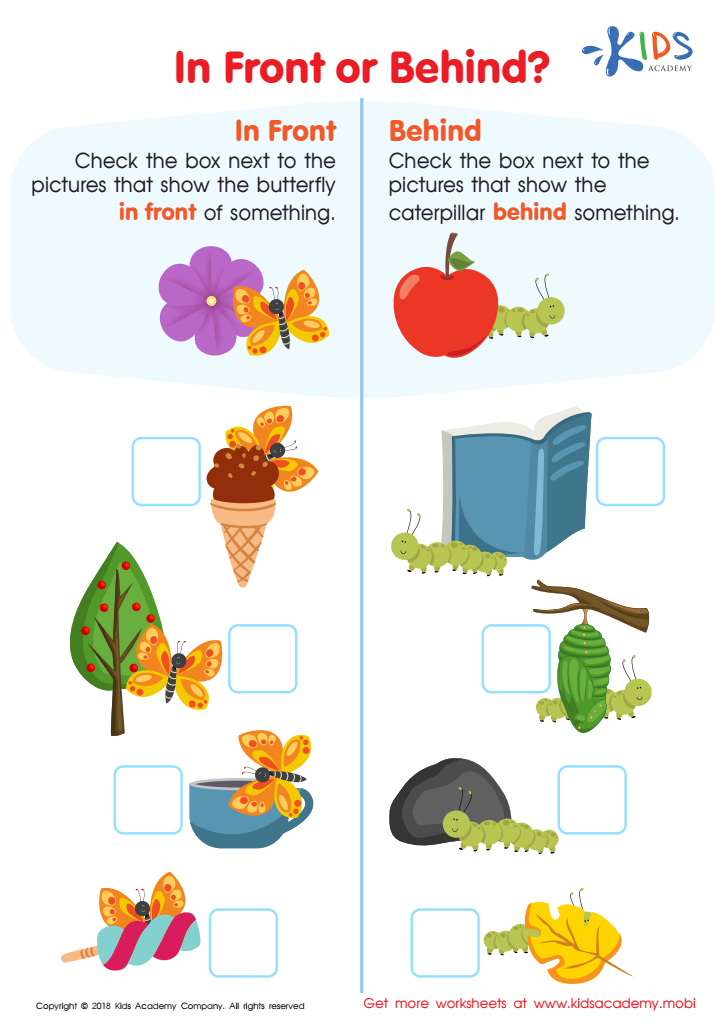
In Front or Behind Worksheet
Hone your child's spatial skills with 'in front' and 'behind'! This knowledge is essential for communication and study. Get them started with this free PDF worksheet - check off the pictures that show the butterfly in front and caterpillar behind!
In Front or Behind Worksheet
Worksheet
Join Kids Academy for Free
Who is primarily going to use this learning content?







Understanding prepositions is crucial for early learners, especially within the context of math for ages 5-9. Firstly, prepositions help children grasp spatial relationships, which are fundamental in math concepts, such as geometry. Words like "above," "below," "between," and "next to" enhance a child's ability to visualize and describe shapes and their positioning, laying the groundwork for higher mathematical thinking.
Furthermore, many math problems and word problems require a solid understanding of prepositions to comprehend the task. For instance, when instructions say, "Add the apples on the table," or "Subtract the books under the shelf," prepositions dictate the relationships between objects that children must interpret correctly to solve problems. This higher order thinking fosters problem-solving skills and strengthens logical reasoning.
Additionally, developing language skills through preposition usage improves communication and helps children articulate their thought processes, enhancing classroom discussions and collaborative work. Parents and teachers can reinforce these language skills in math-related activities, making learning more engaging and applicable. Ultimately, a firm grasp of prepositions not only aids in math but also enriches children's overall academic experience. By prioritizing this area, adults can foster well-rounded, confident learners.








