Visual-motor skills Math Worksheets for Ages 5-9
5 filtered results
-
From - To
Our Visual-Motor Skills Math Worksheets for Ages 5-9 are designed to blend fun with education, enhancing children's learning experiences. These worksheets focus on integrating visual-motor skills with fundamental math concepts, helping young learners improve hand-eye coordination, spatial awareness, and problem-solving abilities. With engaging activities such as maze tracing, dot-to-dot puzzles, and shape recognition, kids master critical math skills including number sequencing, geometry, and basic arithmetic. Ideal for both classroom and home use, these worksheets provide a playful yet structured way to boost confidence and academic performance in early learners. Inspire a love for math with a creative twist today!
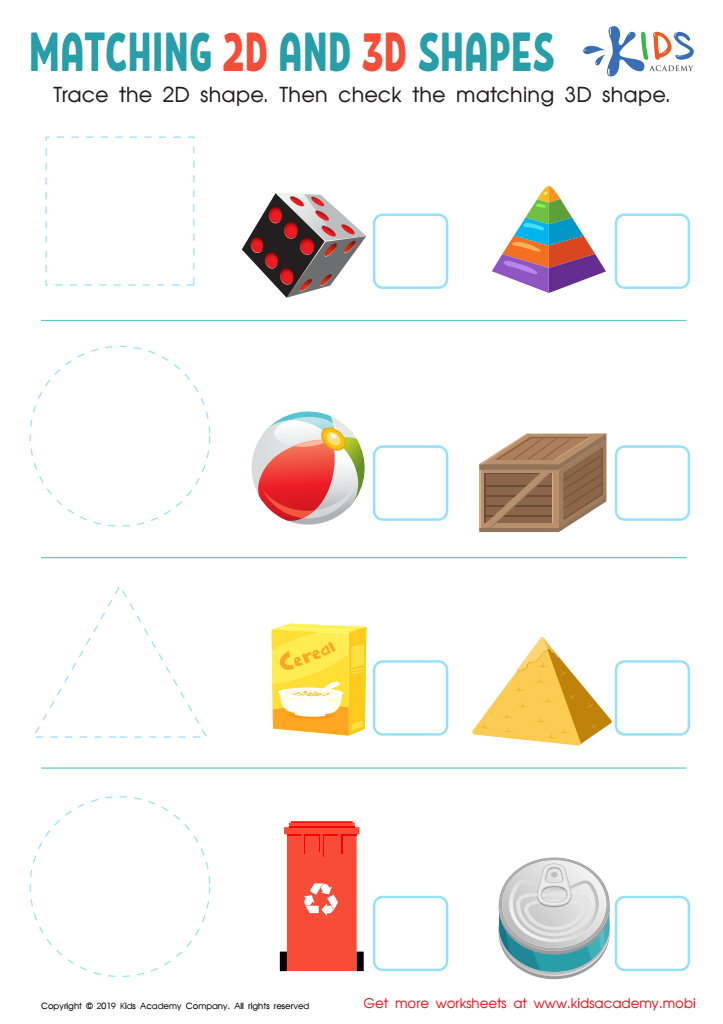
Matching 2D and 3D Shapes Worksheet
 Assign to My Students







Visual-motor skills are essential for young children, particularly for those aged 5-9, as these skills form the foundation for academic success and daily functioning. These skills involve the use of visual input to guide hand movements, coordinating what children see with how they move their hands to perform tasks. In the context of math, visual-motor skills are crucial for activities like writing numbers, solving puzzles, and understanding spatial relationships — all fundamental components of early math education.
When children engage in tasks that develop visual-motor skills, such as coloring within lines, cutting with scissors, or tracing shapes, they enhance their ability to recognize patterns, process visual information, and apply it to physical actions. This translates directly into their ability to write numbers correctly, align mathematical problems accurately, and visualize geometric patterns — skills that are necessary for performing more complex math operations as they progress in their education.
Moreover, strong visual-motor integration improves focus and attention, leading to better academic performance overall. When children struggle with these skills, they may find it difficult to keep up in math, leading to frustration and potential disinterest in the subject. Hence, both parents and teachers should prioritize activities and exercises that support visual-motor development to give children a strong start in their mathematical journey and ensure they remain engaged, confident, and successful learners.








