
Lowercase identification Alphabet Worksheets for 5-Year-Olds
5 filtered results
Difficulty Level
Grade
Age
-
From - To
Subject
Activity
Standards
Help your 5-year-old master the alphabet with our engaging lowercase identification worksheet collection from Kids Academy! These expertly designed printable worksheets use fun and interactive activities to teach children how to recognize, identify, and write lowercase letters. With colorfully illustrated exercises, kids will enjoy tracing, matching, and coloring letters, encouraging hands-on learning and boosting their literacy skills. Perfect for both classroom and at-home use, our worksheets provide a structured yet playful approach to early education, laying a strong foundation for reading and writing confidence. Unlock the joy of learning with our Lowercase Identification Alphabet Worksheets!
Favorites
With answer key
Interactive
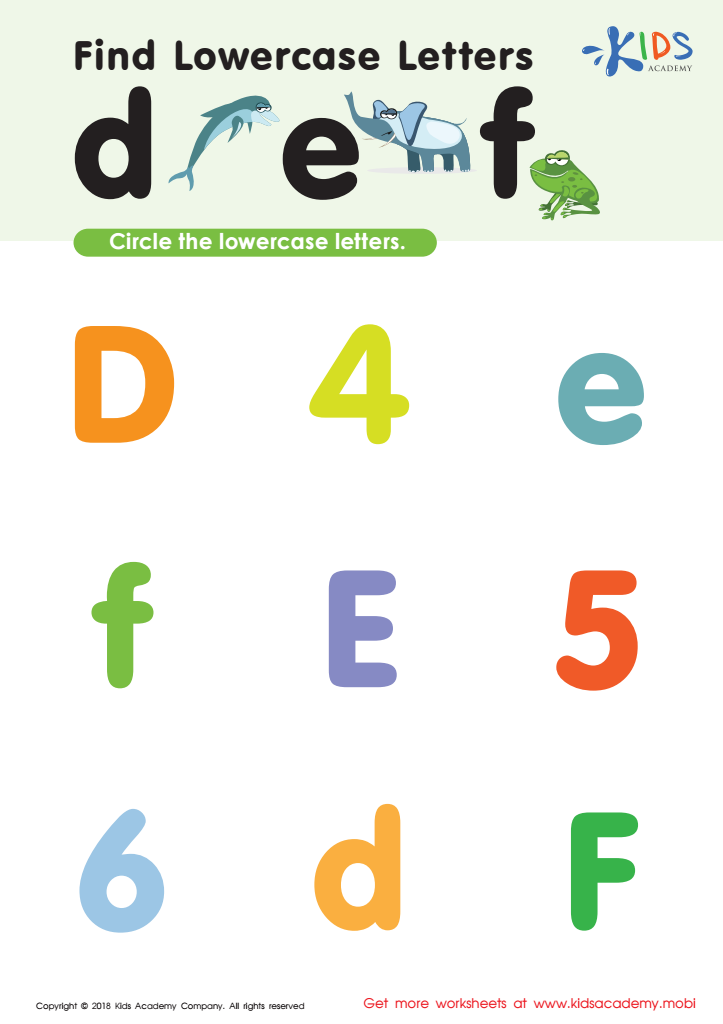
Find Lowercase Letters d e f Worksheet
Engage your child's brain with this fun, colorful worksheet. They'll identify and circle lowercase letters among other numbers and uppercase letters in bright colors. This will keep their attention as they learn, and can be downloaded in PDF form!
 Assign to My Students
Find Lowercase Letters d e f Worksheet
Worksheet
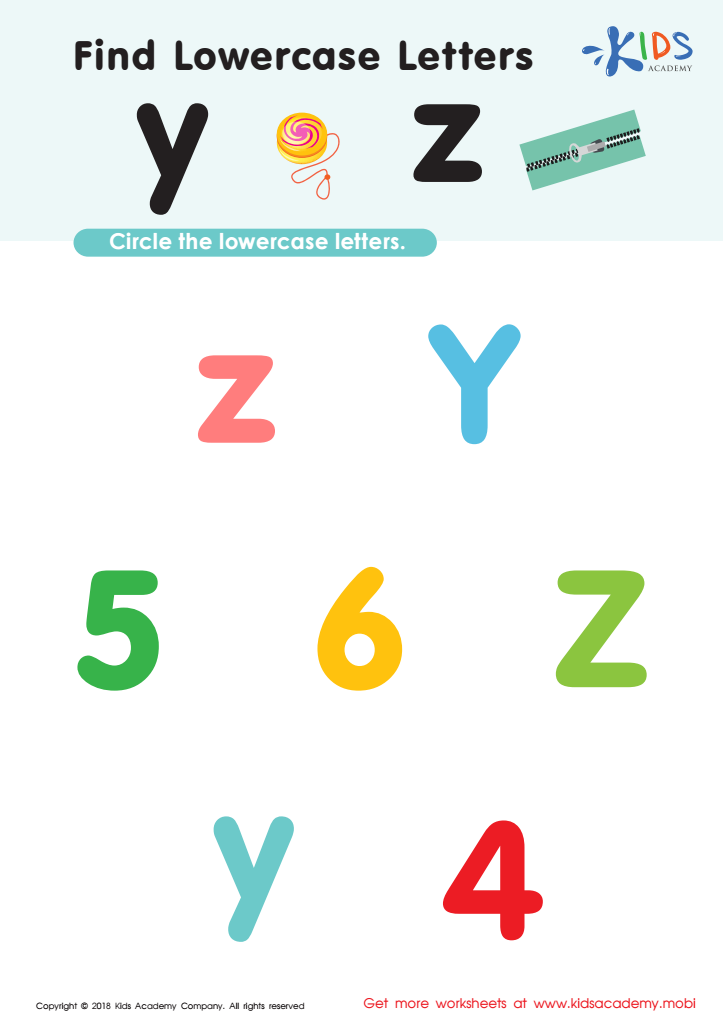
Find Lowercase Letters y z Worksheet
Help your kid learn the alphabet. Before they can move on to words and reading, they must first know the lower and uppercase letters. Show them how to find the letters y and z in this worksheet, which is filled with uppercase letters and numbers. Together, find and circle them.
Find Lowercase Letters y z Worksheet
Worksheet

Find lowercase letters a b c Worksheet
Help your child identify lowercase letters with this worksheet. Carefully look at each letter and have your child circle the lowercase ones. This exercise is vital in helping them understand the alphabet and the difference between lower and uppercase letters.
Find lowercase letters a b c Worksheet
Worksheet
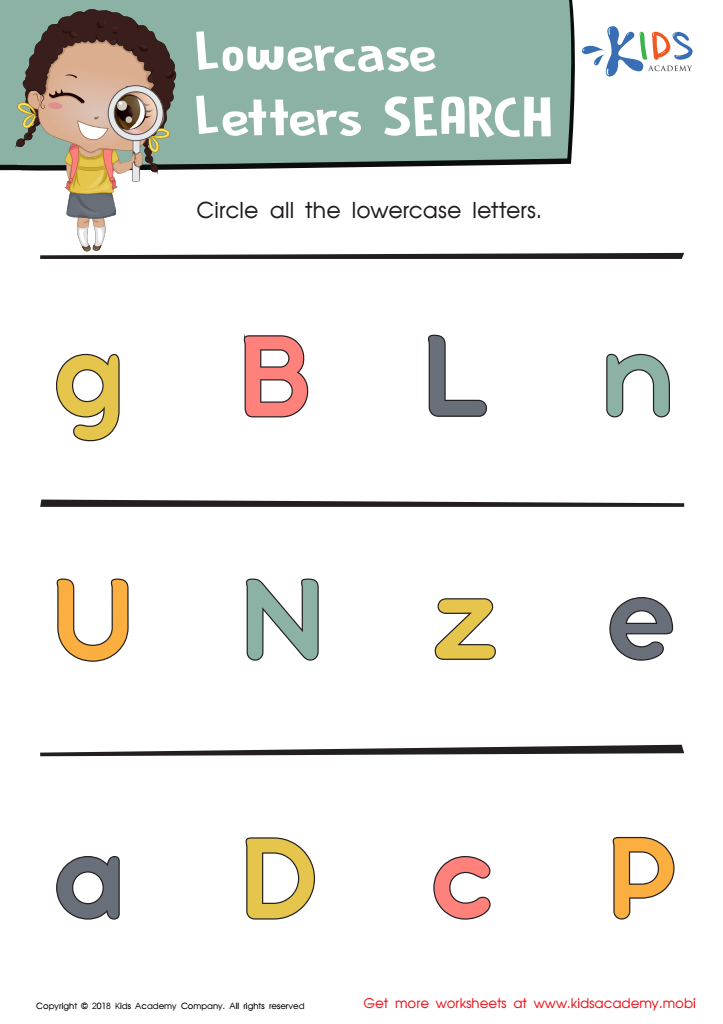
Lowercase Letters Search: Assessment Worksheet
Circle all the lowercase letters in this worksheet. Identify them among a mix of uppercase and lowercase letters. Your child will have fun with this exercise thanks to its bright primary colors. Enjoyment and learning go hand-in-hand!
Lowercase Letters Search: Assessment Worksheet
Worksheet

Find Lowercase Letters v w x Worksheet
If your child doesn't know the alphabet, get them this helpful worksheet. It's an easy exercise to build their understanding of the alphabet and lowercase letters. Find the letters v, w, and x among other uppercase letters and numbers in the downloadable PDF.
Find Lowercase Letters v w x Worksheet
Worksheet
Join Kids Academy for Free
Who is primarily going to use this learning content?








Lowercase alphabet identification is a fundamental skill for 5-year-olds that parents and teachers should prioritize for several vital reasons. Firstly, lowercase letters are more frequently used in daily reading and writing, constituting roughly 95% of written text. Ensuring that children are proficient in recognizing and writing lowercase letters accelerates their reading fluency and comprehension.
Mastering lowercase letters also builds a strong foundation for early literacy, impacting future academic achievement. When young learners can quickly identify these letters, they are better equipped to decode words, which is an essential step toward reading proficiency. Moreover, early literacy skills are closely linked to broader cognitive development and can positively influence a child's overall academic journey.
Beyond academics, proficiency in lowercase letter identification fosters self-confidence and a love of learning. Children who feel capable and competent are more likely to engage in reading activities and enjoy the process of discovery and learning setbacks.
Furthermore, instilling good habits early makes transitions to more complex literacy skills smoother. Lowercase letters ease the acquisition of sight words and spelling, speeding up writing skills essential for classroom tasks. In a nutshell, prioritizing lowercase alphabet identification equips children with the tools they need for successful, lifelong learning and sets them on a path for confident and engaged educational experiences.







