Identify shapes Worksheets for Ages 6-7
12 filtered results
-
From - To
Explore our engaging "Identify Shapes Worksheets" designed specifically for ages 6-7! These worksheets help young learners recognize and differentiate various shapes, such as circles, triangles, squares, and more. Interactive exercises encourage creativity while enhancing shape identification skills, essential for early math proficiency. With vibrant illustrations and age-appropriate challenges, children will enjoy learning about shapes in a fun and stimulating way. Perfect for teachers and parents, these worksheets can be easily printed for use at home or in the classroom. Boost your child's confidence and shape recognition abilities today with our comprehensive collection of worksheets tailored for this developmental stage!
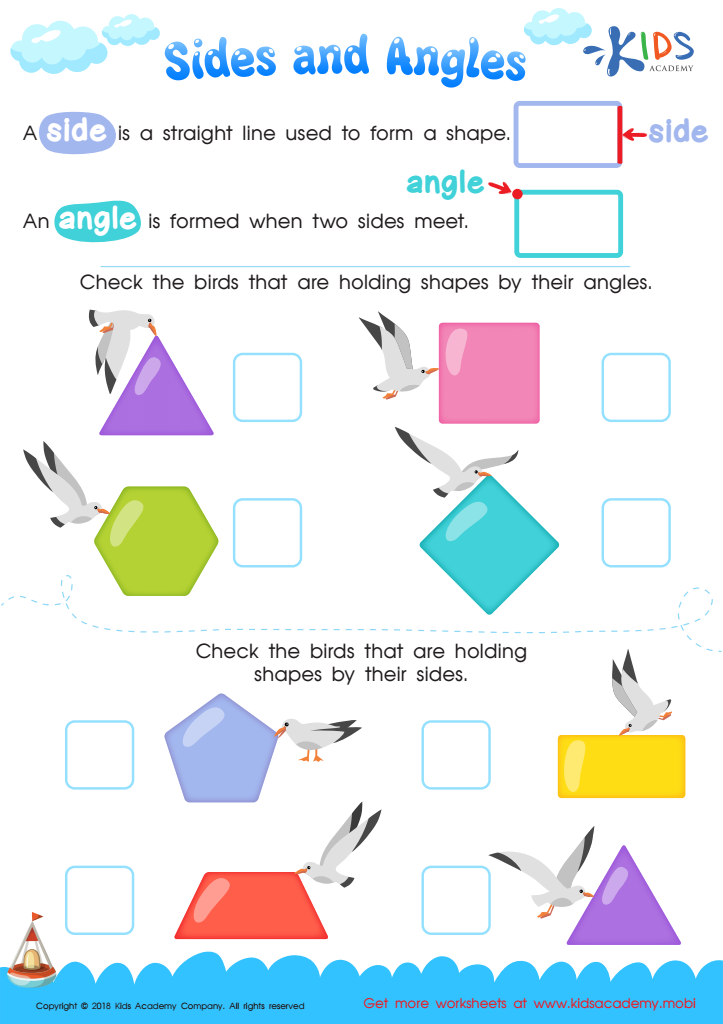
Sides and Angles Worksheet
 Assign to My Students








Identifying shapes is a fundamental skill for children ages 6-7 that lays the groundwork for their mathematical and spatial understanding. Parents and teachers should care about this aspect of early education for several reasons.
Firstly, shape recognition develops critical thinking and observational skills. When children learn to identify and differentiate between shapes, they enhance their ability to classify objects and think analytically about the world around them.
Secondly, shape identification plays a vital role in early geometry, which is essential for later mathematical concepts. Understanding shapes helps children grasp ideas like symmetry, patterns, and area, forming the basis for more complex math skills.
Additionally, recognizing shapes is linked to language development. Describing shapes and their attributes expands vocabulary and improves communication skills, allowing children to articulate their thoughts better.
Furthermore, engaging activities that involve shapes can promote fine motor skills. Activities like drawing, tracing, or creating shapes with physical objects strengthen hand-eye coordination and dexterity.
Finally, teaching shape recognition fosters confidence and encourages a love for learning. When children can successfully identify and work with shapes, they gain a sense of accomplishment that motivates them to tackle more complex concepts in the future. In essence, understanding shapes contributes to children’s overall cognitive development and prepares them for academic success.








