Solve word problems Worksheets for Ages 6-7
3 filtered results
-
From - To
Discover our engaging "Solve Word Problems Worksheets" designed specifically for children ages 6-7. These worksheets help young learners develop critical thinking skills by tackling real-life scenarios through math. Perfect for reinforcing concepts related to addition, subtraction, and basic problem-solving, our resources encourage kids to read, analyze, and solve word problems confidently. Each worksheet is visually appealing, making learning fun and exciting! By practicing these exercises, children strengthen their numeric skills while becoming more proficient in understanding language in a mathematical context. Empower your child’s education today with our collection of printable worksheets that transform learning into an enjoyable adventure!
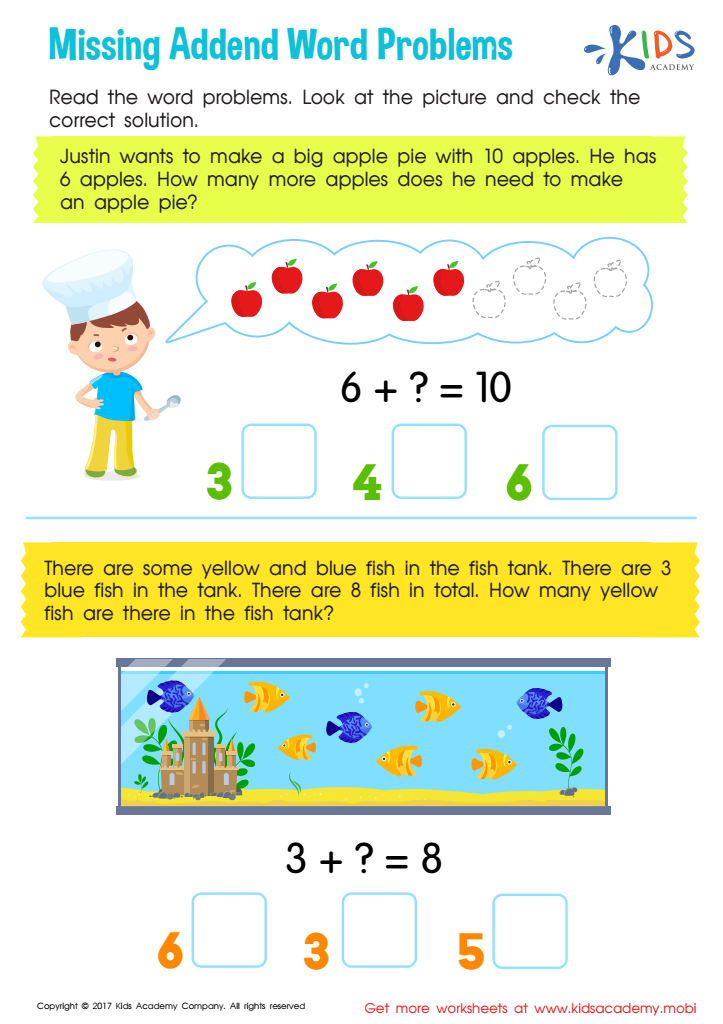
Missing Addend Word Problems Worksheet
 Assign to My Students






Parents and teachers should prioritize helping children solve word problems at ages 6-7 because this skill is crucial for their overall mathematical development and critical thinking. At this early stage, children are learning not just how to perform mathematical operations but also how to apply these concepts in real-world situations. Word problems encourage them to extract relevant information, interpret context, and translate language into mathematical equations, promoting comprehension and reasoning skills.
Additionally, engaging with word problems fosters creativity as children learn to think outside the box and explore various methods to reach a solution. This early exposure prepares them for more complex mathematics in the future, developing a strong foundation for subjects like algebra and geometry. It also builds confidence; as children become adept at solving these problems, they feel more capable and motivated in their overall academic pursuits.
Moreover, collaborating on word problems can enhance the communication skills of children. They practice articulating their thought processes and hearing different perspectives, further developing their social and interpersonal abilities. Thus, focusing on word problems not only boosts mathematical skills but also supports cognitive growth, communication, and a love for learning, making it a crucial focus for both parents and educators.








