Understanding ordinal numbers Worksheets for Ages 6-7
3 filtered results
-
From - To
Explore our engaging "Understanding Ordinal Numbers Worksheets" designed for children aged 6-7. These interactive resources help young learners grasp the concept of ordinal numbers, which describe position or order, essential for developing their mathematical literacy. With vibrant visuals and age-appropriate activities, children will love practicing their skills in identifying first, second, third, and beyond. Our worksheets promote critical thinking, enhance number recognition, and support foundational math concepts. Perfect for classroom use or at-home learning, these worksheets offer fun and effective ways to grow your child's understanding of ordinal numbers, setting them up for future success in math!
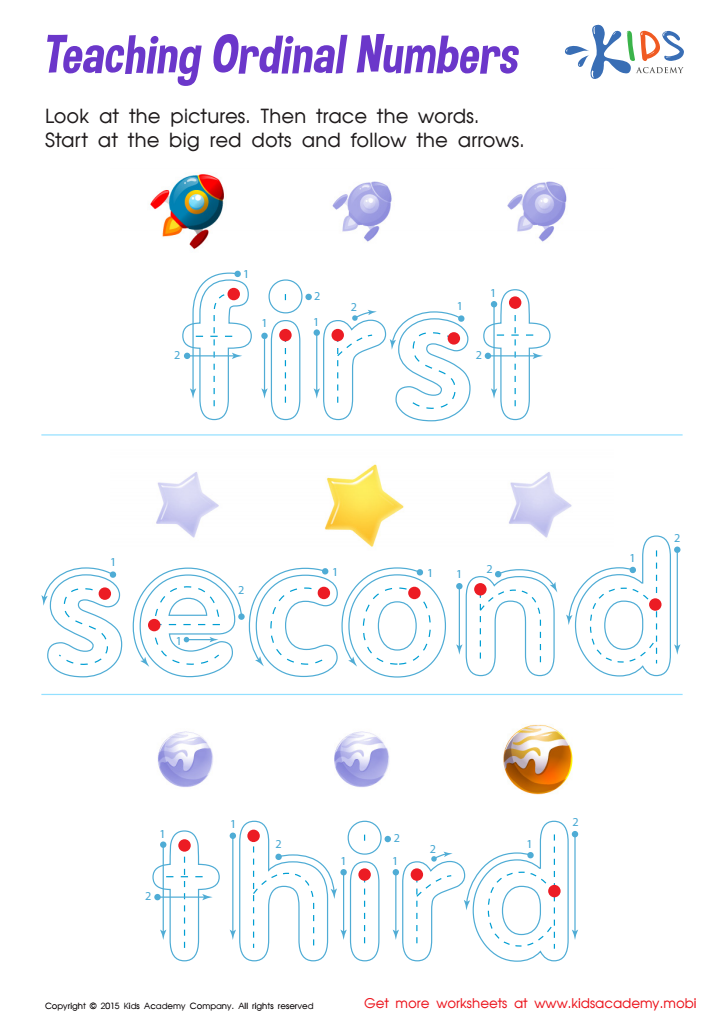
Ordinal Numbers: Teaching Ordinal Numbers Printable
 Assign to My Students
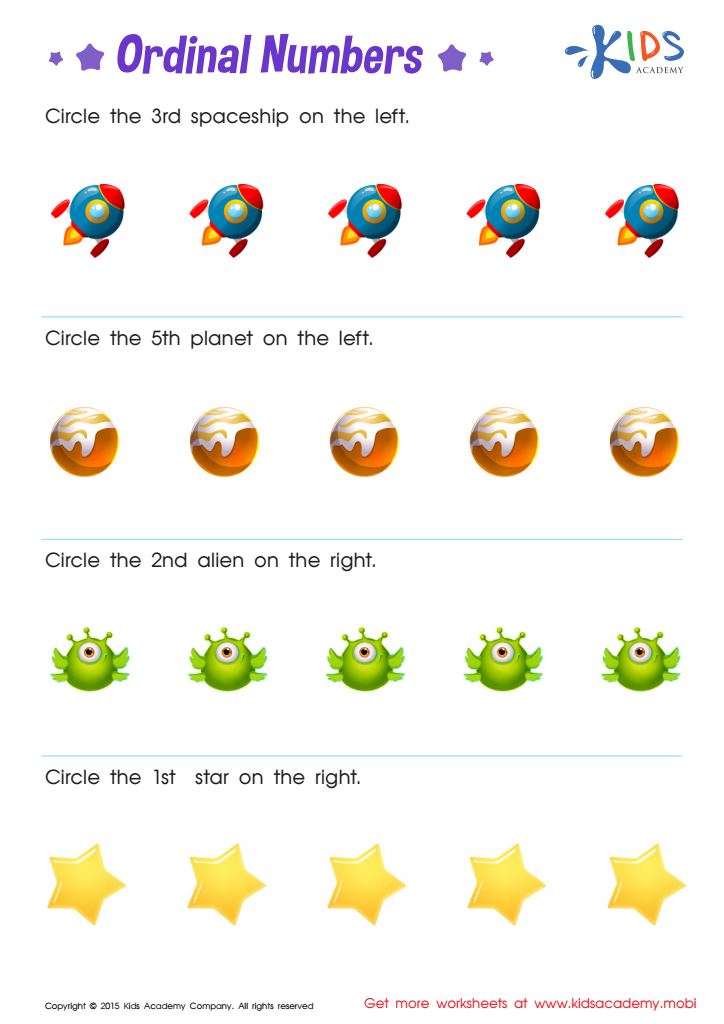
Ordinal Numbers: Space Ordinals Worksheet





.jpg)

Understanding ordinal numbers is crucial for children aged 6-7, and here are several reasons why parents and teachers should care about this concept. Firstly, ordinal numbers, such as first, second, and third, help children organize information in a meaningful way. This skill is essential for everyday situations, such as following instructions and participating in activities like sports and games, where positions and rankings matter.
Secondly, mastering ordinal numbers enhances a child's mathematical foundation. This foundation supports more complex concepts later in their education, such as fractions and sequences, thus making their overall learning journey smoother and more engaging.
Moreover, recognizing positions in a sequence fosters critical thinking and logical reasoning skills. Children begin to understand hierarchies and relationships between objects and events, which is invaluable in subjects beyond math, like reading and science.
Finally, acquiring an understanding of ordinal numbers boosts language development. It equips children with the vocabulary needed to express order and rank effectively, improving their communication skills.
In conclusion, ordinal numbers are not merely a mathematical concept; they enrich cognitive, social, and language skills, making them an important focus for both parents and teachers in the early education of children.








