
Observational skills Addition & Subtraction Worksheets for Ages 6-7
3 filtered results
Difficulty Level
Grade
Age
-
From - To
Subject
Activity
Standards
Enhance your child's mathematical journey with our “Observational Skills Addition & Subtraction Worksheets” designed for ages 6-7! These engaging worksheets focus on developing essential observational skills while practicing addition and subtraction. Children will learn to identify patterns, compare quantities, and analyze visual information, creating a solid foundation for future math concepts. Our worksheets foster critical thinking and attention to detail in a fun and interactive way, sparking a love for learning. Ideal for homeschooling or classroom use, these resources align with early learning standards and make math a delightful exploration. Download now and watch your child thrive in their math abilities!
Favorites
With answer key
Interactive
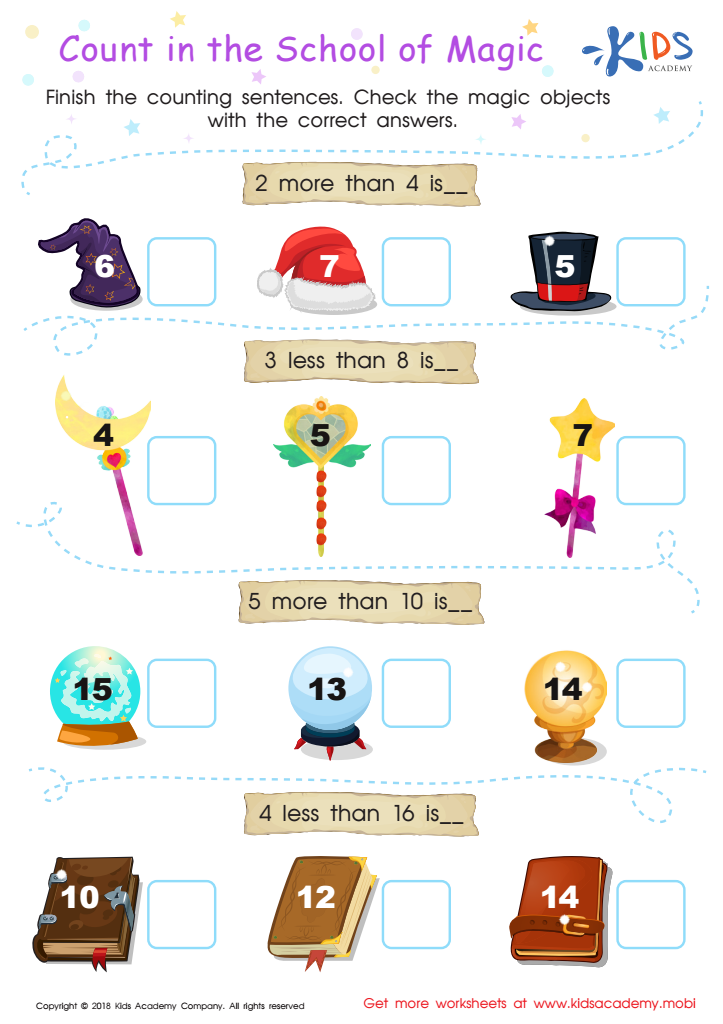
Count in the School of Magic Worksheet
Your math learners can explore the School of Magic with this worksheet. They'll read equations with addition and subtraction numbers under 20, count back and forth to find the answer, then complete the counting sentences. Fun pictures and easy accuracy make it an enjoyable and successful learning experience.
 Assign to My Students
Count in the School of Magic Worksheet
Worksheet
Join Kids Academy for Free
Who is primarily going to use this learning content?








Observational skills in mathematics, particularly with addition and subtraction, are crucial for children ages 6-7 as they lay the foundation for their overall mathematical understanding. At this age, children are just beginning to grasp basic arithmetic concepts, and the ability to observe patterns, relationships, and quantities is essential. This skill helps them visualize numerical concepts and enhances their problem-solving abilities.
For parents and teachers, fostering these observational skills means encouraging students to analyze various mathematical situations. For instance, by observing real-world scenarios, such as sharing snacks or playing games, children can apply addition and subtraction in meaningful contexts. This makes learning relevant and engaging, fostering a deeper understanding of numbers.
Additionally, developing strong observational skills encourages critical thinking, allowing children to approach math problems with confidence. It helps them notice when they’ve made errors and empowers them to seek solutions independently.
Investing time and energy into enhancing these skills will benefit children in their academic journeys, promoting a positive attitude toward mathematics and better preparation for advanced concepts later on. Ultimately, strong observational skills in early math translate to lifelong benefits in critical thinking and analytical reasoning across all subjects.








