Recognizing equivalent fractions Addition & Subtraction Worksheets for Ages 6-7
5 filtered results
-
From - To
Discover our engaging "Recognizing Equivalent Fractions Addition & Subtraction Worksheets," designed specifically for children aged 6-7. These worksheets provide an interactive way for young learners to grasp the concept of equivalent fractions through fun exercises. By combining addition and subtraction activities, kids will solidify their understanding of fractions while enhancing their math skills. Our colorful, child-friendly formats make learning enjoyable and effective. Perfect for home or classroom use, these worksheets aim to cultivate confidence and proficiency in mathematics, ensuring children build a strong foundation in this essential topic. Start their math journey today with our thoughtfully crafted resources!
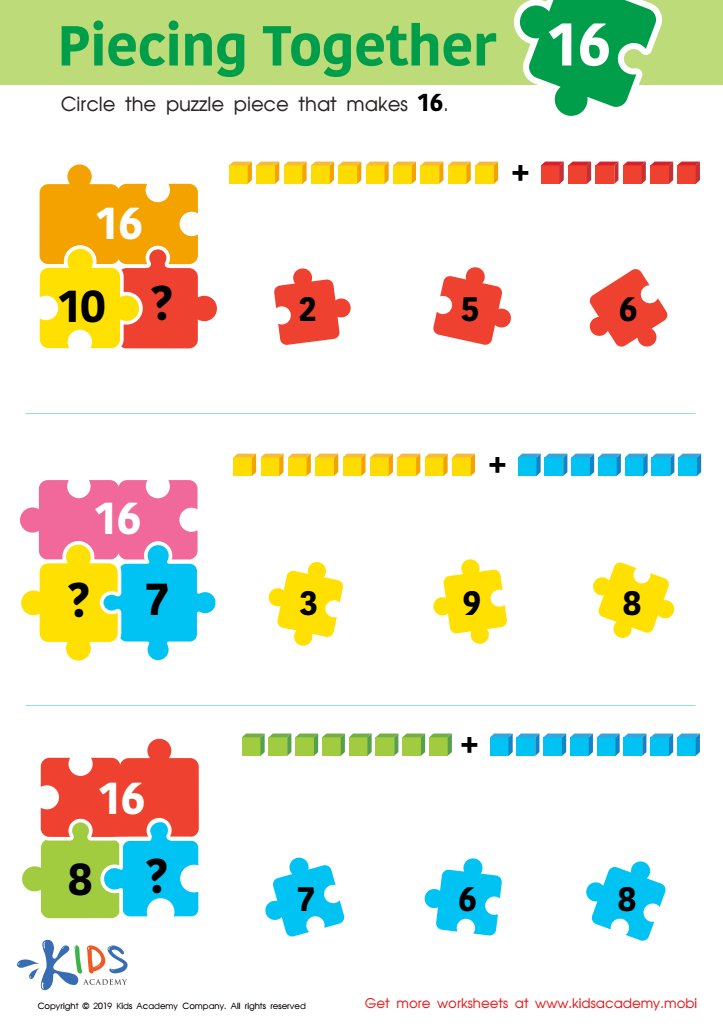
Piecing Together 16 Worksheet
 Assign to My Students








Recognizing equivalent fractions is crucial for children aged 6-7 because it lays the foundation for their understanding of fractions, a key concept in mathematics. As students learn to identify and create equivalent fractions, they develop a more profound comprehension of how numbers relate to one another, particularly in addition and subtraction scenarios.
Understanding equivalent fractions allows children to simplify problems. For instance, recognizing that 1/2 is equivalent to 2/4 helps them add or subtract fractions easily by finding a common denominator. This skill not only enhances arithmetic proficiency but also builds crucial critical-thinking skills as students learn to recognize patterns and make connections in mathematics.
Moreover, mastering equivalent fractions boosts a child’s confidence in tackling various mathematical operations. Parents and teachers should prioritize this concept since proficient fraction skills often pave the way for future math success, allowing children to progress smoothly to more complex concepts in higher grades, like finding percentages or working with ratios. By fostering a solid understanding of equivalent fractions early, caregivers and educators empower students to engage more effectively in math, promoting a positive learning experience that resonates beyond the classroom.








