
Number Sequencing Addition Worksheets for Ages 6-7
10 filtered results
Difficulty Level
Grade
Age
-
From - To
Subject
Activity
Standards
Boost your child's arithmetic skills with our Number Sequencing Addition Worksheets for ages 6-7. Carefully designed to reinforce early math comprehension, these worksheets focus on number sequencing and basic addition. Through engaging, age-appropriate exercises, children will learn to identify number patterns and practice addition in a fun, interactive manner. Perfect for classroom activities or homework, our printables help develop critical thinking and problem-solving abilities, setting a solid foundation for future math success. Make learning enjoyable and effective with Kids Academy's expertly crafted resources.
Favorites
With answer key
Interactive
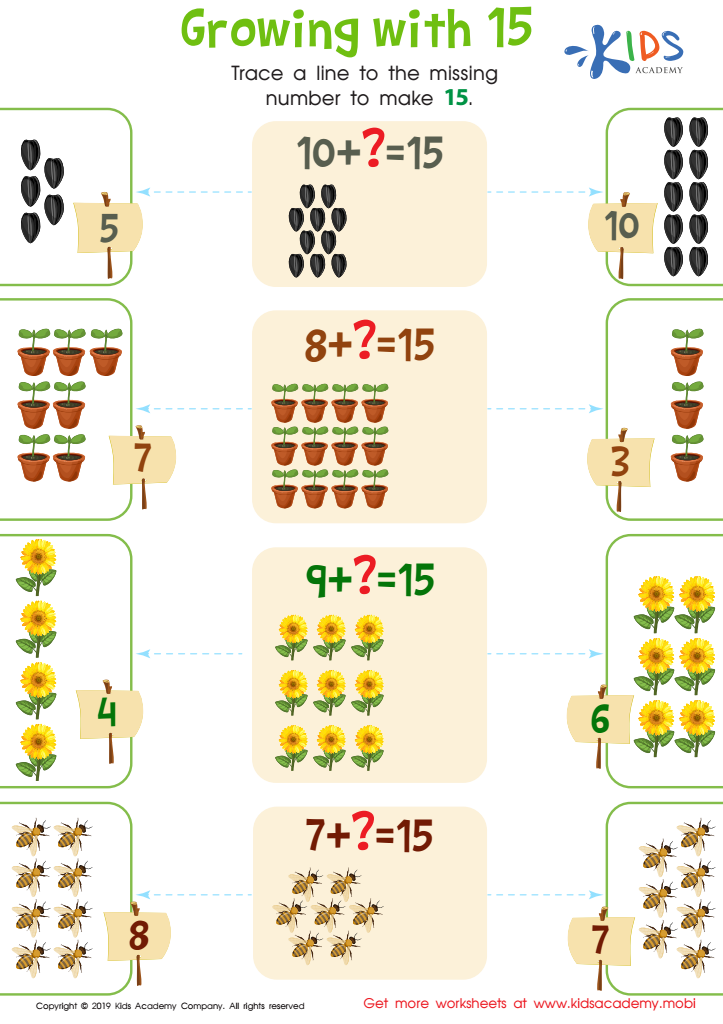
Growing with 15 Worksheet
Remind your kids that adding different sets of numbers can give the same total (e.g. 2+3=5, 4+1=5). Test their understanding by asking them for more examples. Move onto the worksheet: count objects, then trace the line to the number making a total of 15.
 Assign to My Students
Growing with 15 Worksheet
Worksheet
Join Kids Academy for Free
Who is primarily going to use this learning content?








Number sequencing and addition are foundational concepts that significantly impact a child's mathematical development, especially between the ages of 6-7. At this age, children are transitioning from concrete to more abstract forms of thinking and are building the essential skills needed for their future education. Training in number sequencing helps in understanding the order of numbers, improving counting skills, and recognizing patterns, which are crucial for all higher-level math operations.
Additionally, early proficiency in number sequencing aids in developing problem-solving and logical thinking skills. When number sequencing is combined with basic addition exercises, it provides a dual benefit. Children learn to understand not only the sequence but also the practical application of adding numbers in that sequence, which enhances their mental math abilities.
Teachers and parents should care about number sequencing and addition for these reasons: 1. Foundational Knowledge: Mastery of these concepts is essential for later mathematical topics such as subtraction, multiplication, and division. 2. Boosts Confidence: Success in these basic skills promotes self-confidence in overall academic performance. 3. Cognitive Development: It fosters crucial cognitive skills including memory, problem-solving, and analytical thinking.
Therefore, engaging children in fun and educational activities related to number sequencing and addition sets them up for future academic success and a positive attitude towards math.








