Practice addition Addition Worksheets for Ages 6-7
5 filtered results
-
From - To
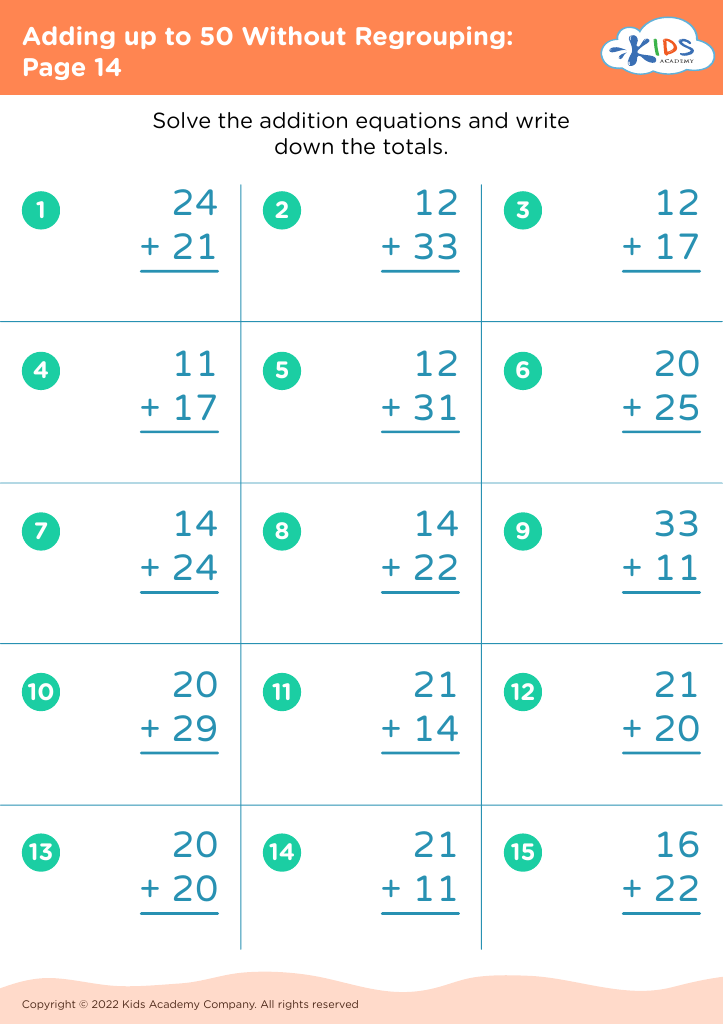
Unlock your child's mathematical potential with our engaging Practice Addition Worksheets, specially designed for kids ages 6-7! Perfect for first graders, these worksheets foster a solid foundation in basic arithmetic. Tailored to stimulate young minds, they focus on enhancing addition skills through fun and interactive problems, ensuring learning stays exciting. Your child will build confidence and proficiency in math as they tackle everything from simple sums to more challenging problems. Our worksheets encourage independent practice and critical thinking, setting the stage for future academic success. Join us on a journey to make math learning enjoyable and effective!
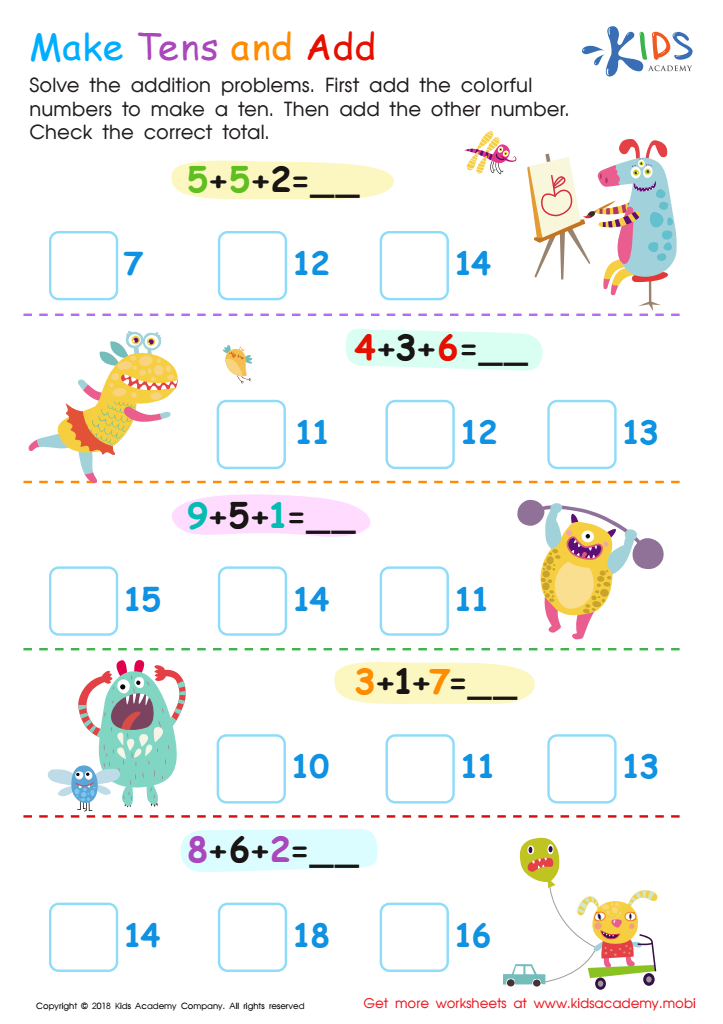
Make Tens and Add Worksheet
 Assign to My Students




.jpg)



Practicing addition for ages 6-7 is crucial for several reasons, and both parents and teachers should prioritize it. During these early years, children's brains are highly adaptable and primed for learning foundational skills. Mastering basic addition sets the stage for future mathematical learning, including more complex arithmetic and higher-level problem-solving skills.
First, addition is integral to everyday tasks and helps in developing logical thinking and reasoning. By practicing addition, children learn to establish connections and recognize patterns, which are essential cognitive skills. Additionally, a strong grasp of addition enhances self-confidence in math, leading to a more positive attitude towards learning in general.
Second, incorporating addition practice helps to solidify the concept of numbers and their relationships. When children repeatedly practice addition problems, they gain hands-on experience with counting, combining quantities, and understanding the properties of operations. This builds a solid numerical foundation that will benefit them throughout their academic and everyday lives.
Finally, ongoing practice promotes the development of automaticity — the ability to perform calculations quickly and accurately without conscious thought. When basic arithmetic becomes second nature, cognitive resources are freed up to focus on solving more complex problems and learning new concepts.
In conclusion, emphasizing addition practice in early education equips children with essential skills, fosters confidence, and lays a robust groundwork for future academic success.








