
Understanding fact families Addition Worksheets for Ages 6-7
4 filtered results
Difficulty Level
Grade
Age
-
From - To
Subject
Activity
Standards
Explore our "Understanding Fact Families Addition Worksheets for Ages 6-7" to boost your child's math skills! Designed for young learners, these engaging worksheets introduce the concept of fact families, helping kids grasp the relationships between addition and subtraction. With fun exercises and interactive problems, children will learn to identify and create fact families, enhancing their number sense and arithmetic fluency. Perfect for first graders, these printable worksheets make math practice enjoyable and effective. Unlock your child's potential in mathematics and set a strong foundation for their future learning with our expertly crafted materials!
Favorites
With answer key
Interactive
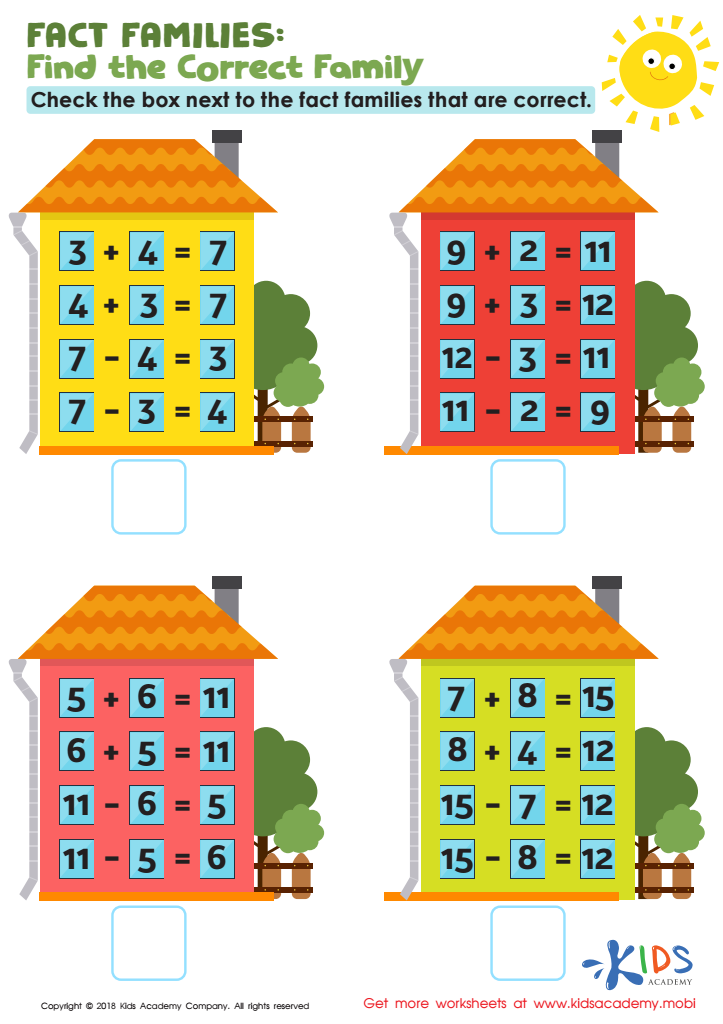
Fact Families: Find Correct Family Worksheet
Test your students' math and reasoning skills with this worksheet. It features 4 houses, each with a group of fact families on it. Some are correct, some are wrong - help students identify which are correct and circle the box next to them. This will help them progress in school.
 Assign to My Students
Fact Families: Find Correct Family Worksheet
Worksheet
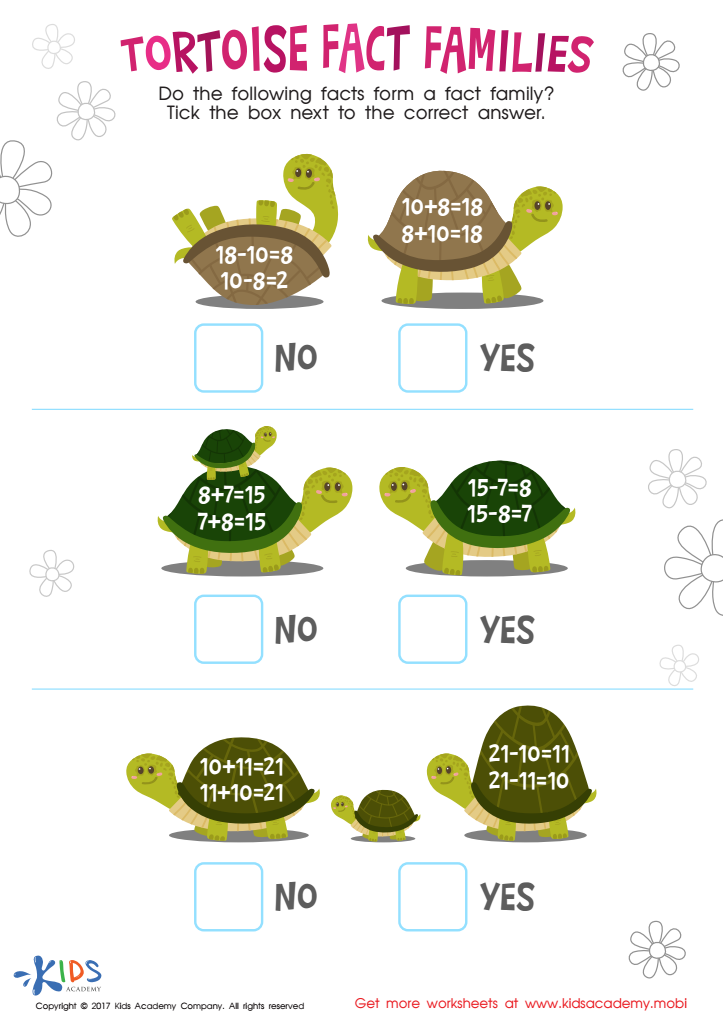
Tortoise Fact Families Printable
With 1st grade add & subtract tortoises, kids can improve their math understanding and skills. Enjoy fun, hands-on practice with fact families and strengthen logical reasoning and critical thinking!
Tortoise Fact Families Printable
Worksheet
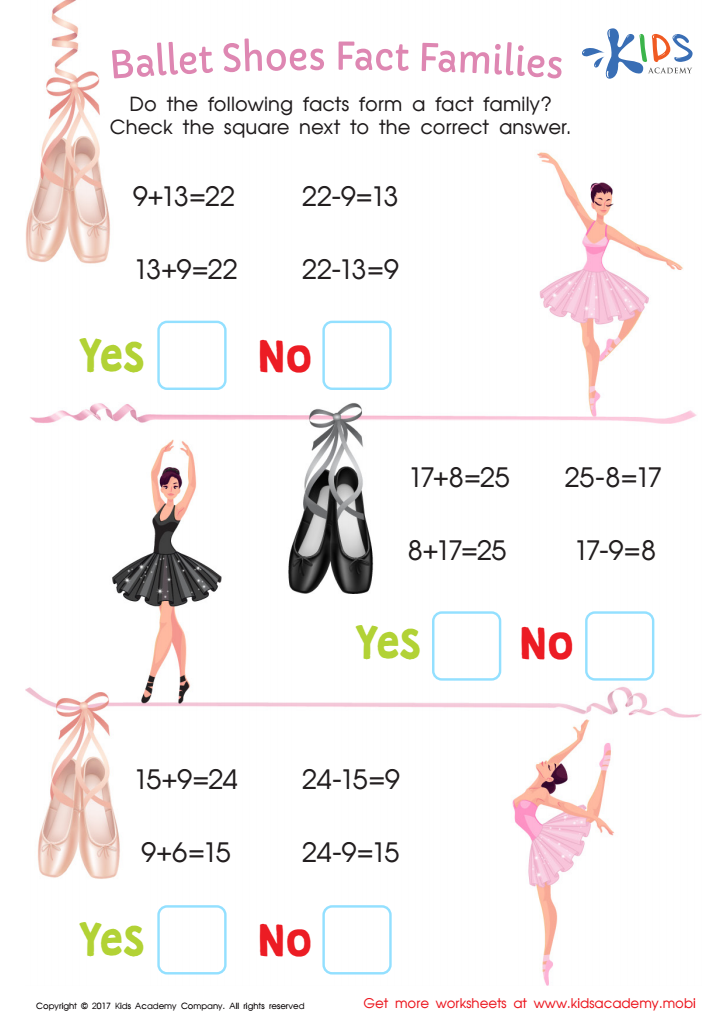
Ballet Shoes Fact Family Printable
Have them observe the equations and determine which groupings are fact families for a delightful learning experience. It encourages critical thinking, showing how addition and subtraction are related.
Ballet Shoes Fact Family Printable
Worksheet
Join Kids Academy for Free
Who is primarily going to use this learning content?








Understanding fact families in addition is crucial for young learners, and teachers and parents should prioritize this concept for several reasons. For children ages 6-7, building a strong foundation in basic arithmetic sets the stage for future mathematical success. Fact families teach children the relationships between numbers and operations, illustrating how numbers can combine and recombine in different ways. Understanding that 3 + 4 = 7, 4 + 3 = 7, 7 - 3 = 4, and 7 - 4 = 3 demonstrates the inverse relationship between addition and subtraction, solidifying their comprehension of basic math principles.
When children grasp these relationships early on, they develop flexibility in thinking and problem-solving skills. This flexibility allows for more effortless recall of math facts, reducing reliance on memorization and fostering deeper understanding. Additionally, recognizing fact families helps children build confidence in their math abilities, transforming a subject that can often feel daunting into one that is manageable and even enjoyable.
Parents and teachers play a critical role by incorporating games, activities, and real-life examples that highlight these addition relationships, making learning interactive and relevant. By prioritizing the understanding of fact families, parents and teachers lay a strong, confident foundation in mathematics for their children, paving the way for more complex math learning in the future.








