
Improving mathematical skills Math Worksheets for Ages 6-7
5 filtered results
Difficulty Level
Grade
Age
-
From - To
Subject
Activity
Standards
Enhance your child's mathematical skills with our engaging Math Worksheets for ages 6-7! Designed to support young learners, these worksheets encompass a variety of essential math concepts, including addition, subtraction, shapes, and simple word problems. Each activity fosters critical thinking and problem-solving abilities while making learning fun. Perfect for classroom use or at-home practice, our materials are curated by educators to align with developmental milestones. Watch your child's confidence soar as they practice independently. Discover the joy of learning math with our extensive collection of interactive worksheets that cater to different learning styles and preferences. Start boosting mathematical skills today!
Favorites
With answer key
Interactive
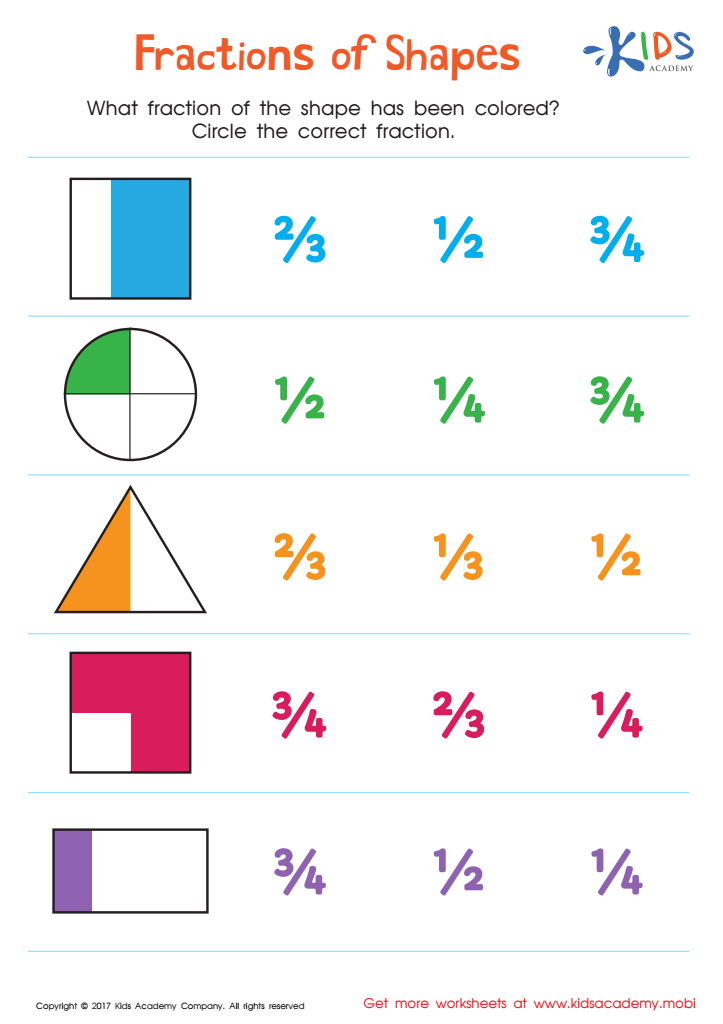
Fractions of Shapes: Math Concept Worksheet
Fractions can be tricky, but with pictures to illustrate them, they become much easier to understand. Our fractions of shapes worksheet is a great way to help children visualize fractions and gain a better understanding of them.
 Assign to My Students
Fractions of Shapes: Math Concept Worksheet
Worksheet
Join Kids Academy for Free
Who is primarily going to use this learning content?








Improving mathematical skills for ages 6-7 is crucial for several reasons. At this developmental stage, children are building foundational knowledge that will support their overall academic success. Math at this age is not just about numbers—it helps in developing critical thinking, problem-solving abilities, and analytical skills. These cognitive skills are essential for understanding more complex concepts as students progress in their education.
In addition, strong mathematical skills enhance a child's confidence and help foster a positive attitude towards learning. When children grasp basic math concepts like addition and subtraction, they feel a sense of achievement that motivates them to tackle new challenges. Furthermore, math skills are vital in daily life—parents and teachers can use this opportunity to teach practical applications, such as measuring ingredients in cooking or managing money in shopping scenarios.
Encouraging a love for math at an early age can also reduce math anxiety later on, ensuring that students do not shy away from advanced mathematics in higher grades. By focusing on foundational math skills, parents and teachers not only promote academic readiness but also equip children with lifelong skills that will serve them well both in school and beyond.








