
Learning subtraction Math Worksheets for Ages 6-7
3 filtered results
Difficulty Level
Grade
Age
-
From - To
Subject
Activity
Standards
Enhance your child’s math skills with our engaging Learning Subtraction Math Worksheets designed for ages 6-7. These worksheets streamline subtraction concepts through fun and colorful exercises, transforming learning into an enjoyable experience. Each worksheet builds foundational skills, catering to young learners with various subtraction strategies. With kid-friendly designs, they’re perfect for both classroom and home learning. Monitor progress, and watch as abstract numbers become concrete concepts in your child's mind. Give your little one the confidence to tackle subtraction problems effortlessly and develop a strong mathematical foundation. Start today with our thoughtfully crafted materials that make subtraction exciting and accessible!
Favorites
With answer key
Interactive
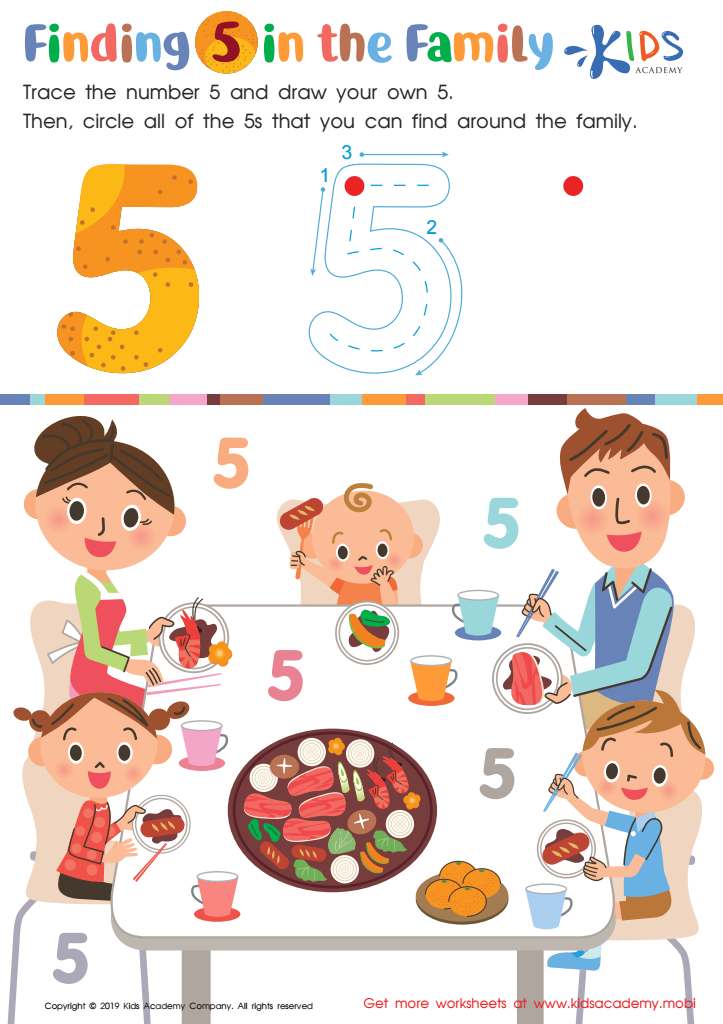
Finding 5 in the Family Worksheet
This worksheet helps kids identify and write the number 5. Ask what the family is doing and who the family members are. Help them trace and draw the 5, then have them circle all 5s in the picture.
 Assign to My Students
Finding 5 in the Family Worksheet
Worksheet
Join Kids Academy for Free
Who is primarily going to use this learning content?








Learning subtraction is crucial for young children, ages 6-7, as it forms the foundation of their future mathematical understanding. At this age, children are developing their cognitive skills rapidly, and subtraction helps cultivate critical thinking and problem-solving abilities. By mastering subtraction, children learn to comprehend the concept of 'taking away,' helping them understand numerical relationships more deeply.
For parents and teachers, ensuring that children grasp subtraction is essential because it builds confidence in handling numbers, which is critical in everyday life—whether it’s making change in a transaction, or sharing items fairly among friends. More importantly, subtraction skills are pivotal for progressing to more complex mathematical concepts, such as multiplication, division, algebra, and higher-order mathematical reasoning.
Engaging with subtraction at an early stage also helps children cultivate perseverance and patience, as they practice and refine their skills through repetitive learning and practice. Parents and teachers play a vital role in providing support and enthusiasm around this learning process, using hands-on activities, games, and real-life examples to make subtraction more relatable and enjoyable.
Ultimately, solid subtraction skills enhance academic performance and curiosity in exploring further mathematical concepts, equipping children with valuable life skills and a positive attitude towards learning and problem-solving.








