Number Sequencing Skip Counting Worksheets for Ages 6-7
3 filtered results
-
From - To
Explore our engaging Number Sequencing Skip Counting Worksheets designed specifically for children ages 6-7! These interactive worksheets help young learners enhance their counting skills while developing a strong foundation in mathematics. Skip counting, a vital essential skill, assists students in recognizing patterns and understanding number sequences, making math fun and approachable. Our worksheets are colorful, age-appropriate, and include a variety of activities to keep kids motivated and eager to learn. Perfect for both classroom and home learning settings, these resources boost confidence and proficiency in number sequencing. Dive into the world of skip counting and watch your child excel in math!
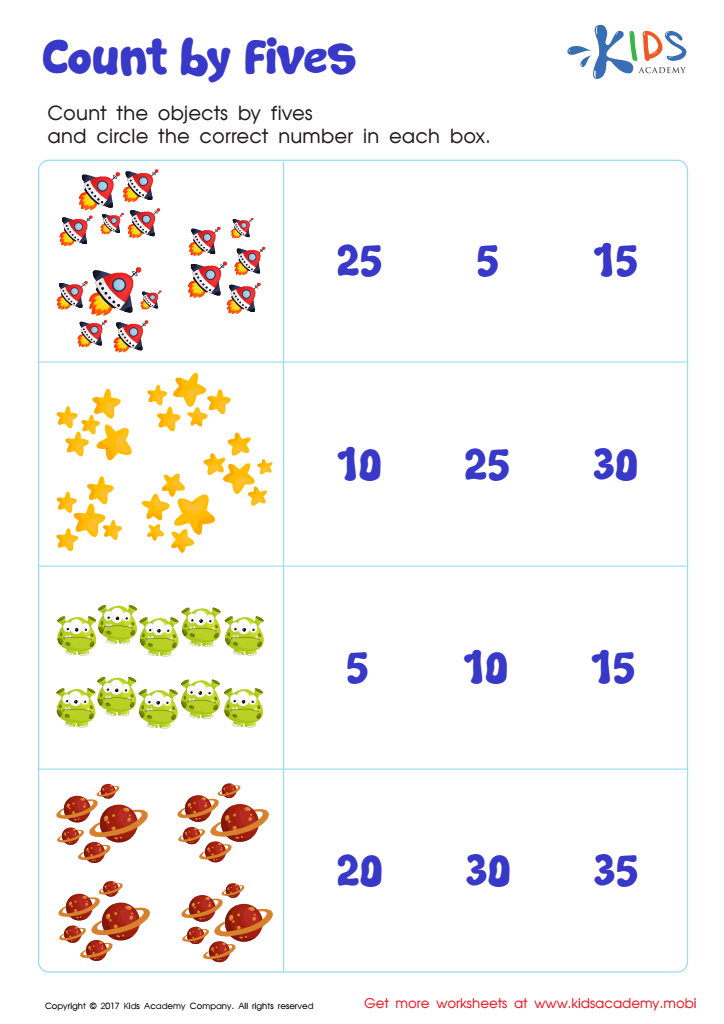
Skip Counting by 5s: Space Math Printable
 Assign to My Students
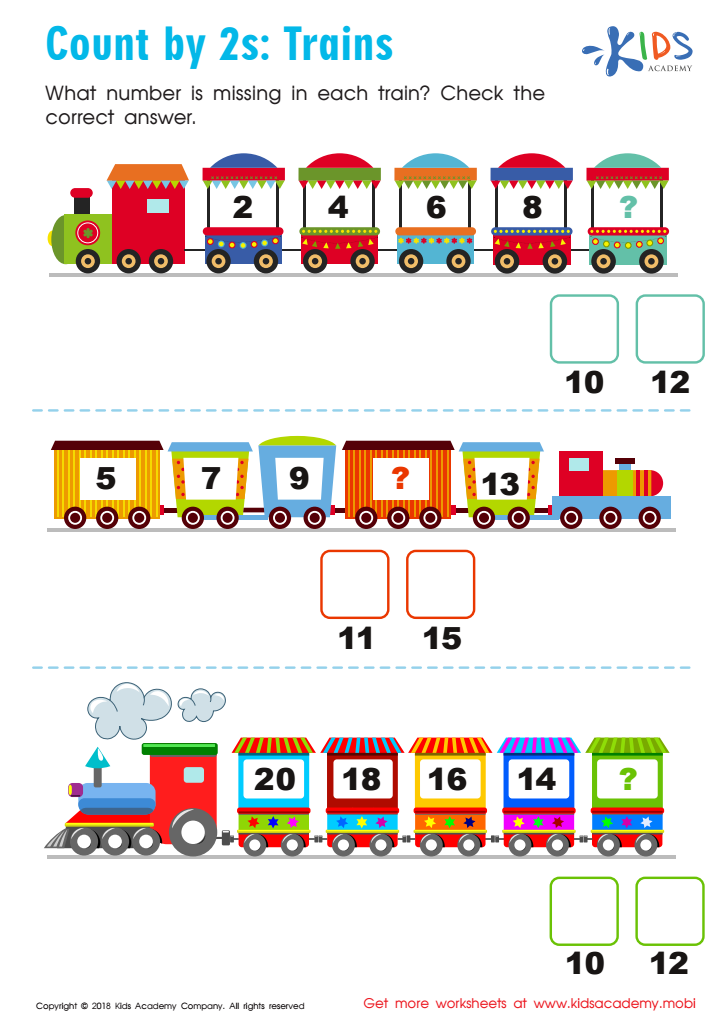
Count by 2's: Trains Worksheet
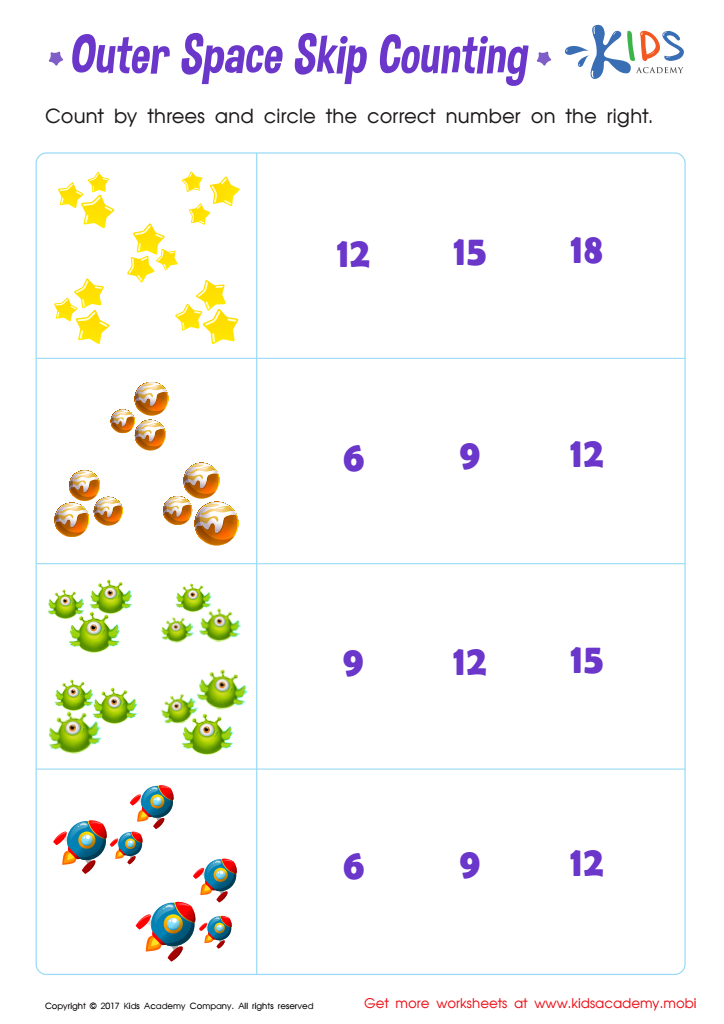
Skip Counting by 3s: Outer Space Skip Counting Printable








Number sequencing and skip counting are fundamental skills that significantly impact a child's mathematical development—even starting at ages 6-7. Understanding these concepts fosters a child's ability to recognize patterns and relationships among numbers, which are essential for more complex mathematical operations.
Skip counting, whether by twos, fives, or tens, enhances a child’s confidence in numerical manipulation and strengthens their understanding of place value. This skill is foundational for future math concepts, including addition, subtraction, and even multiplication. When children learn to skip count, they not only improve their counting speed but also begin to understand grouping and the concepts of even and odd numbers.
Moreover, these skills contribute to critical thinking and problem-solving abilities. Through skip counting, children can explore various mathematical concepts and strategies, enabling them to approach challenges with creativity and logical reasoning.
For parents and teachers, fostering mastery of number sequencing and skip counting lays the groundwork for a positive mathematical mindset, reducing anxiety towards numbers and encouraging a love for learning. Engaging children in these activities provides them with tools for academic success, instilling lifelong skills that extend beyond the classroom. Thus, understanding and promoting these skills is crucial for their ongoing educational journey.








