
Recognizing Patterns Science Worksheets for Ages 6-7
3 filtered results
Difficulty Level
Grade
Age
-
From - To
Subject
Activity
Standards
Unlock the wonders of science with our "Recognizing Patterns Science Worksheets" for ages 6-7! Designed to captivate young minds, these engaging worksheets help children explore and identify patterns in the world around them. By recognizing patterns, students develop critical thinking and problem-solving skills essential for future scientific inquiry. Perfect for both classroom and home use, our worksheets feature diverse activities that make learning fun and interactive. Boost your child’s confidence and curiosity in science with Kids Academy’s expertly crafted materials! Explore now and lay the foundation for a lifelong love of science.
Favorites
With answer key
Interactive
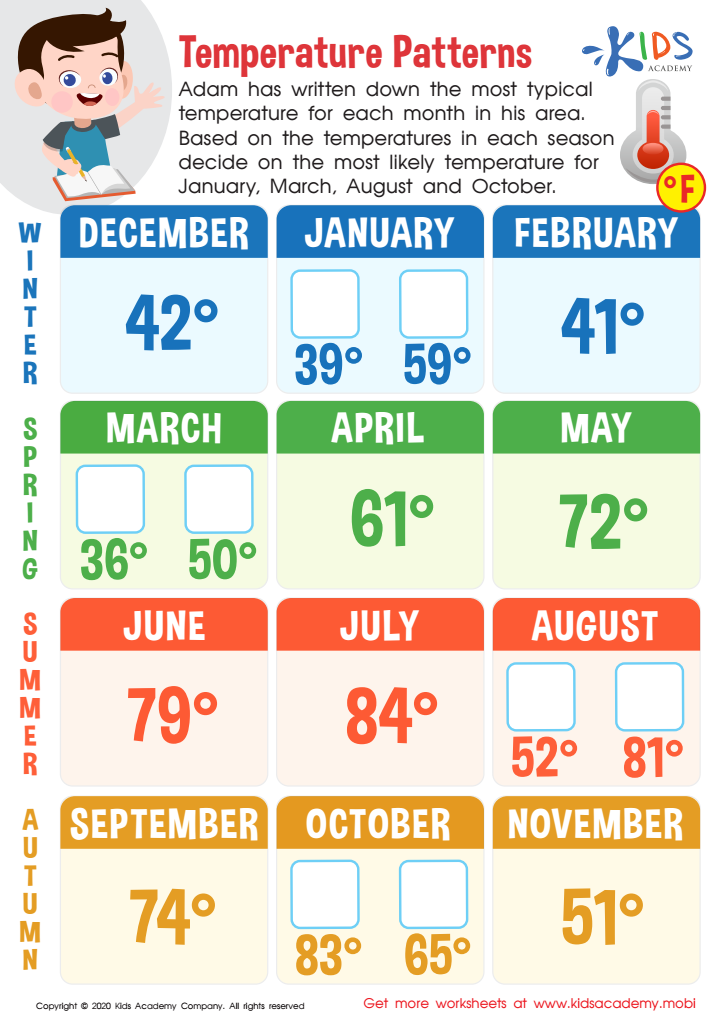
Temperature Patterns Worksheet
Adam has recorded temperatures in his area. Help your child use the data to predict temperatures for one month in each season. Check the box next to the correct temperature for each row in this worksheet. In America, temperatures vary by climate and season - colder in winter, hotter in summer.
 Assign to My Students
Temperature Patterns Worksheet
Worksheet
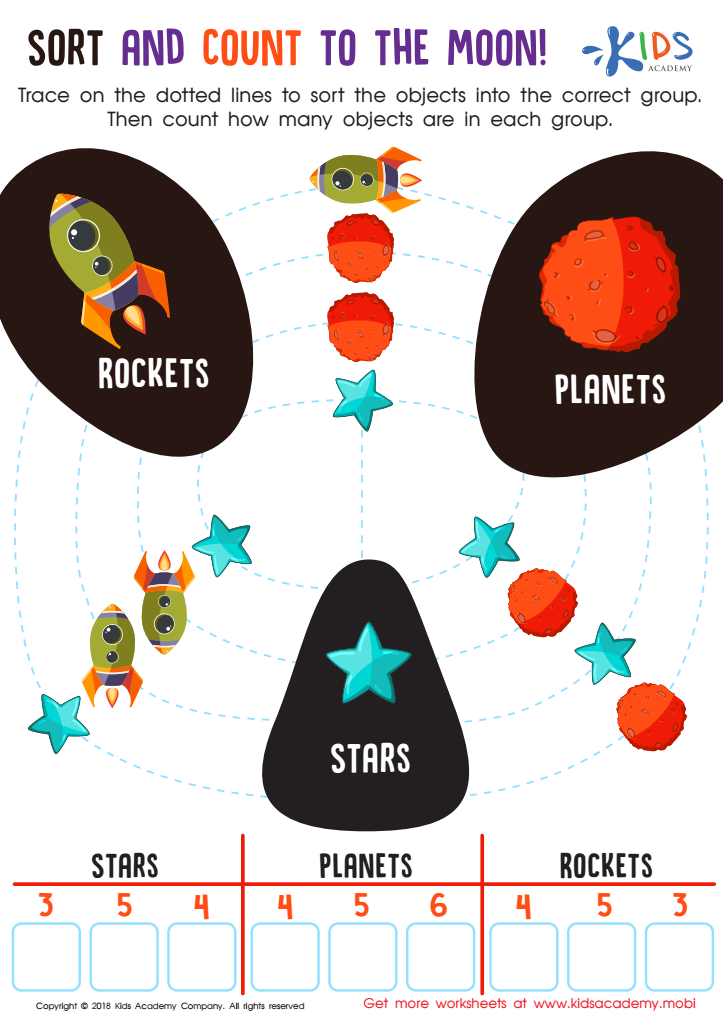
Sort and Count to the Moon Worksheet
Little space explorers will love counting, sorting and strengthening number sense with this galactic worksheet! They'll use traceable lines to sort pictures of stars, planets and rockets into categories according to properties. After sorting, they'll count each item and fill in the boxes. Bold pictures make it fun and build critical thinking skills.
Sort and Count to the Moon Worksheet
Worksheet
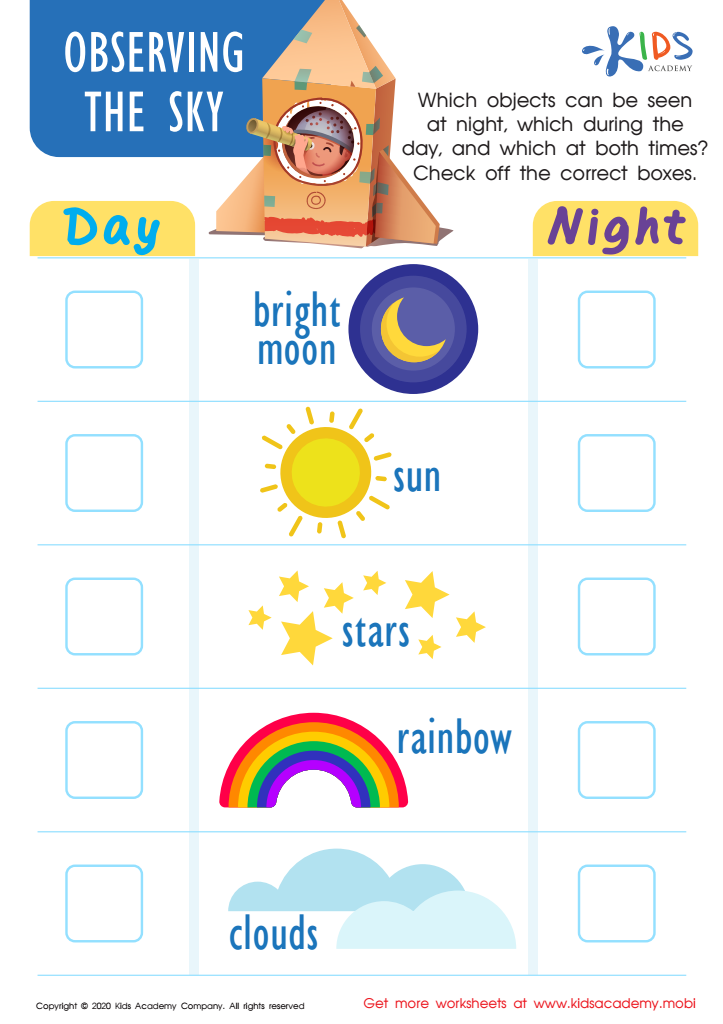
Observing the Sky Worksheet
Look up to the sky and observe day and night objects! See a rainbow or some clouds by day and stars and the moon at night. Help your little learner review this science concept with Kids Academy's fun and colorful worksheet. Have them sort and check off the objects seen by day or night, going down the column in the center.
Observing the Sky Worksheet
Worksheet
Join Kids Academy for Free
Who is primarily going to use this learning content?








Recognizing patterns is a foundational skill in science education, particularly for young children aged 6-7. At this critical stage, children's brains are highly receptive to learning and making connections. Introducing them to patterns helps develop essential cognitive abilities such as logical thinking, problem-solving, and the ability to predict outcomes—all vital for scientific inquiry and everyday problem solving.
Parents and teachers should care because understanding patterns forms the groundwork for more advanced scientific concepts. For instance, recognizing weather patterns early on can later help children understand climate science. Identifying patterns in nature, like the life cycles of plants and animals, lays the basis for biology. Moreover, these skills are not limited to science; pattern recognition is also pivotal in mathematics, language arts, and music.
Encouraging pattern recognition aligns with the natural curiosity children have about the world. It keeps them engaged, making learning a joyful and integrated experience. Activities like sorting objects, predicting sequences, and observing recurring behaviors in nature, foster scientific thinking and ignite curiosity that can last a lifetime. Direct parental and teacher involvement ensures that children receive guidance and encouragement, helping them build self-confidence as budding scientists and problem-solvers. Overall, fostering these skills in early childhood can provide lifelong benefits, supporting academic success and a more profound understanding of the world.







