
Understanding forces Science Worksheets for Ages 6-7
3 filtered results
Difficulty Level
Grade
Age
-
From - To
Subject
Activity
Standards
Explore our "Understanding Forces Science Worksheets" designed for children aged 6-7! These engaging worksheets introduce young learners to fundamental concepts of forces, such as push and pull, gravity, friction, and motion. Each activity promotes critical thinking, encourages hands-on exploration, and fosters a love for science through fun exercises and relatable examples. Perfect for reinforcing classroom learning or for home studies, these worksheets provide exciting opportunities for children to experiment and discover the world around them. Help your child build a solid foundation in science and ignite their curiosity about the forces that shape our everyday lives!
Favorites
With answer key
Interactive
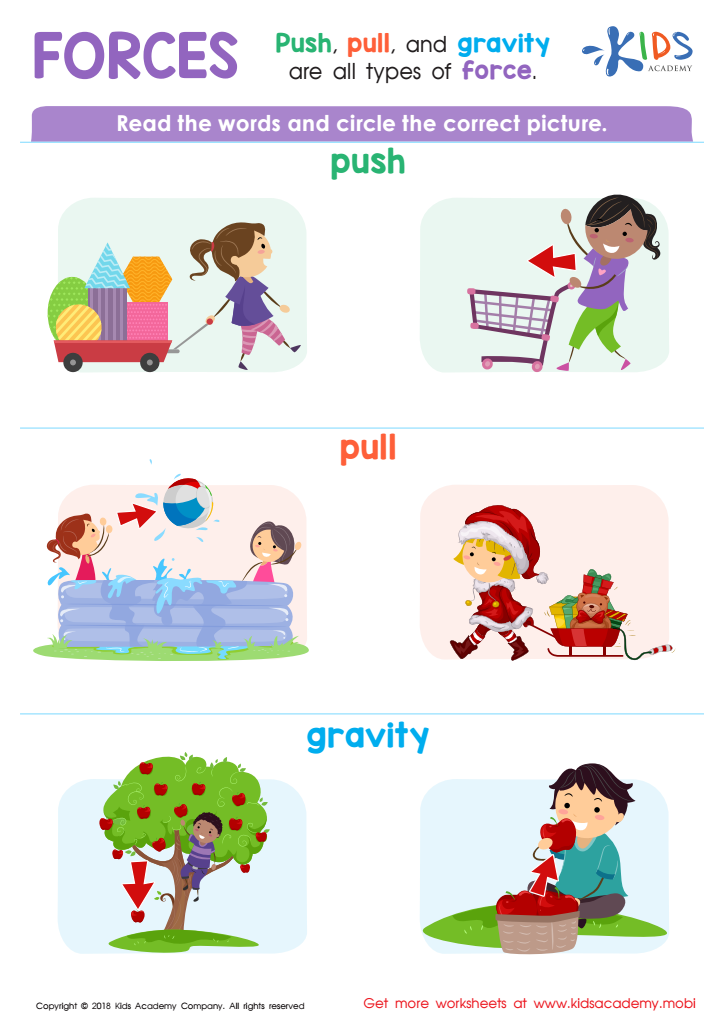
Forces Worksheet
Teach your child about forces! Ask them to identify which of six pictures shows push, pull or gravity. Read the words beside each picture and have them circle the correct one. It's a great way to learn about forces; push, pull and gravity!
 Assign to My Students
Forces Worksheet
Worksheet
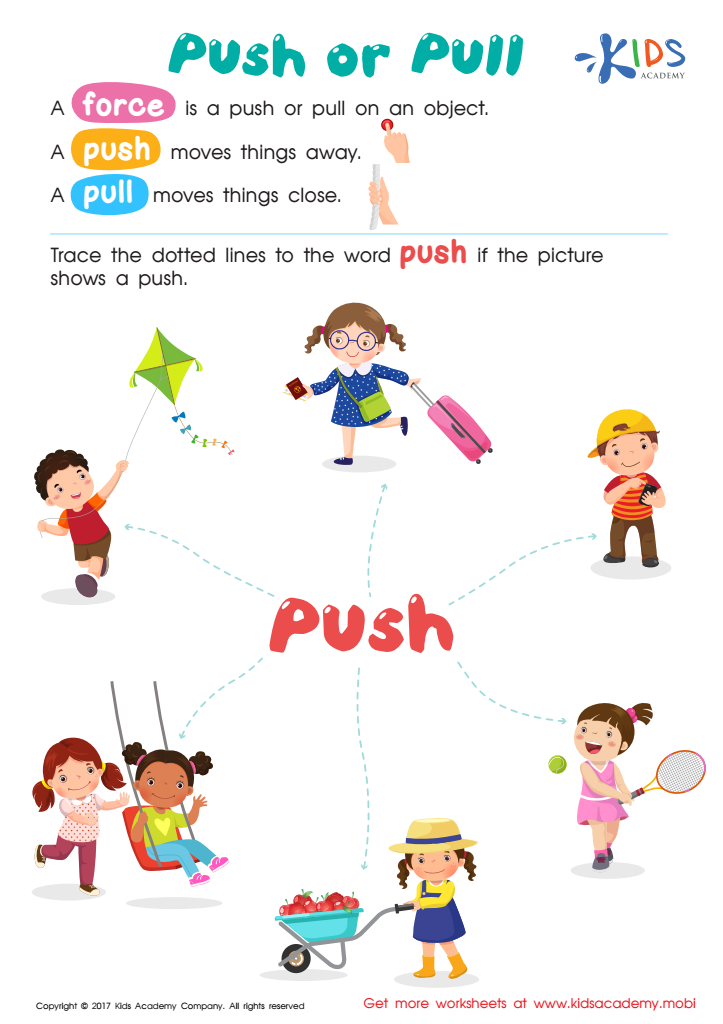
Push or Pull Worksheet
and which involve pulling! With this fun worksheet, your child will learn about force and its simple application in everyday activities. Get them started with Push or Pull! (80 words)
Push or Pull Worksheet
Worksheet
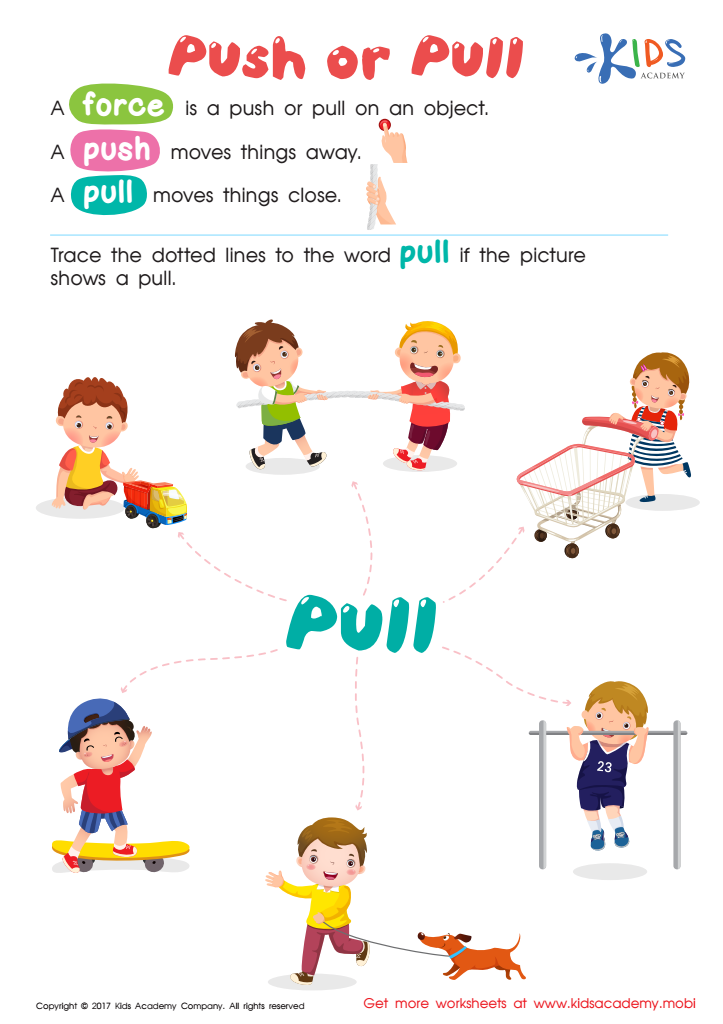
Pull or Push Worksheet
With this fun worksheet, they'll explore physics by sorting objects into categories according to their mode of motion. It's a great way to get them interested in science.
Pull or Push Worksheet
Worksheet
Join Kids Academy for Free
Who is primarily going to use this learning content?







Understanding forces is essential for children aged 6-7 as it lays the groundwork for critical thinking and scientific literacy. At this stage, children are naturally curious about how the world works, making it an ideal time to introduce basic concepts of forces—like pushing, pulling, friction, and gravity. Teaching these concepts not only fosters an interest in science but also encourages problem-solving skills and inquiry-based learning.
When parents and teachers focus on forces, they help children develop observational skills. For instance, when kids push a toy car and observe how far it rolls, they begin to connect actions with outcomes, a fundamental part of scientific thinking. Additionally, grasping forces helps children understand everyday phenomena, promoting a sense of agency and comprehension of their environment.
Incorporating interactive activities, such as simple experiments with balls, ramps, and different surfaces, can make learning about forces fun and engaging. This playful approach can inspire a lifelong passion for science, instilling a profound appreciation for how physical laws govern the world. Ultimately, understanding forces is more than just curriculum knowledge; it's about helping young learners grow into inquisitive, analytical thinkers ready to tackle complex challenges in the future.







