
Reading proficiency Vowels Worksheets for Ages 6-8
5 filtered results
Difficulty Level
Grade
Age
-
From - To
Subject
Activity
Standards
Discover our engaging "Reading Proficiency Vowels Worksheets" designed for children aged 6-8! These interactive printable resources focus on building essential reading skills by emphasizing vowel recognition, sound blending, and word formation. Each worksheet is crafted to enhance kids' understanding of vowel usage, making learning both effective and enjoyable. By completing these activities, young learners will boost their confidence in reading while developing a foundation for more advanced literacy skills. Perfect for home or classroom use, our worksheets will motivate your child through fun exercises that promote curiosity and comprehension. Empower your child's reading journey with our specialized vowel worksheets today!
Favorites
With answer key
Interactive
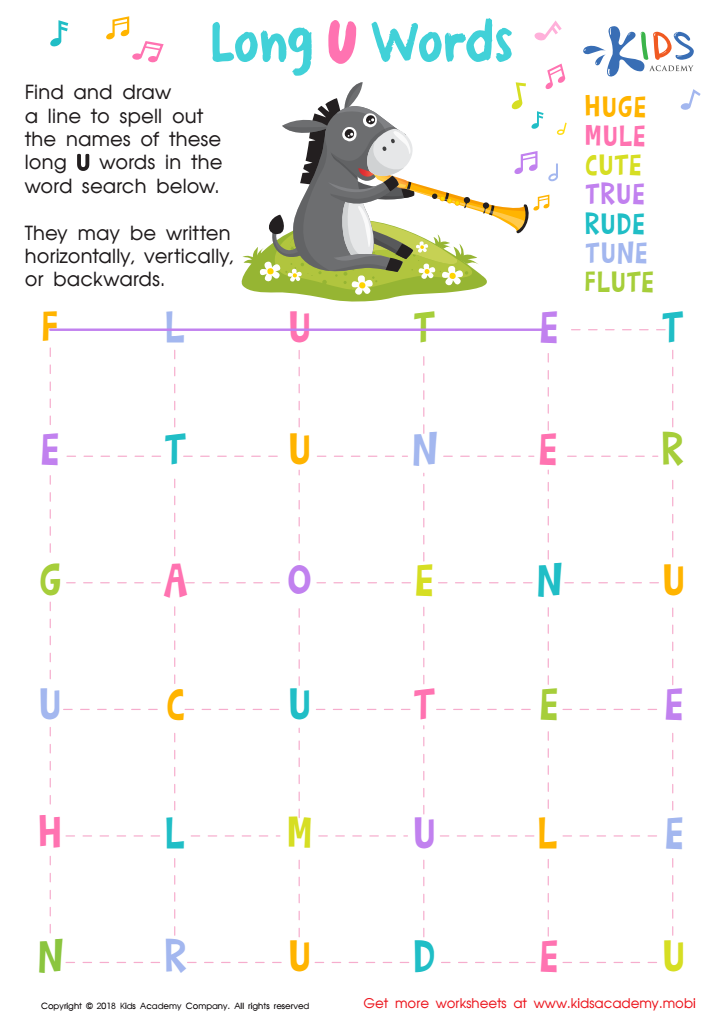
Long /u/ Words Worksheet
Your child needs to learn phonetics to enunciate and differentiate words. This fun worksheet encourages them to find and draw lines connecting the long 'U' words in the word search. Help them read the words on the right side of the picture, then look for them in the word search (horizontally, backwards or vertically).
Long /u/ Words Worksheet
Worksheet
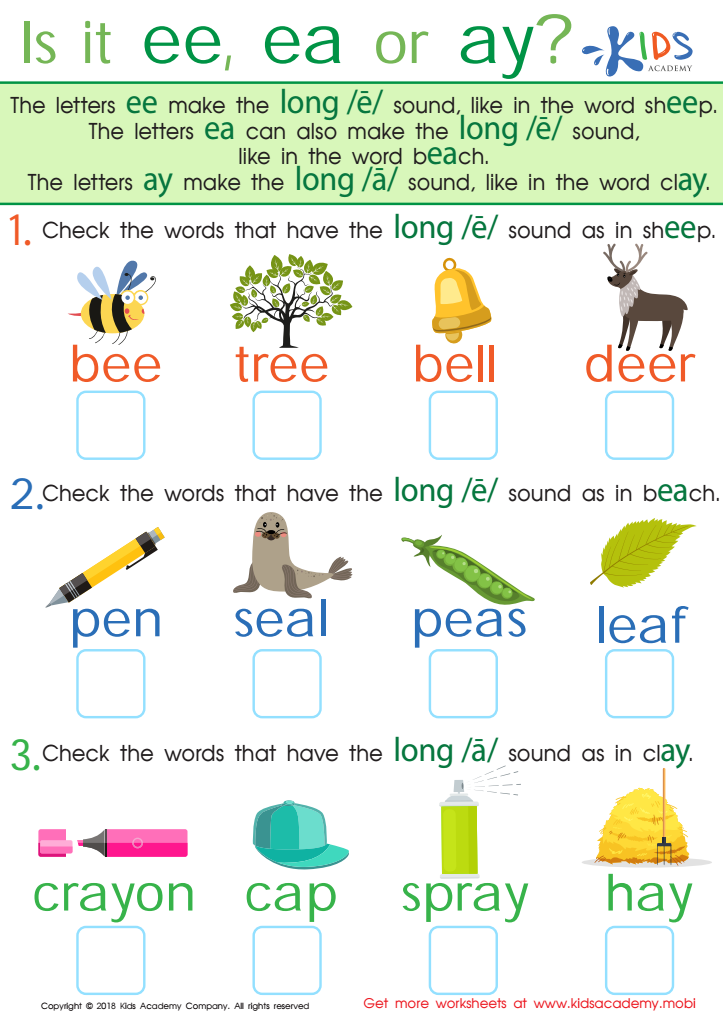
Is It EE, EA, or AY? Worksheet
When 'ee', 'ea' and 'ay' are in words, they usually make the long /e/ and /a/ sounds. Examples of words with 'ee' are "sheep", 'beach' and 'seat' with 'ea', and 'clay' and 'play' with 'ay'. Check this colourful worksheet with your kids; help them find the words that make the long /e/ sound like 'sheep'.
Is It EE, EA, or AY? Worksheet
Worksheet
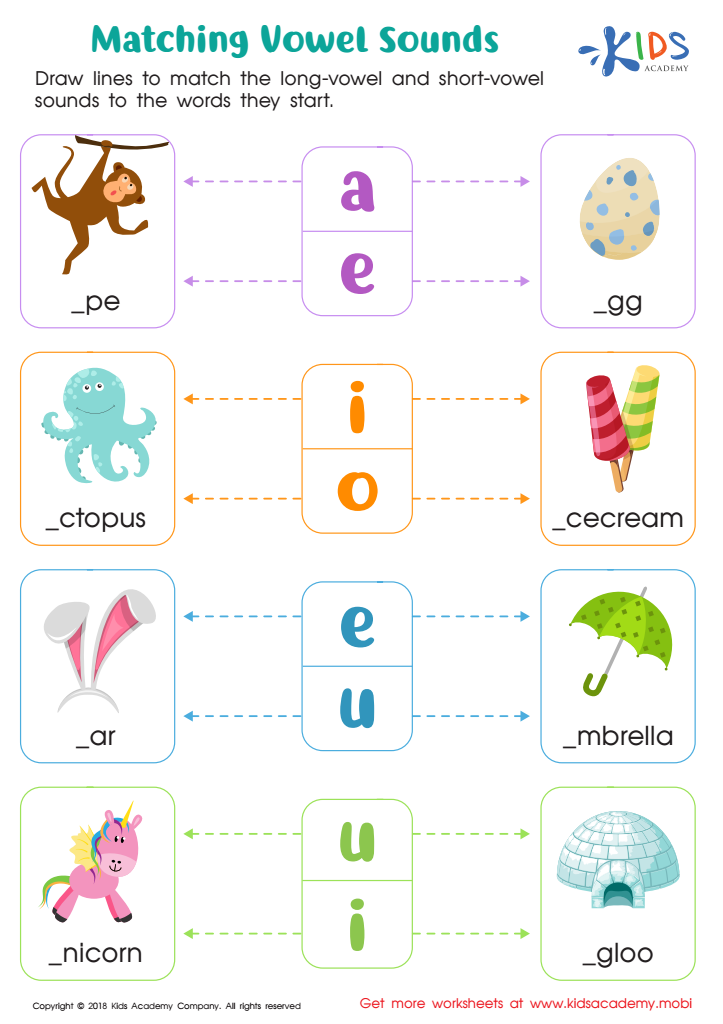
Matching Vowel Sounds Worksheet
Teach your child phonics with a fun worksheet! Ask your child to name a vowel sound and listen if it's long or short. Differentiating between long and short vowel sounds can be tricky, but this matching worksheet makes it easy for kids to understand. Have fun and master phonics - the worksheet will help them understand the difference between long and short vowel sounds!
Matching Vowel Sounds Worksheet
Worksheet

Long and Short U Worksheet
Revised: Spice up your lesson on long and short vowels with this fun printout! Kids read the words "tube" and "tub," then reinforce the sound by coloring in the words and pictures. It's a great way to make phonics class enjoyable!
Download (PDF)
 Assign to My Students
Assign to My Students
Long and Short U Worksheet
Worksheet
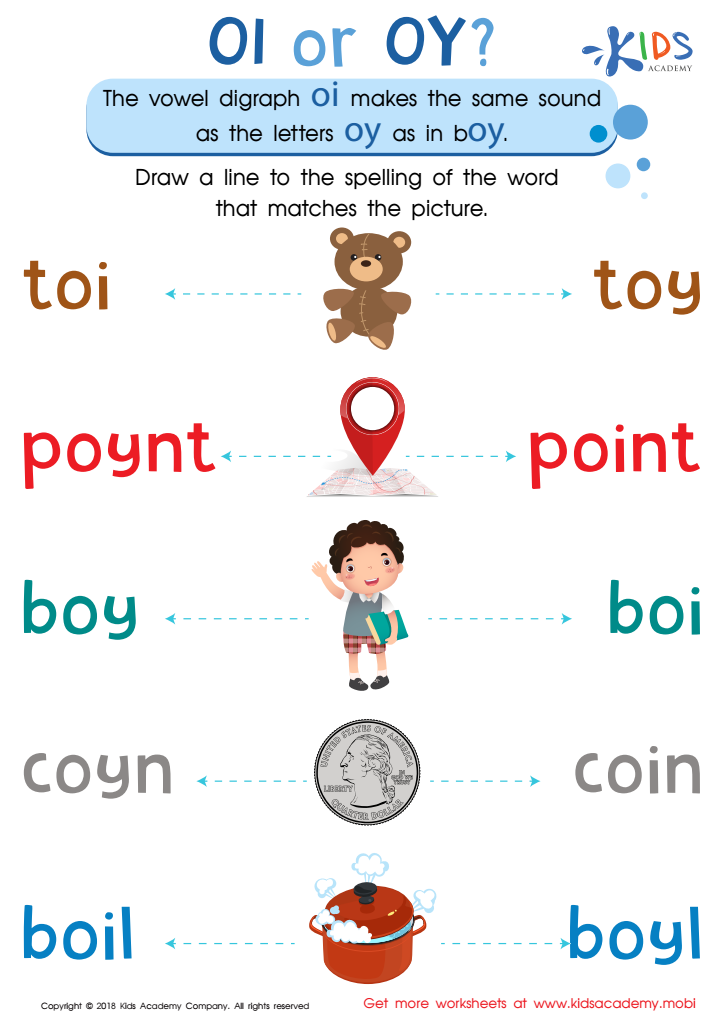
Reading: OI and OY Worksheet
Ask your students if they know the rule for words with /oi/ or /oy/ sound. If not, it's easy to learn! Rule: If /oy/ at end of word, spell with 'oy'; if /oi/ in middle of word, spell with 'oi'. Use this worksheet to help them master these digraphs and improve their ability to decode.
Reading: OI and OY Worksheet
Worksheet
Join Kids Academy for Free
Who is primarily going to use this learning content?





Reading proficiency, particularly in recognizing and understanding vowels, is crucial for children aged 6-8 as it forms the foundation for their literacy skills. Vowels are integral to phonetics and phonemic awareness, which are essential for decoding words. As children progress through early literacy stages, they face increasingly complex texts, making a solid grasp of vowels and their sounds imperative for reading comprehension and fluency.
Parents and teachers play vital roles in fostering this understanding. When children are proficient in recognizing vowels, they are better equipped to tackle vocabulary, spelling, and writing skills, impacting their overall academic performance. Moreover, strong reading skills contribute to increased self-esteem and a love for learning, leading to lifelong benefits.
Furthermore, children with weak vowel proficiency may struggle with reading, causing frustration and leading to a negative association with literacy. Providing engaging activities that highlight vowel sounds and their significance can improve reading recognition and spark an interest in stories. Thus, by emphasizing vowel comprehension between ages 6-8, parents and teachers can cultivate a strong, confident reader, setting the stage for future educational success and fostering an appreciation for reading and learning.







