
Understanding base ten Numbers Worksheets for Ages 6-8
3 filtered results
Difficulty Level
Grade
Age
-
From - To
Subject
Activity
Standards
"Understanding Base Ten Numbers Worksheets for Ages 6-8" are designed to introduce young learners to the foundational concept of base ten. This collection offers engaging and colorful activities that help children grasp place value, addition, and subtraction of multi-digit numbers. Featuring a variety of exercises such as counting blocks, numerical representation, and simple math problems, these worksheets make complex ideas easy to comprehend. Perfect for teachers and parents, these tools support classroom learning or home practice, ensuring kids build a strong mathematical foundation essential for future academic success. Explore our resources and make math enjoyable and educational!
Favorites
With answer key
Interactive
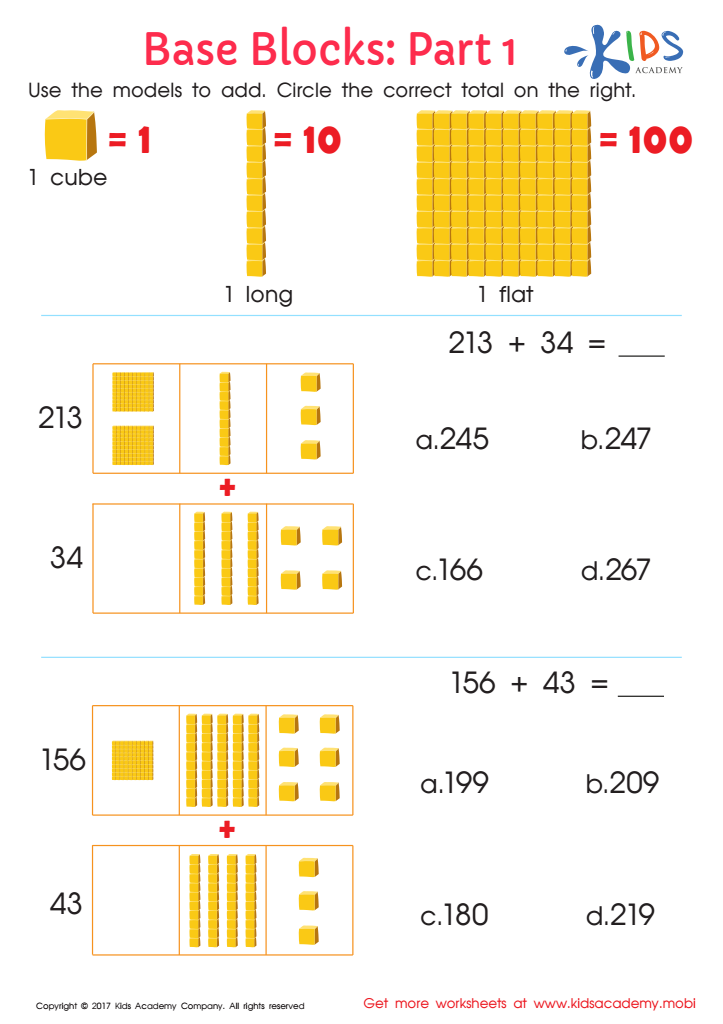
Base Ten Blocks Worksheet: Part 1
They promote numeracy and are a great substitute when kids don't have access to physical blocks.
 Assign to My Students
Base Ten Blocks Worksheet: Part 1
Worksheet
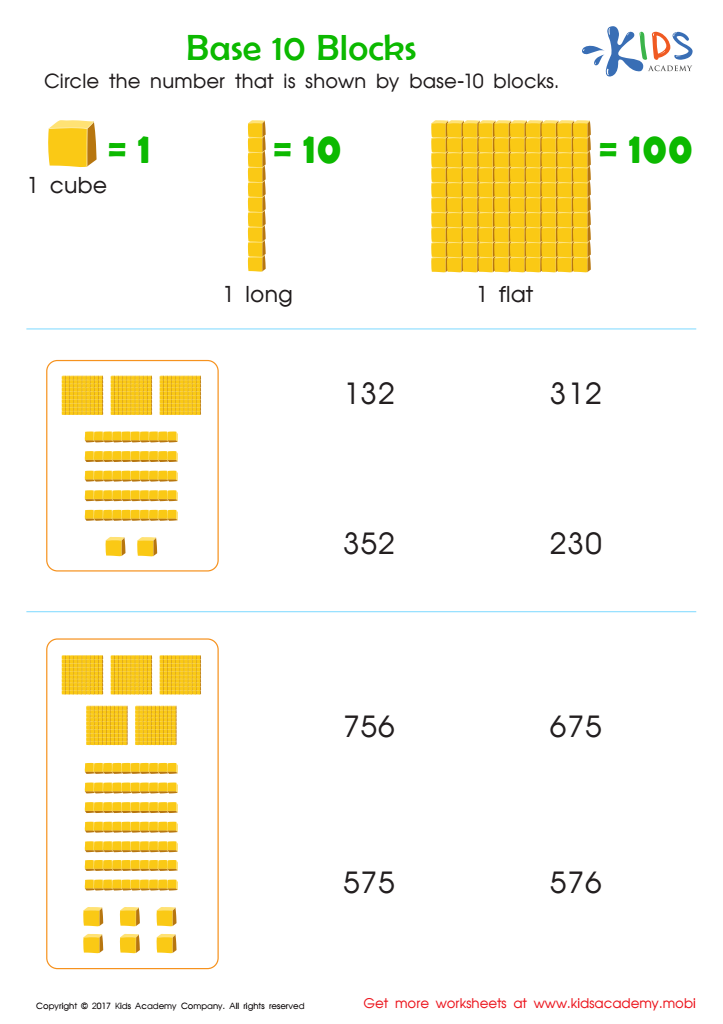
Base Ten Blocks Worksheet
When school ends, your child can still practice place value at home with this base ten blocks worksheet. They'll count and circle the right number, gaining mastery of the concept. It's a fun, easy way to hone their skills!
Base Ten Blocks Worksheet
Worksheet
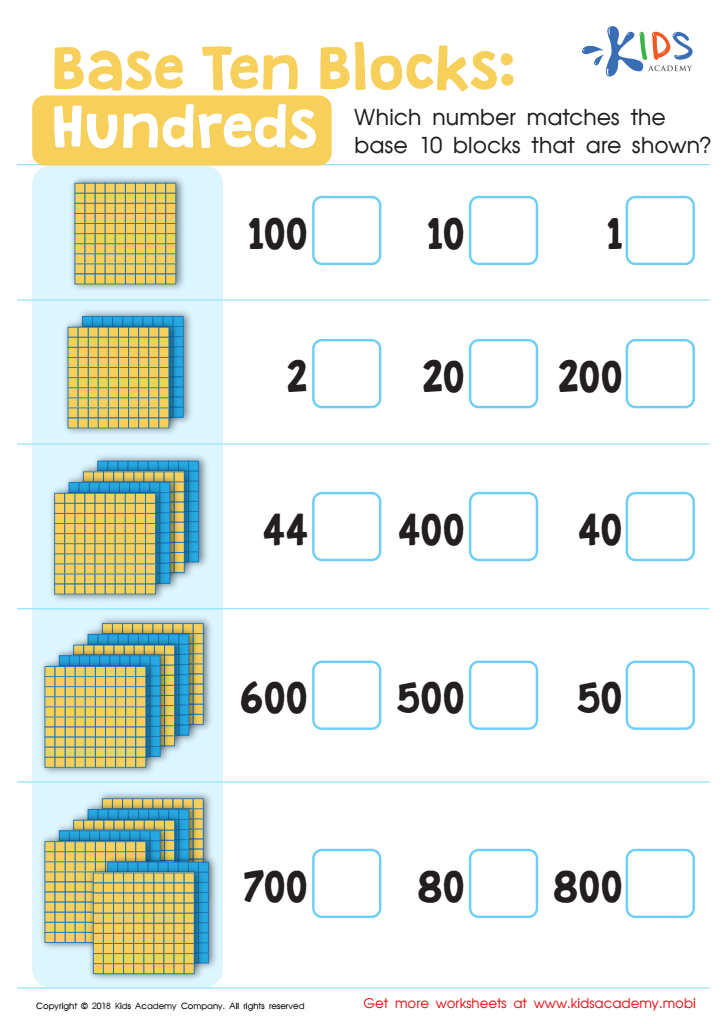
Base Ten Blocks: Hundreds Worksheet
Help your child overcome their dislike of math by guiding them with this base ten blocks worksheet. Count the blocks and answer the questions together. Ask them which number matches the base ten blocks shown. This will help them solve math problems more easily.
Base Ten Blocks: Hundreds Worksheet
Worksheet
Join Kids Academy for Free
Who is primarily going to use this learning content?








Understanding base ten numbers is a crucial foundational mathematical concept for children aged 6-8, and it is pivotal for parents and teachers to focus on it. The base ten system, also known as the decimal system, is the standard system for denoting integer and non-integer numbers. It's a building block for arithmetic operations and higher-level math skills.
For children in early grades, grasping the concept of base ten aids in their comprehension of place value, which is essential for all future mathematics learning. Place value allows students to distinguish between the 'ones,' 'tens,' 'hundreds,' etc., and helps them understand that the value of digits changes based on their position. This understanding simplifies complex operations like addition, subtraction, multiplication, and division by breaking numbers into manageable parts.
Moreover, fluency in base ten concepts supports the development of problem-solving skills. Real-life applications such as counting money, telling time, and measuring are all grounded in the base ten system. When children understand and are comfortable with base ten numbers, they are more likely to succeed in both academic and everyday tasks.
In summary, parents and teachers should prioritize teaching base ten numbers to children aged 6-8 to lay a strong mathematical foundation, promote number sense, and ensure they can confidently approach more advanced math concepts in the future.








