Counting skills improvement Math Worksheets for Ages 6-8
3 filtered results
-
From - To
Enhance your child's counting skills with our engaging Math Worksheets designed specifically for ages 6-8. Our worksheets provide fun and interactive activities that motivate young learners while reinforcing essential counting concepts. From number recognition to skip counting and basic addition, these worksheets cater to varying skill levels, ensuring each child can progress at their own pace. With colorful illustrations and easy-to-follow instructions, children will enjoy practicing their mathematical abilities. Perfect for home or classroom use, these resources help build a strong foundation in math that supports future learning. Start your child's counting journey today and watch their confidence grow!
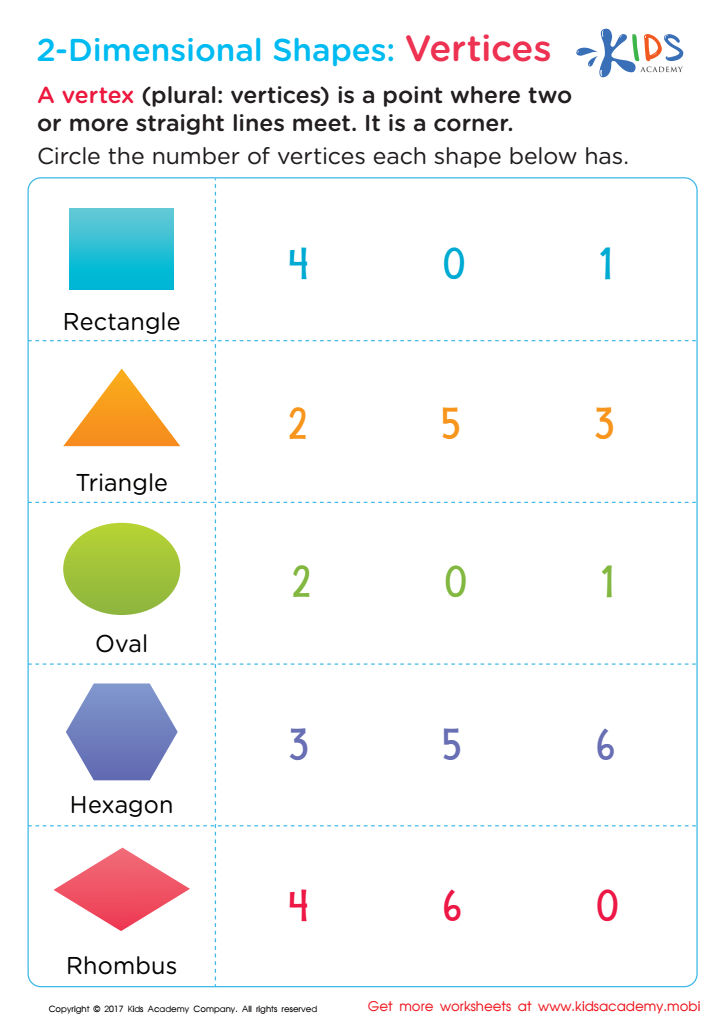
Two–Dimensional Shapes: Vertices Printable
 Assign to My Students
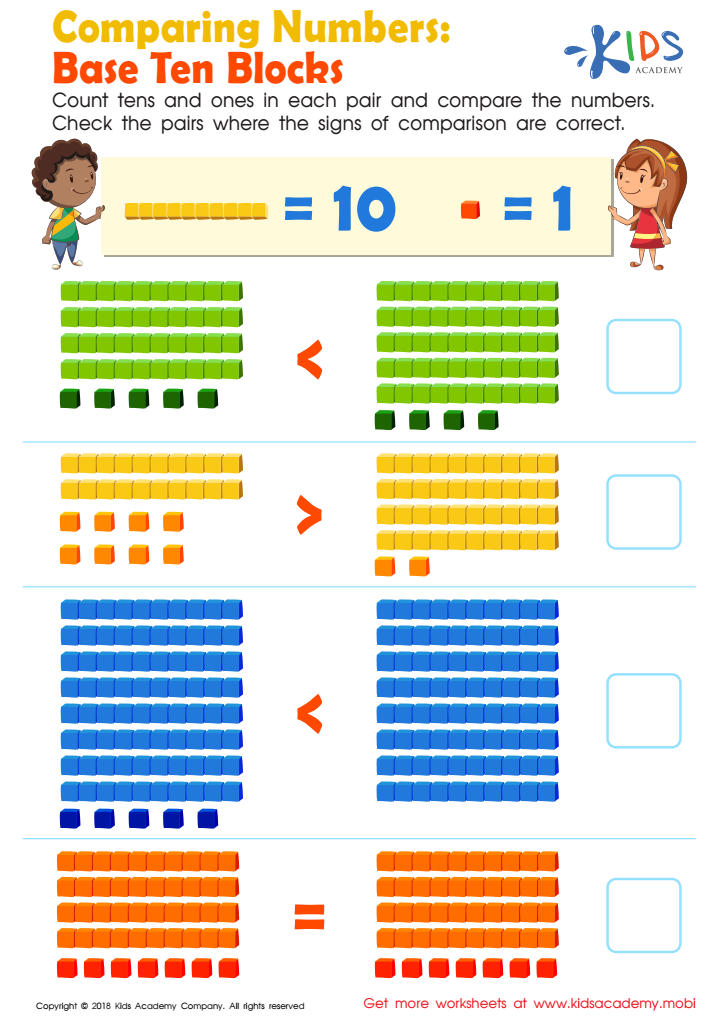
Comparing Numbers: Base Ten Blocks Worksheet
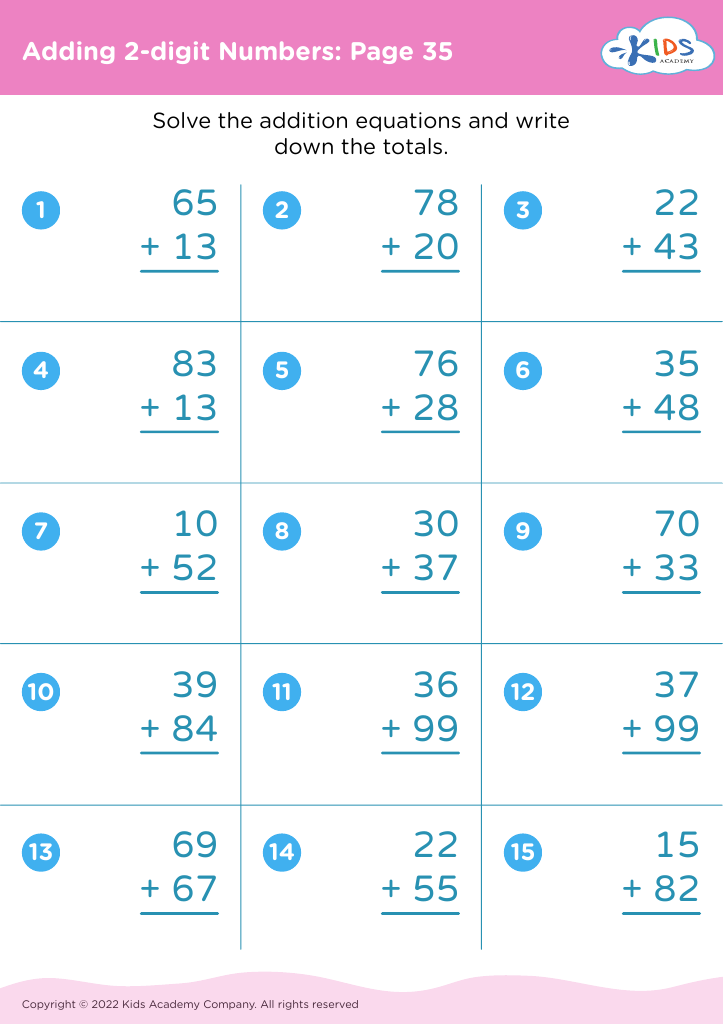








Counting skills are foundational to a child's mathematical development, particularly in the ages of 6 to 8. At this stage, children are not only solidifying basic counting but also transitioning into more complex mathematical concepts. Parents and teachers should prioritize the improvement of these skills for several reasons.
Firstly, strong counting abilities enhance a child's number sense, which is vital for problem-solving and logical reasoning in math. Children who are confident in counting can better tackle tasks such as addition and subtraction, laying the groundwork for more advanced topics like multiplication and division.
Secondly, counting skills contribute to cognitive development. Engaging in counting activities helps improve memory, attention, and processing speed—skills that are applicable across subjects, both in and out of the classroom.
Moreover, these skills encourage a positive attitude towards mathematics. Children who experience success in counting are more likely to develop a growth mindset, viewing challenges in math as opportunities for learning rather than obstacles.
Ultimately, investing in counting skill development during these formative years sets children on a path for academic success, promoting both confidence and competence in mathematics that will benefit them throughout their educational journey.








