
Practice problem-solving Math Worksheets for Ages 6-8
5 filtered results
Difficulty Level
Grade
Age
-
From - To
Subject
Activity
Standards
Unlock your child's potential with our engaging problem-solving math worksheets designed for ages 6-8! These worksheets focus on essential critical thinking skills, encouraging young learners to tackle various math challenges with confidence. Each worksheet provides fun and interactive exercises that help children practice addition, subtraction, and more complex problem-solving techniques. Ideal for both classroom use and home study, our resources align with educational standards to ensure foundational math skills are developed effectively. Promote a love for math and enhance your child’s analytical abilities today. Explore our collection and watch your young mathematicians thrive! Start their problem-solving journey now!
Favorites
With answer key
Interactive
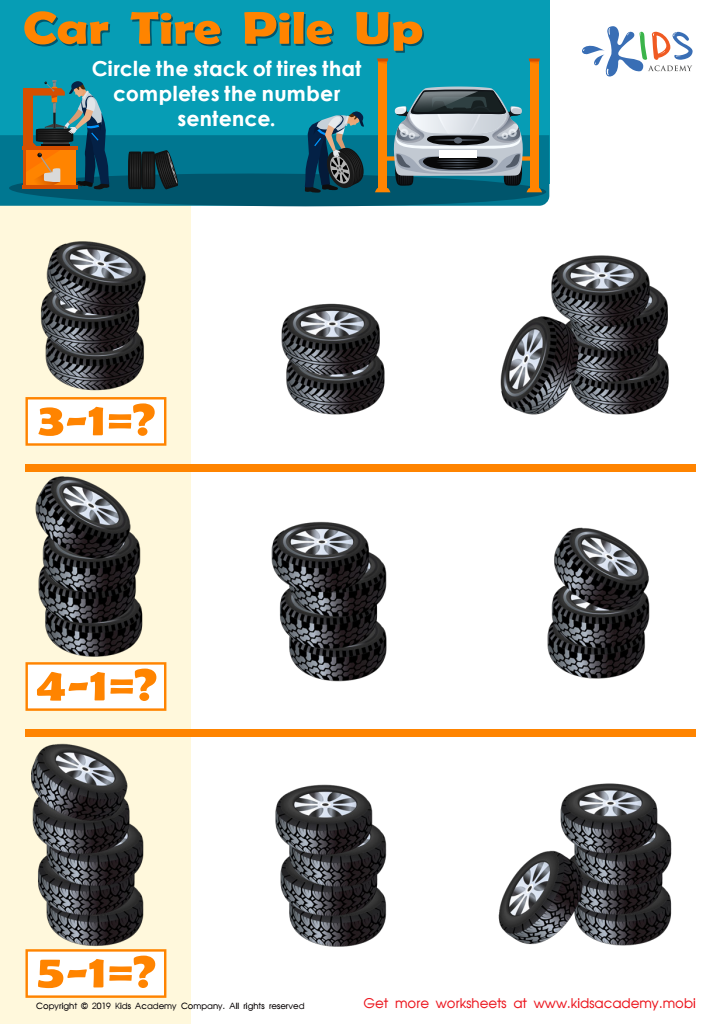
Car Tire Pile Up Worksheet
Examine the pic with your kids. Can they recognize the items piled up? The tires are organized in different quantities. Equations are on the left. Have your children work out the equations, counting the tire stacks to identify the correct answer.
 Assign to My Students
Car Tire Pile Up Worksheet
Worksheet
Join Kids Academy for Free
Who is primarily going to use this learning content?




.jpg)


Parents and teachers should prioritize problem-solving math for children ages 6-8 as it lays the foundation for critical thinking, reasoning, and analytical skills necessary for lifelong success. This age group is naturally curious and eager to explore abstract concepts, making it the ideal time to introduce problem-solving strategies.
Engaging in math problems helps young learners develop a growth mindset, encouraging them to view challenges as opportunities for growth rather than obstacles. When children tackle varied math problems, they learn to approach situations methodically, experiment with multiple strategies, and embrace the process of trial and error. These skills not only enhance mathematical understanding, but they also translate into everyday problem-solving abilities, which are essential in real-world scenarios.
Moreover, mastering foundational math skills can boost confidence and foster a positive attitude towards learning. When children see their progress in problem-solving, they are more likely to engage with more complex tasks and maintain an interest in mathematics as they grow older. Encouraging problem-solving in math cultivates resilience, perseverance, and self-confidence—traits that are invaluable in both academic settings and life beyond the classroom. Ultimately, supporting problem-solving in math cultivates a generation of empowered, capable thinkers.








