
Understand sequencing Math Worksheets for Ages 6-8
3 filtered results
Difficulty Level
Grade
Age
-
From - To
Subject
Activity
Standards
Unlock your child's potential with our "Understand Sequencing Math Worksheets for Ages 6-8". Tailored for young learners, these engaging activities help to develop critical thinking and problem-solving skills. Children will explore number order, patterns, and progression through fun, interactive exercises. With vibrant visuals and clear instructions, each worksheet is designed to hold your child's interest while building essential math foundations. Perfect for classroom support or homeschooling, these worksheets ensure that mastering sequencing is an enjoyable journey. Empower your child to succeed in math by enhancing their understanding of sequencing concepts today. Visit Kids Academy for more resources!
Favorites
With answer key
Interactive
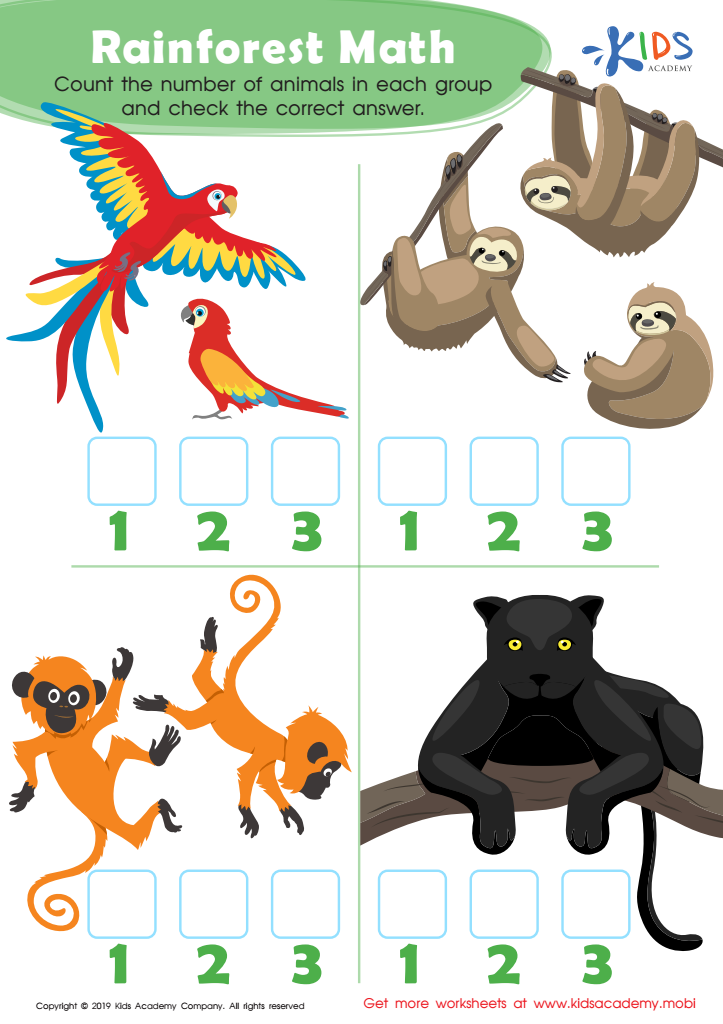
Rainforest Math Worksheet
Kids love learning about rainforest animals! This worksheet helps them with counting and number sense. It features recognizable rainforest animals and asks children to choose the correct number from the answer choices. It's a fun way for children to build their skills - without even knowing it!
 Assign to My Students
Rainforest Math Worksheet
Worksheet
Join Kids Academy for Free
Who is primarily going to use this learning content?







Understanding sequencing in math is crucial for children aged 6-8 as it lays the foundation for essential cognitive and academic skills. Sequencing involves the ability to understand and organize events, numbers, or objects in a logical order—skills that are pivotal across various areas of learning. Here’s why parents and teachers should prioritize this:
-
Mathematical Proficiency: Sequencing enhances numerical understanding and arithmetic operations. For these young learners, grasping order helps in counting, addition, and subtraction, which are building blocks of arithmetic.
-
Reading and Comprehension: A good grasp of sequencing aids in reading comprehension. Understanding stories require recognizing the order of events, a skill that directly impacts a child’s ability to absorb and retell narratives.
-
Problem-Solving Skills: Sequencing also advances logical thinking and problem-solving abilities. It teaches kids to approach problems step-by-step, whether it’s solving a math puzzle or following instructions.
-
Daily Life Skills: Everyday tasks, from following daily routines to understanding timelines and instructions, rely heavily on sequencing. This makes it essential for fostering independence and organizational skills.
-
Confidence and Participation: Mastery in sequencing boosts children's confidence in classroom activities, ensuring active participation. It encourages a positive attitude towards learning by making complex concepts more digestible.
Investing in sequencing skills not only supports immediate academic success but also cultivates essential life-long learning habits.








