Understanding measurement units Math Worksheets for Ages 6-8
3 filtered results
-
From - To
Explore our "Understanding Measurement Units Math Worksheets" designed for children ages 6-8. These engaging, printable activities help young learners grasp essential measurement concepts. Through fun exercises, kids will learn to identify and compare different units of measurement such as length, weight, and volume. Our worksheets encourage hands-on learning, critical thinking, and practical application of measuring skills, making math both enjoyable and educational. Ideal for classroom use or at-home practice, these worksheets will boost your child's confidence and proficiency in measurement. Perfect for parents and educators looking to enrich their math curriculum!
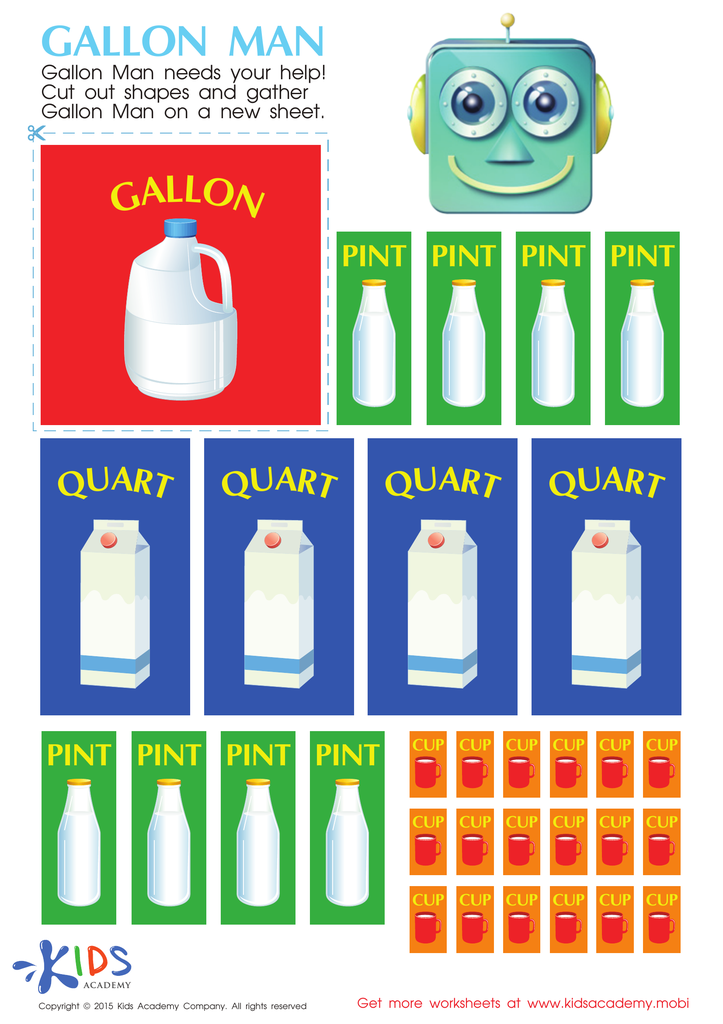
Cups, Pints and Quarts With Gallon Man Worksheet
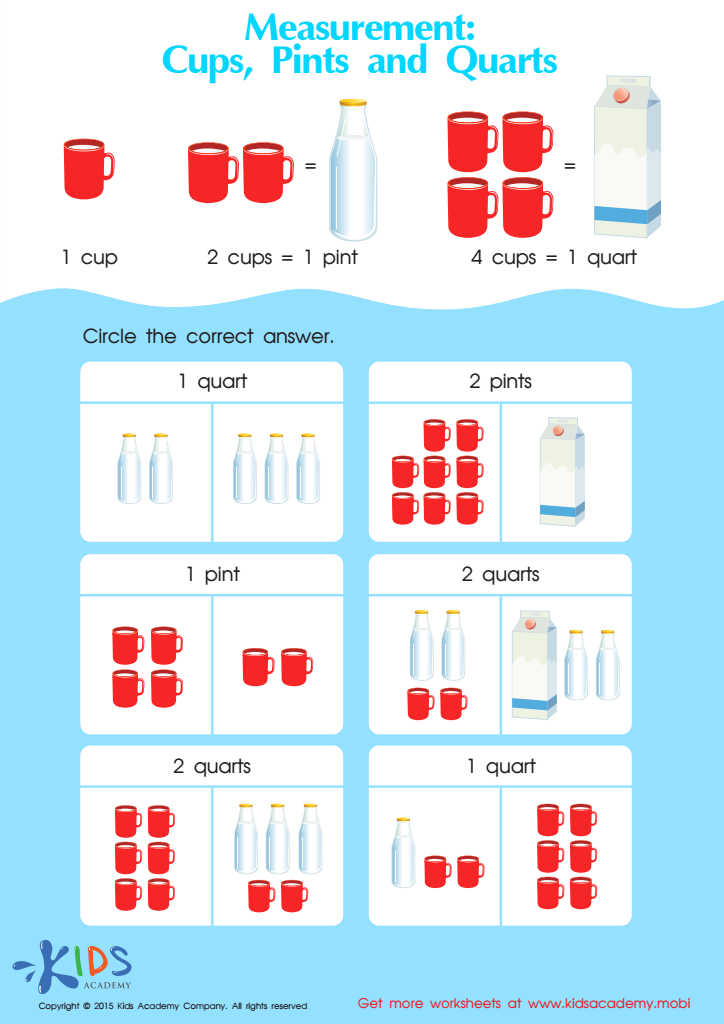
Cups, Pints and Quarts Worksheet
 Assign to My Students
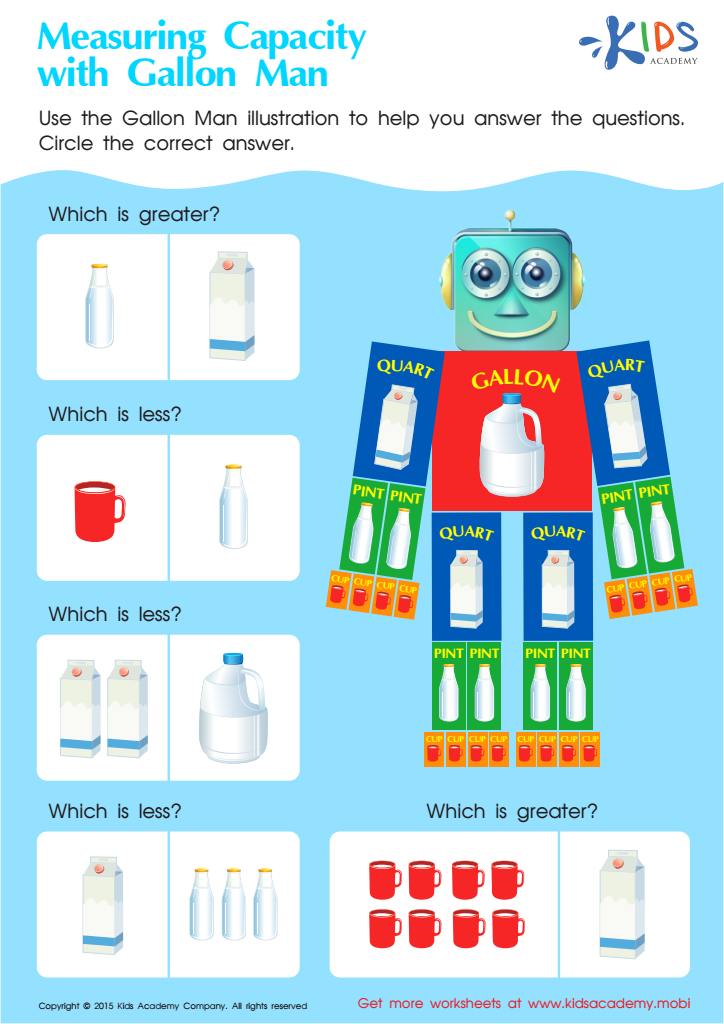
Measurement: Measuring Capacity with Gallon Man Worksheet






Understanding measurement units is a fundamental skill for children aged 6-8, and it holds significant importance for several reasons. Firstly, it lays the groundwork for mathematical reasoning and problem-solving. When children grasp the concept of measurement, they're better equipped to understand more complex math topics in the future, such as geometry and algebra. This foundational knowledge also enhances their ability to notice patterns, make comparisons, and develop critical thinking skills.
In addition to academic growth, understanding measurement units has practical, everyday applications. Children learn to measure ingredients for a recipe, determine the length of objects, or gauge distances. These practical exercises help them connect math to real life, making the subject more engaging and less abstract.
Moreover, measurement skills are often linked to scientific inquiry. When conducting simple experiments, children use measurement to collect and analyze data, fostering curiosity and a love for learning. This sets the stage for future STEM education initiatives.
Lastly, by understanding and using standard measurement units, children develop better communication skills. They can more accurately convey information, follow instructions, and interpret data shared by others, all of which are critical for teamwork and collaboration.
Thus, both parents and teachers should prioritize teaching measurement units to children, recognizing its broad and lasting impacts on their cognitive development and practical abilities.








