
Understanding ordinal numbers Math Worksheets for Ages 6-8
3 filtered results
Difficulty Level
Grade
Age
-
From - To
Subject
Activity
Standards
Unlock your child's potential with our "Understanding Ordinal Numbers" math worksheets, specially designed for ages 6-8. These engaging activities help young learners grasp the concept of ordinal numbers, allowing them to effectively identify positions in a sequence—first, second, third, and beyond. Each worksheet is crafted with vibrant illustrations and age-appropriate exercises that make learning both fun and interactive. Ideal for reinforcing classroom concepts or providing supplemental home practice, our worksheets cater to varied learning styles. Foster your child's mathematical confidence and comprehension of ordinal numbers today with these exciting, informative resources! Download and watch their skills blossom!
Favorites
With answer key
Interactive
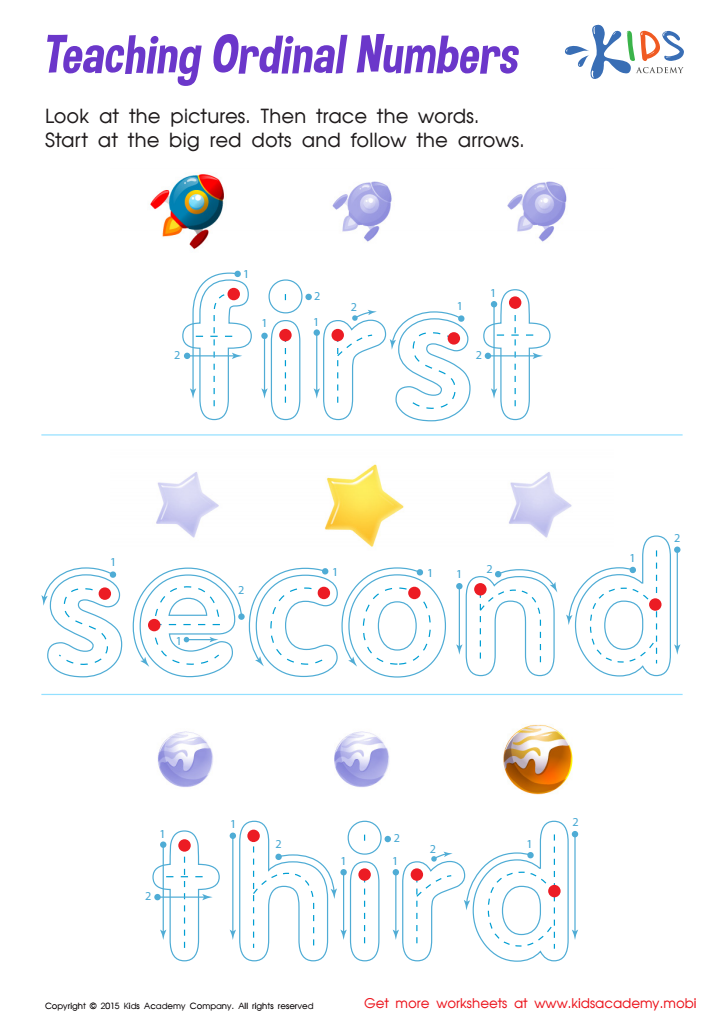
Ordinal Numbers: Teaching Ordinal Numbers Printable
Practice makes perfect!
Kids need to understand ordinal numbers - placement, recognition and spelling. Our worksheet helps kids make connections between the placement and spelling of ordinal numbers. Practice will help your little one perfect this vital number concept.
 Assign to My Students
Ordinal Numbers: Teaching Ordinal Numbers Printable
Worksheet
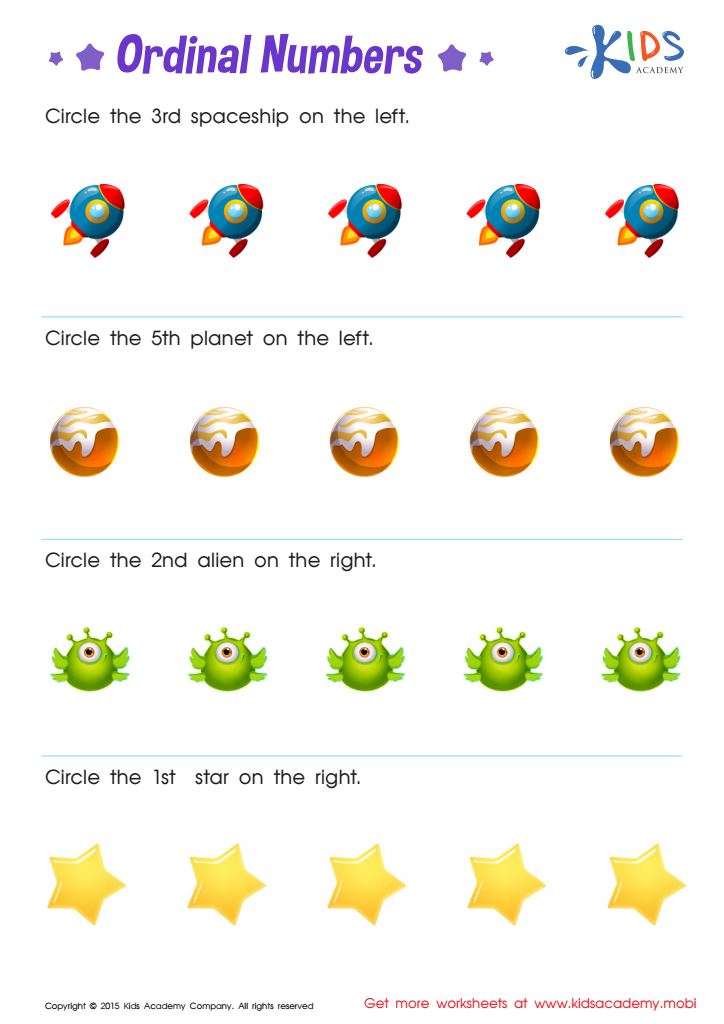
Ordinal Numbers: Space Ordinals Worksheet
Practicing with ordinal numbers worksheet PDFs helps kids master crucial concepts for higher-level math. Plus, when kids have fun learning, the knowledge sticks! So, have your child “blast off” with this space-themed worksheet to read directions, practice relative directions, and learn ordinal numbers.
Ordinal Numbers: Space Ordinals Worksheet
Worksheet
Join Kids Academy for Free
Who is primarily going to use this learning content?








Understanding ordinal numbers is fundamental for children aged 6 to 8, as it lays the groundwork for critical thinking, organizational skills, and problem-solving. Ordinal numbers, which represent position or order in a sequence (first, second, third, etc.), are prevalent in everyday life and academic contexts. Parents and teachers should prioritize teaching this concept because it enhances children's ability to follow directions, comprehend benchmarks, and categorize information effectively.
When children grasp ordinal numbers, they can navigate various scenarios—from understanding positions in a race to following steps in a set sequence—promoting independence and self-confidence. Furthermore, mastering ordinals aids in developing mathematical skills, as they often act as the building blocks for more advanced concepts, such as fractions and basic number lines.
In a classroom environment, incorporating ordinal numbers into lessons can make learning fun and engaging through games and playful activities. Additionally, understanding the importance of order helps children with time management, such as arranging daily tasks or understanding timelines in history. Overall, fostering a strong foundation in ordinal numbers supports a well-rounded, numerically literate child, ready to tackle challenges both in school and beyond.








