
Fraction subtraction Worksheets for Ages 6-9
3 filtered results
Difficulty Level
Grade
Age
-
From - To
Subject
Activity
Standards
Enhance your child’s mathematical skills with our engaging Fraction Subtraction Worksheets, designed specifically for ages 6-9. These printable resources support young learners in mastering the concept of subtracting fractions through various activities. Our worksheets feature vibrant visuals and fun, age-appropriate exercises that encourage students to develop their understanding of fractions in a supportive, interactive environment. From simple problems to more complex challenges, these worksheets cater to different learning levels. Perfect for at-home practice or classroom use, they help build confidence and proficiency in math. Equip your young learners with essential skills for their educational journey today!
Favorites
With answer key
Interactive
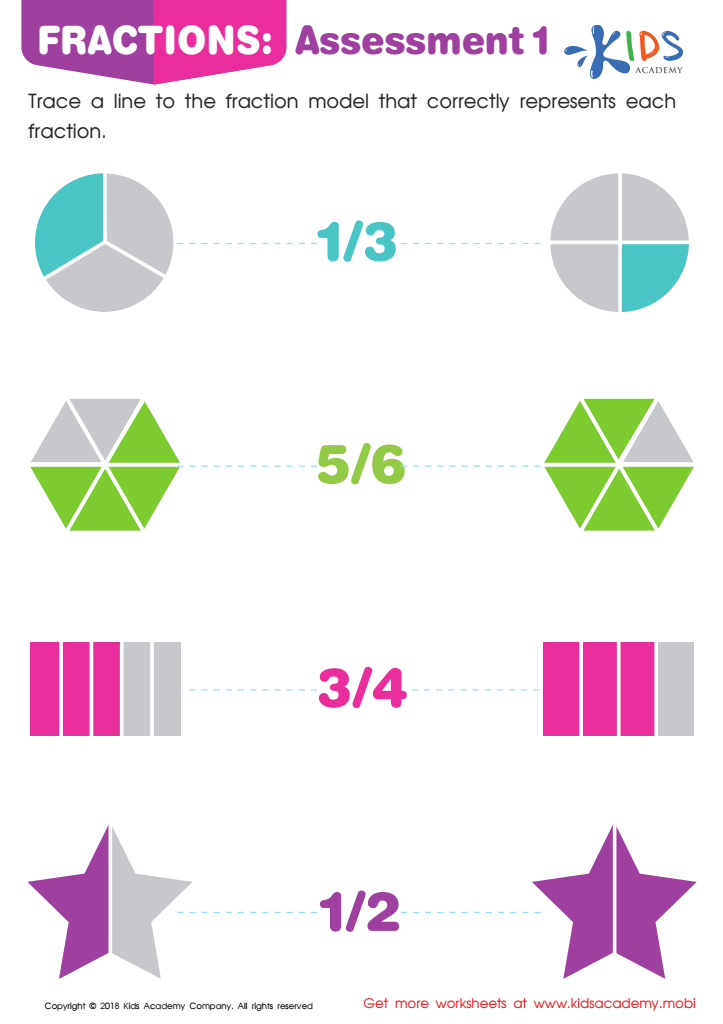
Fractions: Assessment 1 Worksheet
Master fractions easily with this worksheet! It has four sets of fraction models and fraction equations with two models each. Guide your kids to trace a line to the correct fraction model for each equation.
 Assign to My Students
Fractions: Assessment 1 Worksheet
Worksheet
Join Kids Academy for Free
Who is primarily going to use this learning content?







Understanding fraction subtraction is essential for children ages 6-9 as it lays the foundation for more advanced mathematical concepts. At this age, students are developing critical thinking and problem-solving skills, and mastering fraction subtraction helps them grasp the idea of parts of a whole. This concept is not only fundamental in math but also in real-life situations, such as cooking or sharing.
By learning how to subtract fractions, children cultivate mathematical reasoning and analytical skills. It encourages them to think about relationships between numbers and enhances their ability to approach complex problems logically. Moreover, proficiency in fractions boosts confidence in tackling mathematics as they progress in their education.
Parents and teachers should also emphasize fraction subtraction as it supports cross-curricular learning. Understanding fractions enriches scientific exploration, like measuring liquids or understanding ratios, thereby making contributions to inquiry-based learning.
Furthermore, early mastery can prevent future misunderstandings in higher mathematics, such as algebra or even calculus. By prioritizing fraction subtraction, caregivers and educators empower children not only to succeed in their current studies but to develop a love for mathematics that lasts a lifetime.








