
Learning number patterns Worksheets for Ages 6-9
4 filtered results
Difficulty Level
Grade
Age
-
From - To
Subject
Activity
Standards
Discover engaging and educational Learning Number Patterns Worksheets for children aged 6-9! These carefully designed worksheets help young learners grasp the fundamentals of number patterns, a vital math skill. Perfect for teachers and parents, our resources promote critical thinking and enhance problem-solving abilities. Through fun and interactive activities, kids will recognize sequences, identify missing numbers, and strengthen their mathematical understanding. Each worksheet supports personalized learning, catering to different skill levels, ensuring every child can progress at their own pace. Bring excitement to math lessons and watch your child's confidence soar as they master number patterns! Start exploring today!
Favorites
With answer key
Interactive
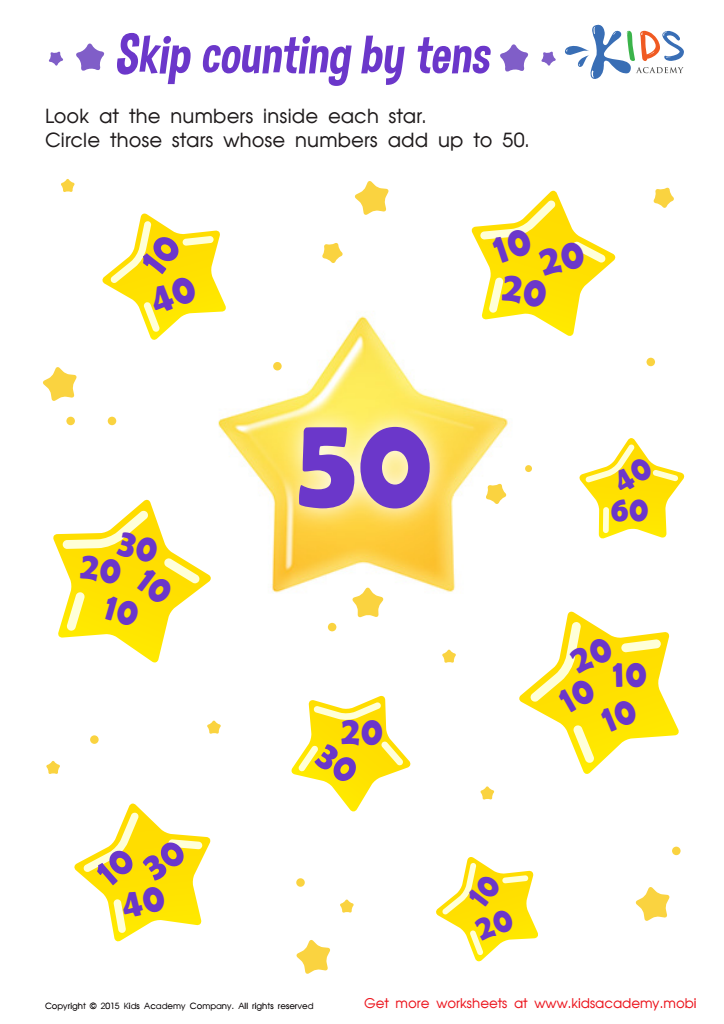
Learn Dozens: Skip Counting by Tens Printable
This skip counting by 10 worksheet helps kids strengthen fluency, practice addition & build number sense. They'll use problem-solving skills to find the correct answer, which is revealed by stars. This worksheet is a fun way to practice crucial foundational math skills.
 Assign to My Students
Learn Dozens: Skip Counting by Tens Printable
Worksheet
Join Kids Academy for Free
Who is primarily going to use this learning content?



Learning number patterns is crucial for children aged 6-9 as it lays the foundation for their mathematical understanding and problem-solving skills. At this age, students are developing their cognitive abilities, and recognizing patterns can enhance their analytical thinking. Understanding number patterns helps children identify relationships between numbers, which is essential for grasping concepts like addition, subtraction, multiplication, and division later on.
Moreover, learning number patterns fosters critical skills that extend beyond mathematics. It encourages logical reasoning, boosts creativity in problem-solving, and improves memory retention. These skills are transferable and beneficial throughout a child's education and future endeavors.
By engaging with number patterns, children become better equipped to tackle more complex math concepts in higher grades, minimizing math anxiety and building confidence in their abilities. It also encourages a positive attitude towards math, making it a fun and rewarding subject rather than a daunting one.
For parents and teachers, prioritizing number pattern recognition in early education means investing in a child's long-term academic success and resilience, ensuring they develop a solid grasp of mathematical concepts that will serve them for years to come. Active involvement in their learning process fosters a love for math and a desire to explore further.








