
Understanding grouping Worksheets for Ages 6-9
3 filtered results
Difficulty Level
Grade
Age
-
From - To
Subject
Activity
Standards
Discover our "Understanding Grouping Worksheets for Ages 6-9" at Kids Academy! These expertly designed printable worksheets help young learners hone their math skills by mastering the crucial concept of grouping. Perfect for kids aged 6 to 9, these engaging activities make learning fun and meaningful. With colorful visuals and clear instructions, children explore ways to organize objects, numbers, and shapes into groups, cultivating arithmetic competence and critical thinking. Our worksheets cover a variety of topics like counting, addition, and multiplication, ensuring a strong foundation for future math success. Boost your child's confidence and enjoyment in math with our comprehensive resources!
Favorites
With answer key
Interactive
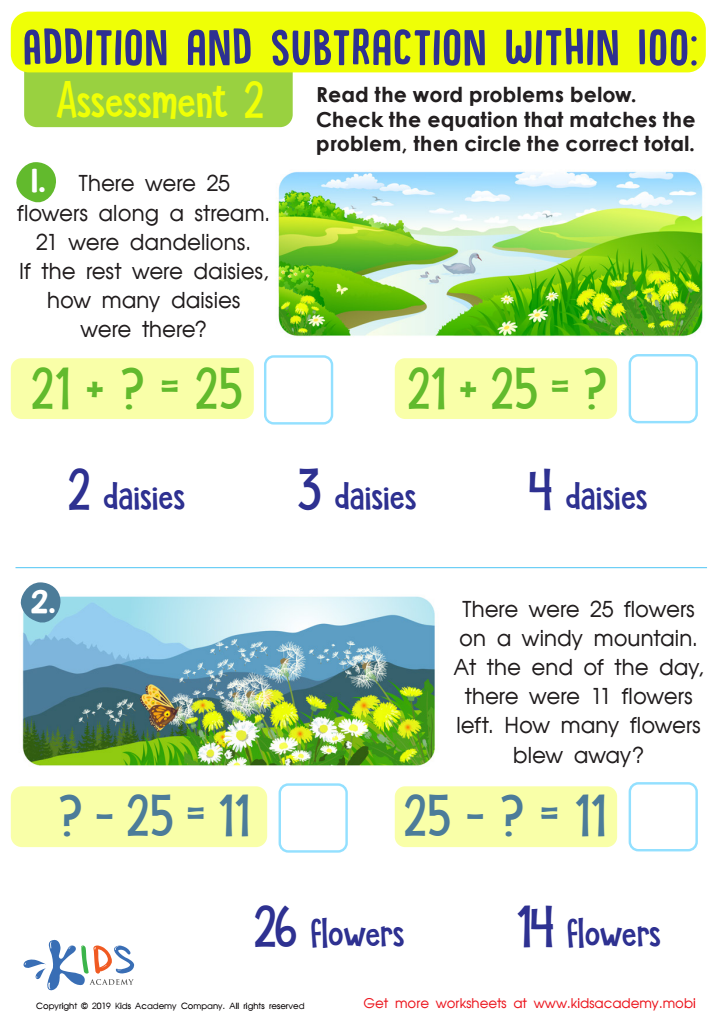
Assessment 2 Math Worksheet
Using fun exercises and pictures, you can get kids excited about math. With practice and reminders of what they've learnt, they'll be solving simple addition and subtraction equations with ease. Read the word problems in the picture to them, then help them check the equation and choose the correct answer.
 Assign to My Students
Assessment 2 Math Worksheet
Worksheet
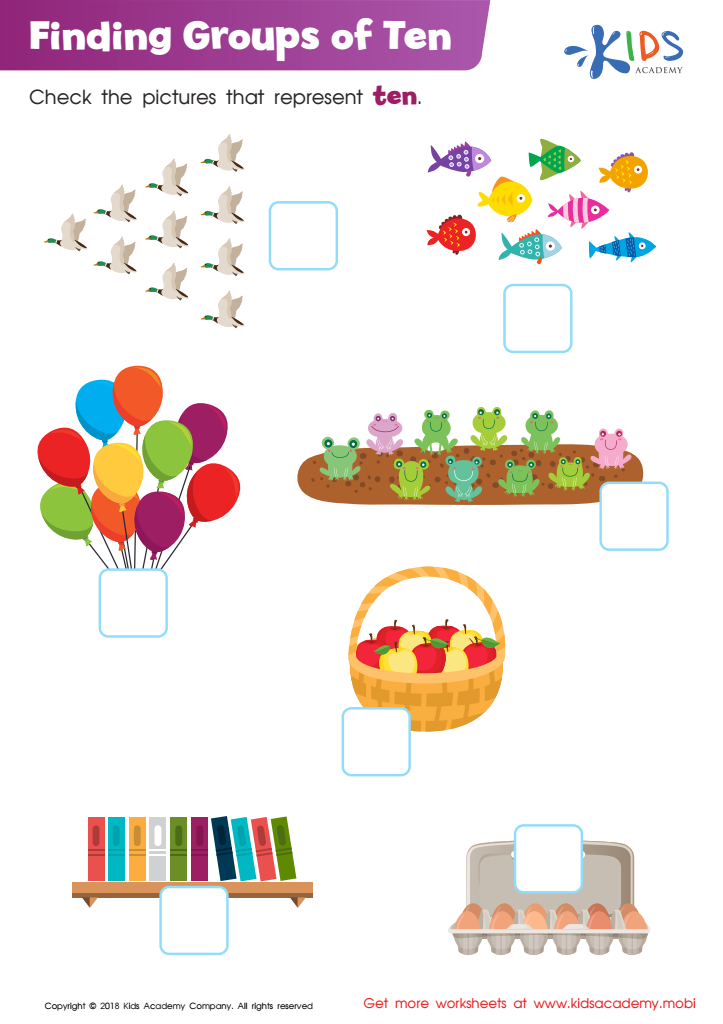
Finding Groups of Ten Worksheet
Can your kids count? If they can't go higher than tens, introduce them to this worksheet. Counting can be fun and easy with this exercise. Ask if they can identify the pictures, then help them count each group. Help them check the pictures that represent ten.
Finding Groups of Ten Worksheet
Worksheet
Join Kids Academy for Free
Who is primarily going to use this learning content?




Understanding grouping is fundamental for children ages 6-9 because it lays the groundwork for mathematical reasoning and number sense. At this developmental stage, kids transition from counting objects individually to comprehending more abstract concepts like addition, subtraction, multiplication, and division.
Firstly, grouping helps children understand place value, which is essential for arithmetic operations. For instance, recognizing that the number 29 is made up of two tens and nine ones teaches the foundation of our base-ten system.
Secondly, grouping fosters problem-solving skills. When children learn to group objects, they begin to see patterns and relationships between numbers. This skill is critical for mental math and estimating sums and differences, which make everyday tasks easier, from splitting a pizza to managing an allowance.
Additionally, grouping enhances cognitive development. It pushes students to classify, organize, and analyze information, refining skills that are transferable to other subjects, such as science and reading.
Furthermore, early introduction to these concepts builds confidence and reduces math anxiety. When children master foundational skills, they are more engaged and motivated to tackle more complex mathematical ideas in the future.
Thus, parents and teachers should focus on helping young learners understand grouping to ensure they develop robust numeracy skills, logical thinking, and a positive attitude towards math.








