
Visual perception Addition & Subtraction Worksheets for Ages 6-9
5 filtered results
Difficulty Level
Grade
Age
-
From - To
Subject
Activity
Standards
Introducing our "Visual Perception Addition & Subtraction Worksheets" designed for children ages 6-9! These engaging worksheets help young learners develop their math skills while enhancing their visual perception. Each activity combines fun visuals with fundamental arithmetic exercises to make learning enjoyable and effective. By focusing on addition and subtraction, kids will build a strong foundation in math, improving their ability to recognize patterns, understand spatial relationships, and solve problems. Ideal for home or classroom use, these worksheets are perfect for helping children develop critical thinking and analytical skills. Unlock your child's potential with our dynamic and interactive learning tools!
Favorites
With answer key
Interactive
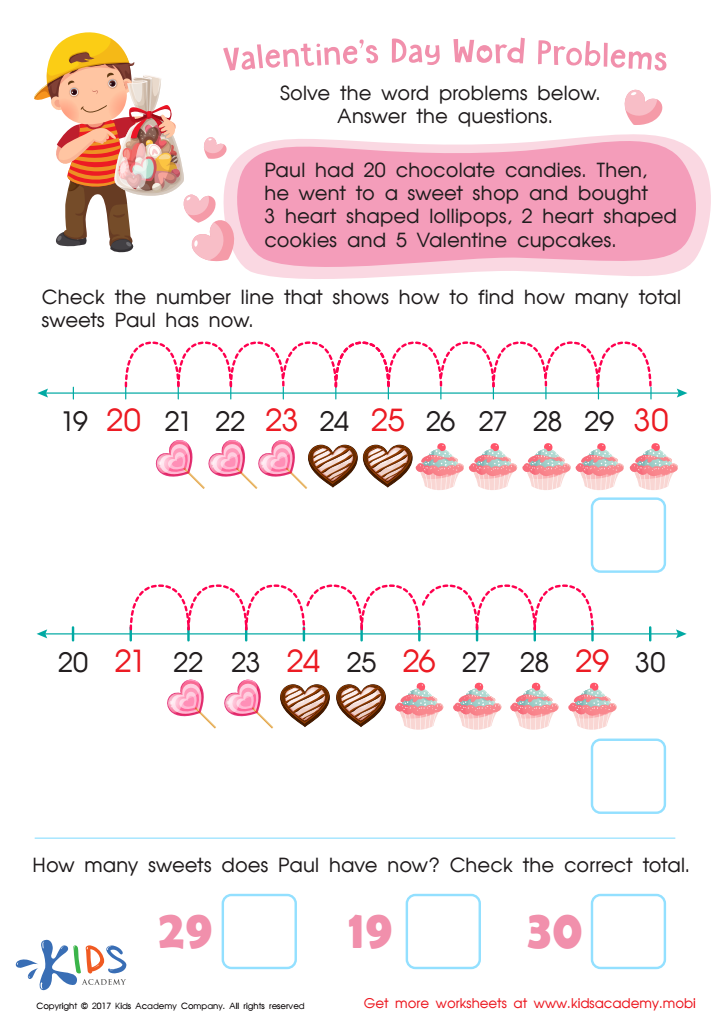
Valentines Day 2 Printable
This PDF worksheet uses a number line to help solve the problems. Your child will be ready for Valentine's Day after completing it. Counting and adding from 20 is also reinforced.
 Assign to My Students
Valentines Day 2 Printable
Worksheet
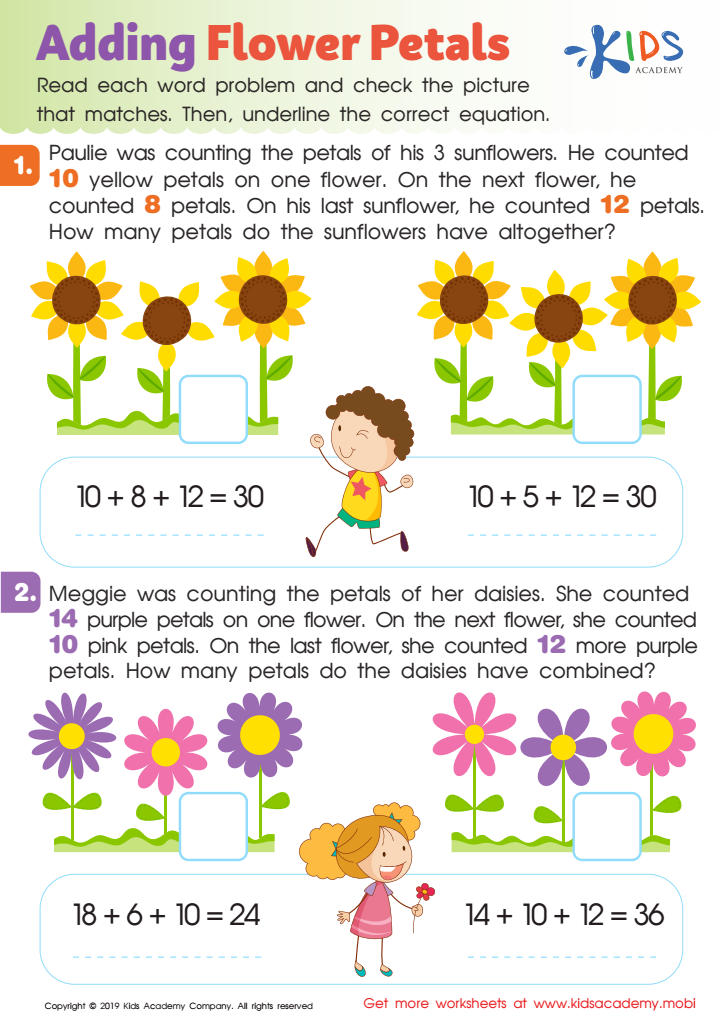
Adding Flower Petals Worksheet
This free worksheet helps little mathematicians learn to understand word problems. They'll read each one and match it to the corresponding picture. Important info is highlighted, teaching kids to look for key info when solving problems. Then they'll underline the correct number equation that matches the picture. A great way to practice problem-solving skills!
Adding Flower Petals Worksheet
Worksheet
Join Kids Academy for Free
Who is primarily going to use this learning content?








Visual perception skills and a strong understanding of basic addition and subtraction are critical for children ages 6-9 as they form the building blocks for more complex mathematical concepts and overall academic success.
Firstly, visual perception—the ability to interpret and make sense of visual information—helps children not only in reading and writing but also in solving math problems. Recognizing patterns, understanding spatial relationships, and visualizing math problems are essential for effective learning. Children who develop strong visual perceptual skills often find it easier to grasp math concepts, as these skills help them to quickly interpret numbers and signs and understand relationships between different mathematical elements.
Addition and subtraction, being foundational arithmetic operations, are vital for navigating everyday tasks and future academic challenges. Mastering these skills enables children to approach more complex concepts like multiplication and division with confidence. Building proficiency in these areas encourages logical thinking, problem-solving abilities, and helps in the development of mathematical reasoning.
Parents and teachers play a crucial role in nurturing these essential skills through engaging, hands-on activities and supportive learning environments. By prioritizing visual perception and fundamental arithmetic operations, they set children up for success, fostering confidence and a positive attitude toward math, which is critical during these formative years.








