
Vocabulary development Addition & Subtraction Worksheets for Ages 6-9
8 filtered results
Difficulty Level
Grade
Age
-
From - To
Subject
Activity
Standards
Enhance your child’s math skills with our engaging Vocabulary Development Addition & Subtraction Worksheets tailored for ages 6-9. These expertly designed worksheets seamlessly blend vocabulary learning with fundamental math concepts, allowing children to build stronger math foundations while expanding their linguistic abilities. Each activity fosters a deeper understanding of math terminology, solving word problems, and performing calculations with confidence. Our extensive collection ensures a progressive learning journey that aligns with educational standards. Give your child the tools they need for academic success and a love for learning with these immersive worksheets, designed to make math fun and accessible.
Favorites
With answer key
Interactive
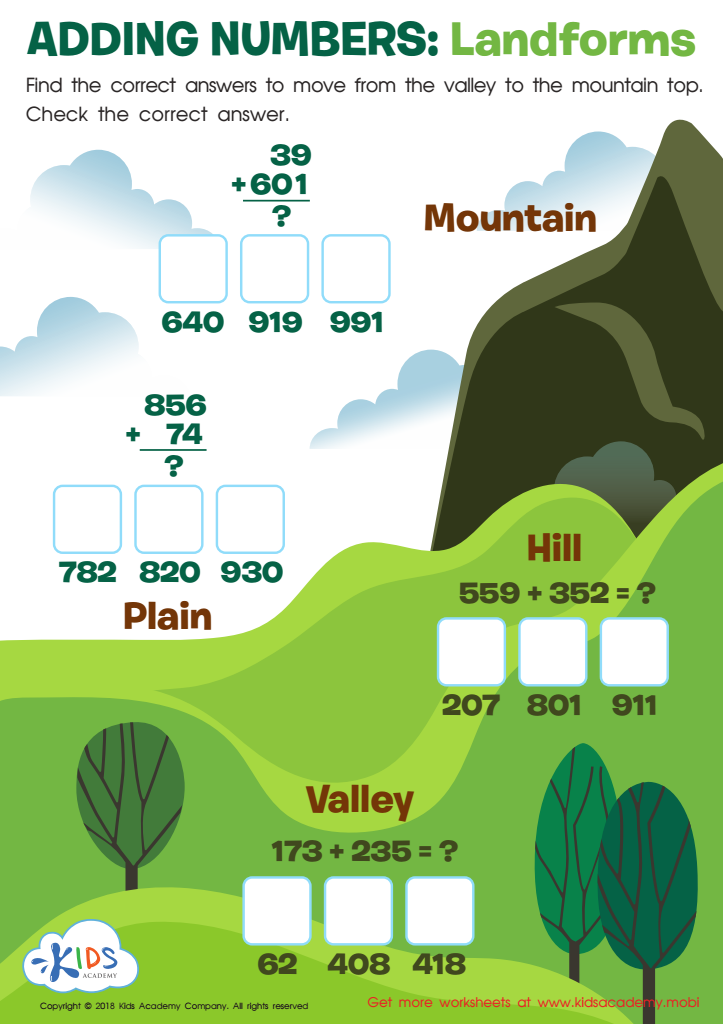
Adding Numbers: Landforms Worksheet
Help your kids solve simple equations and find the right answers to climb from valley to mountain top, then check the correct answer. Land on Earth is home to plants, animals and humans. It's not flat; there are mountains, valleys and hills.
 Assign to My Students
Adding Numbers: Landforms Worksheet
Worksheet
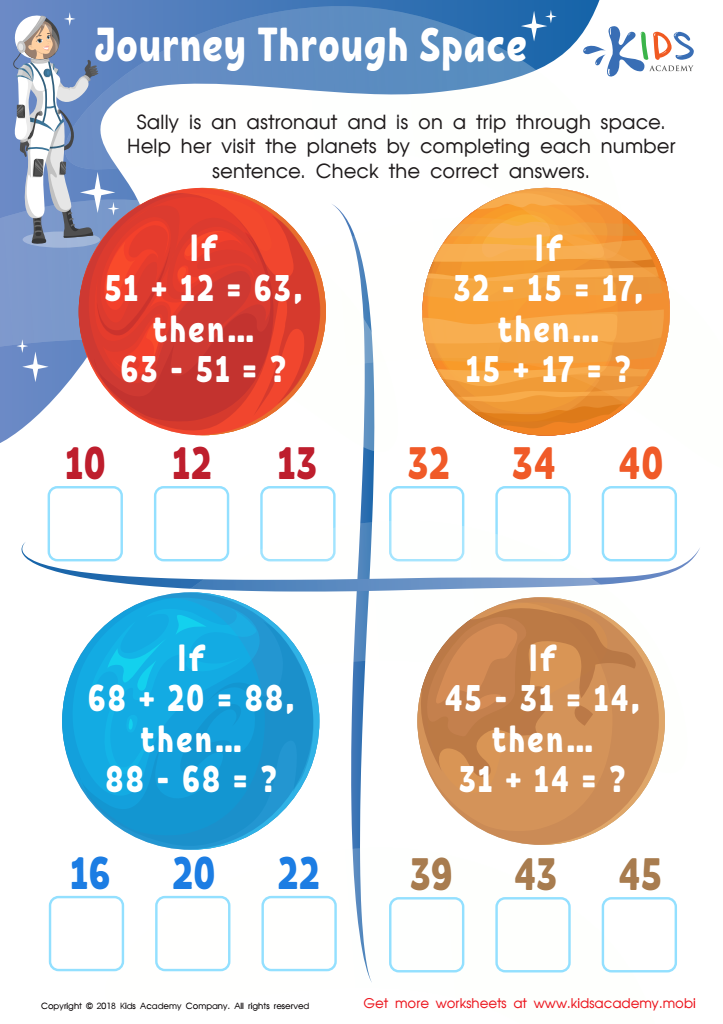
Journey Through Space Worksheet
Astronauts are essential explorers. They travel between Earth and other planets to gain knowledge of life in space. Being an astronaut requires strong math skills, so help your child develop them through this worksheet. Ask them to assist Sally on her journey to the planets by solving the number sentences in the picture. Verify the answers are correct.
Journey Through Space Worksheet
Worksheet
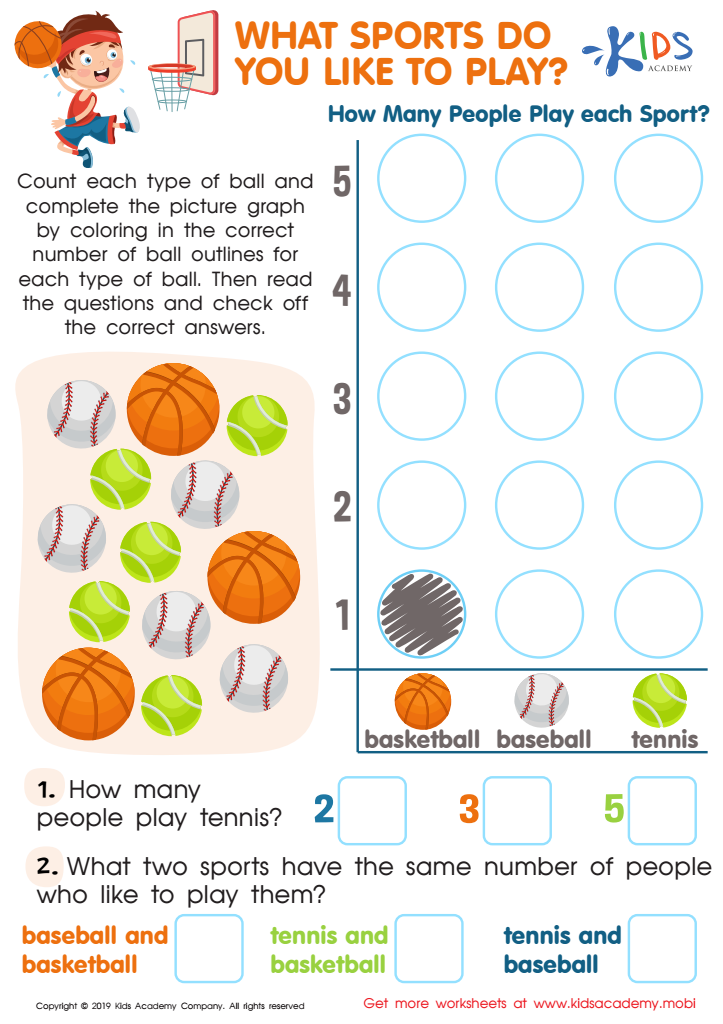
What Sports Do You Like to Play Worksheet
Encourage your kids to complete this fun sports-themed math worksheet! Count each type of ball then help them complete the picture graph. It's a great way to make math a fun, tear-free activity. Download our printable PDF to get started!
What Sports Do You Like to Play Worksheet
Worksheet
Join Kids Academy for Free
Who is primarily going to use this learning content?








Vocabulary development and foundational skills in addition and subtraction for ages 6-9 are pivotal elements in a child's early education. At this stage, children are rapidly expanding their language and cognitive abilities. Enhancing their vocabulary equips them with the tools they need to express themselves clearly and understand new concepts across subjects. A rich vocabulary paves the way for improved reading comprehension, better academic performance, and effective communication skills that benefit social interactions.
Similarly, mastering addition and subtraction is critical for their mathematical foundation. These operations are not just about number manipulation but also about cultivating reasoning and problem-solving abilities. Proficiency in addition and subtraction lays the groundwork for more complex mathematical concepts and operations in later years, such as multiplication, division, fractions, and algebra.
When parents and teachers emphasize vocabulary development and arithmetic competency, they are essentially preparing children for a lifetime of learning and critical thinking. These foundational skills facilitate not just academic success but also life skills such as budgeting, planning, and logical reasoning. Therefore, investing time and resources in these areas during the early years promotes overall intellectual development and increases the likelihood of future academic and personal achievements.








