Basic geometry Geometry Worksheets for Ages 6-9
3 filtered results
-
From - To
Welcome to our Basic Geometry Worksheets for Ages 6-9! Designed for young learners, these engaging, printable worksheets introduce fundamental geometric concepts in a fun and approachable manner. Our resources cover essential skills, including shape recognition, understanding lines, angles, and symmetry, ensuring that children build a strong foundation in geometry. With colorful illustrations and interactive activities, students will enjoy developing their spatial awareness and critical thinking skills. Perfect for classroom use or home practice, these worksheets foster a love for learning while making math accessible and enjoyable. Explore our collection and help your child master the basics of geometry today!
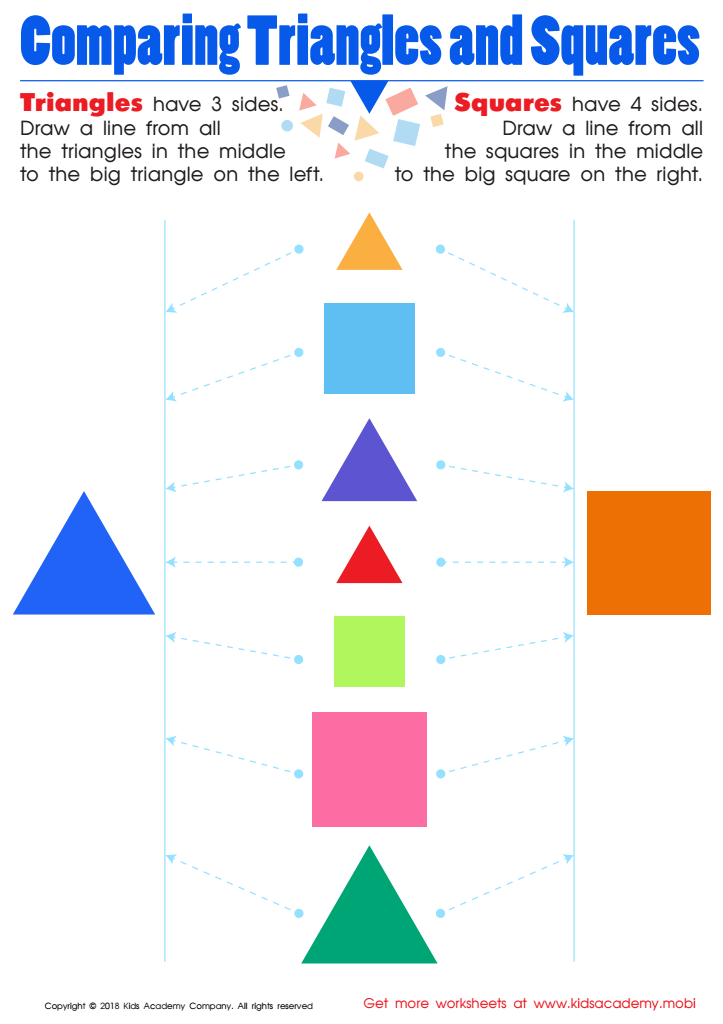
Comparing Triangles Squares Worksheet
 Assign to My Students











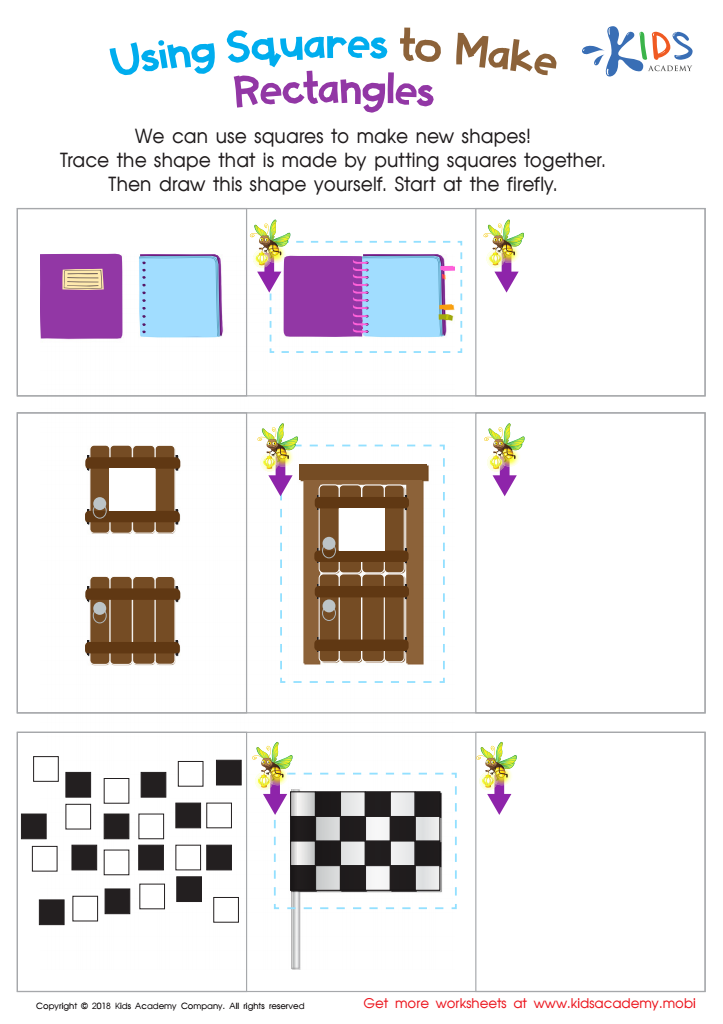
Using Squares to Make Rectangles Worksheet
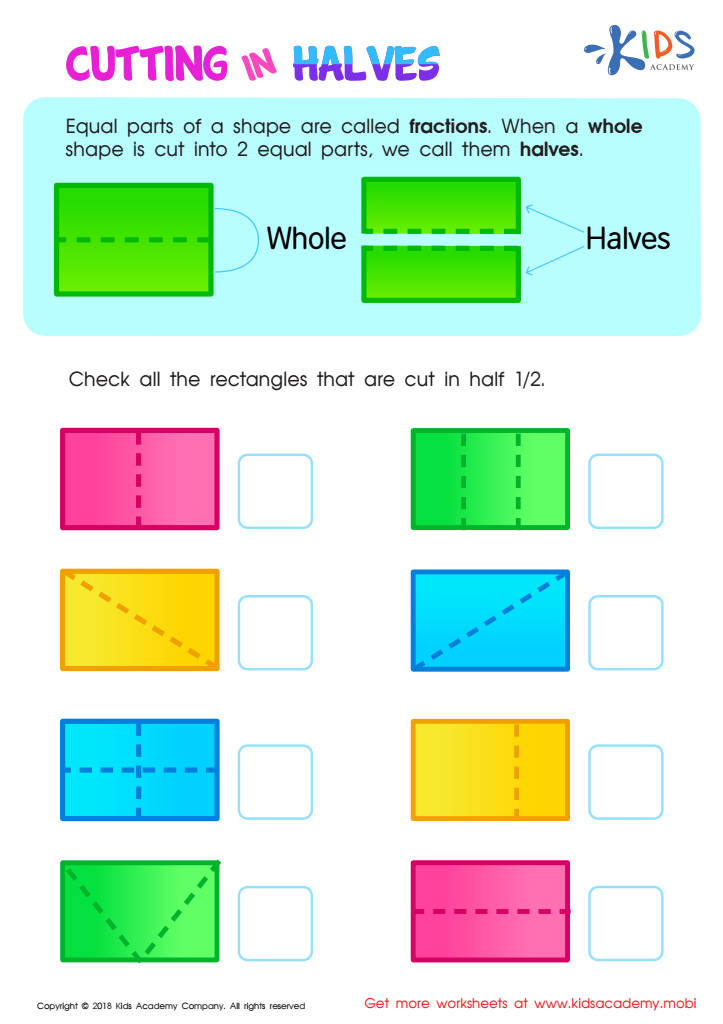
Cutting in Halves Worksheet








Parents and teachers should care about basic geometry for ages 6-9 because it lays the foundation for critical thinking and problem-solving skills essential in everyday life. At this developmental stage, children are naturally curious and eager to explore shapes, sizes, and spatial relationships. Engaging them with geometry helps enhance their observation and reasoning abilities.
Understanding basic geometric concepts like shapes, symmetry, and measurement promotes cognitive development by encouraging logical reasoning and the ability to make connections between abstract ideas and the physical world. For instance, recognizing shapes and their properties aids in the development of spatial awareness, which is crucial for subjects such as math, science, and even art.
Additionally, geometry activities can easily blend with play, making learning enjoyable. This cross-disciplinary approach fosters creativity and collaboration, essential qualities for social development. Feeling confident in geometry during these formative years can also boost a child's overall academic performance.
Moreover, knowledge of basic geometry is integral for later studies in related fields like algebra and calculus, ensuring a smoother transition into more complex mathematical concepts. Therefore, by focusing on geometry early on, parents and teachers are equipping children with fundamental skills that will benefit them throughout their education and beyond.








