
Improve vocabulary Math Worksheets for Ages 6-9
3 filtered results
Difficulty Level
Grade
Age
-
From - To
Subject
Activity
Standards
Enhance your child's vocabulary alongside their math skills with our engaging Improve Vocabulary Math Worksheets for ages 6-9! These worksheets combine fun math exercises with vocabulary-building activities, ensuring that learning is both effective and enjoyable. Children will explore essential mathematical terms while practicing addition, subtraction, and reasoning. Our carefully designed worksheets foster critical thinking, problem-solving, and language development. Perfect for classroom use or at-home practice, these resources support young learners in building confidence in both math and language skills. Empower your child to excel academically and communicate effectively with our exciting vocabulary math worksheets today!
Favorites
With answer key
Interactive
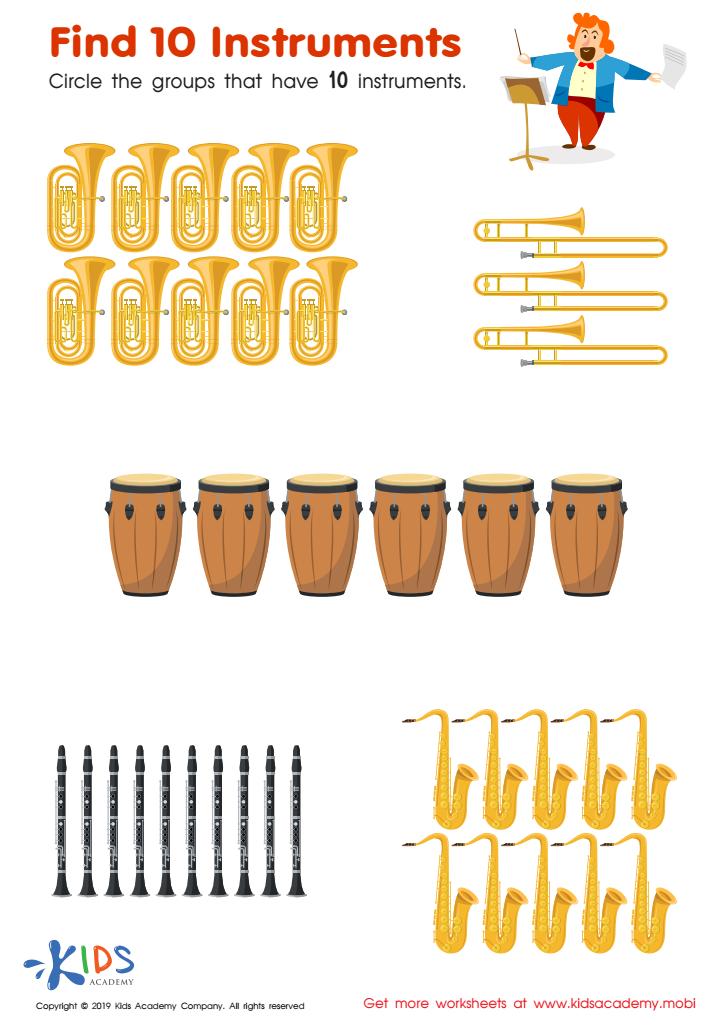
Find 10 Instruments Worksheet
Teach your kids to count with educational DVDs, video games and this worksheet. Show them the picture and help them count the instruments, then circle the groups of 10. It's a great way to practice counting numbers, one of the first things they'll learn.
 Assign to My Students
Find 10 Instruments Worksheet
Worksheet
Join Kids Academy for Free
Who is primarily going to use this learning content?








Improving vocabulary in mathematics for children aged 6-9 is crucial for their overall academic development. Young learners in this age group are not only grasping numerical concepts but also building a foundational language that helps them articulate their understanding. A strong math vocabulary allows children to comprehend instructions, engage with word problems, and explain their reasoning.
Parents and teachers should care about this because a rich math vocabulary fosters critical thinking skills. When children can effectively express their thoughts about mathematical concepts—such as "add," "subtract," "more than," and "equal to"—they develop the ability to manipulate these ideas cognitively. Additionally, a comprehensive vocabulary helps eliminate confusion, reducing math anxiety and building confidence.
Beyond academics, developing strong communication skills is essential for lifelong learning. Older students, in subjects like geometry, algebra, and beyond, thrive because they possess a strong mathematical language base. Furthermore, parental involvement in enhancing math vocabulary fosters a positive attitude towards learning, promoting a supportive environment at home.
In summary, focusing on vocabulary in math is a key ingredient in nurturing young minds, steering them towards academic success and stronger problem-solving skills. Investing in this aspect of education lays the groundwork for their future learning across all subjects.








