Understanding symmetry Math Worksheets for Ages 6-9 - Page 2
30 filtered results
-
From - To
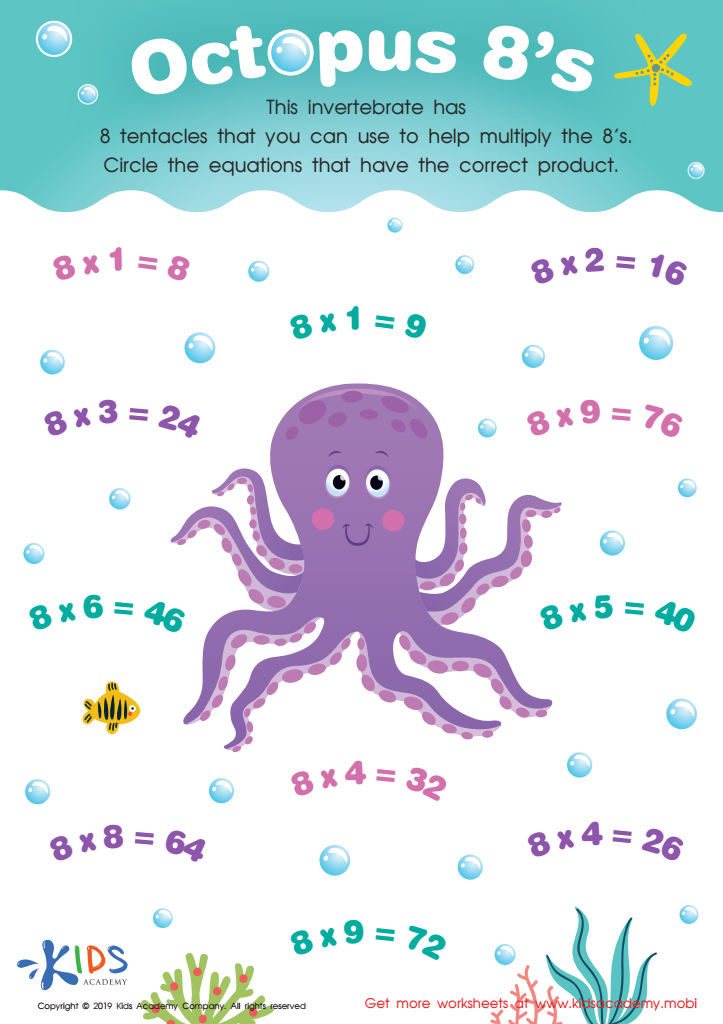
Octopus 8’s Worksheet
 Assign to My Students





Understanding symmetry is essential for young children aged 6-9 as it lays the groundwork for many future math skills and fosters crucial cognitive development. Firstly, symmetry helps children develop their spatial awareness and visual-spatial reasoning. These skills are foundational not only in math but also in everyday tasks and fields such as engineering, architecture, art, and computer science.
When children explore symmetry, they learn to recognize patterns, which is vital for developing problem-solving skills and mathematical thinking. Recognizing symmetrical patterns reinforces the concepts of balance and equality, aiding in their ability to understand more advanced geometric principles in later grades. Moreover, activities involving symmetry can be engaging and fun, allowing children to experience math in a hands-on and creative way.
Additionally, understanding symmetry ties directly into learning about reflection and transformation, critical concepts in both math and the sciences. Such awareness at a young age can stimulate an interest in these subject areas, promoting a lifelong enthusiasm for learning.
For teachers and parents, emphasizing symmetry in early education encourages a well-rounded development, as it not only helps children academically but also supports their ability to appreciate the aesthetic aspects of the world around them. All these skills contribute to their success both inside the classroom and in real-life situations.








